Gordon Murray and the McLaren F1
Gordon Murray, Creating the McLaren F1
Episode #51
09.16.26
Before I get into the details on this book that I have, on the McLaren F1, one of the greatest road cars ever created. There’s a story at the end of the book that I want to start with.
So you got to understand this car. The McLaren F1, even back in the 1990s, when you brought this car in to get it serviced, the technicians could plug it in and then they could pull up all the records, like all the daily logs of the engine and all the car systems.
So here’s what they found when one McLaren F1 owner brings his car into the shop for service. This is from the end of the book that I’m going to get into. It’s a book called Driving Ambition. So here’s what it says.
“There is a story, I think it’s true, of the German owner of a McLaren F1 returning his car to its ancestral home for a routine service. As is customary, access was obtained to the car’s engine management system so that an electronic map of the unit’s recent history could be displayed and examined. It showed that there had been no problems. It also showed that the car had exceeded 200 miles per hour on 12 of the previous 14 days.”
So the author of this article, he keeps going on in the book, he’s telling the story. He says,
“When I first heard this story, I was struck by two thoughts. Naturally, my blood ran cold at the thought of the forces of law and order being empowered to access a car’s electronics as easily as in this story. But simultaneously, the cockles of my heart were warmed at the thought of the F1, so often dismissed by the myopic and low-horizoned as a gross indulgence with performance nobody could possibly use, being thrashed to within an inch of its life on almost a daily basis.”
So that’s a story at the end of the book. It’s written by a McLaren F1 owner, Rowan Adkinson. So we’ll come back to this story in a bit.
Inside The Book Driving Ambition
Okay, so back to one of my favorite books that I own about the McLaren F1. Here’s one of the coolest things about the book. It’s the entire decade-long process of this car. From when the very first idea started all the way through the late 1990s.
What’s in the book, though, the actual notes and sketches from Gordon Murray photocopied from his original notebooks. So at the very beginning, Gordon has to present this idea to the board of directors. So here’s where I want to start. This is what was in the notebook of Gordon Murray, right here, his vision for the car. It says,
“Quite simply the world’s best car, built for the most discerning and limited market, to transcend existing standards and vehicle design by a large factor, and by virtue of design and marketing, to become the most wanted vehicle in the automobile world. The product must be a state-of-the-art vehicle, in areas of which matter, of extremely high performance, but also desirable and collectible from an object-day art point of view.”
So this is the first paragraph right out of this four-page memo that Gordon Murray wrote. It was his proposal to the group of co-directors at McLaren to get approval to proceed into the development of this new road car. So this is all from the book that I have that I’ve been talking about.
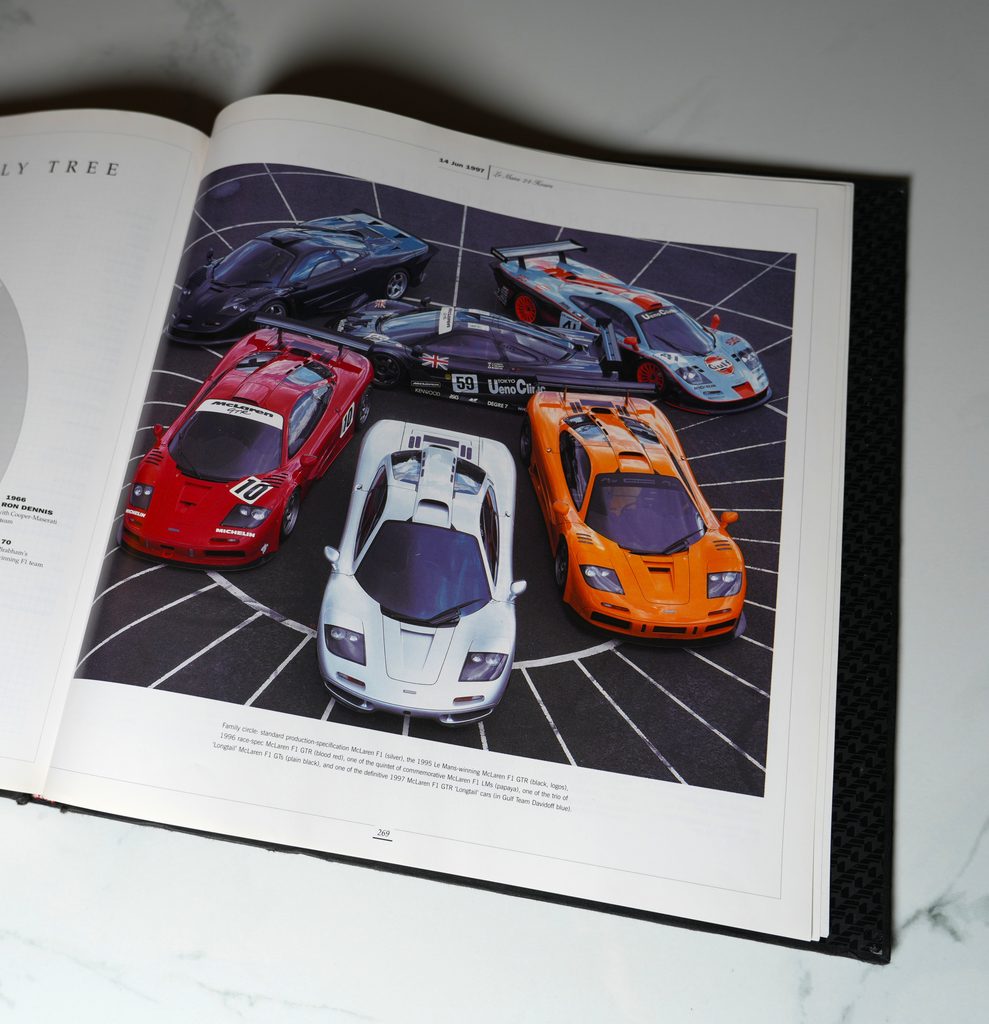
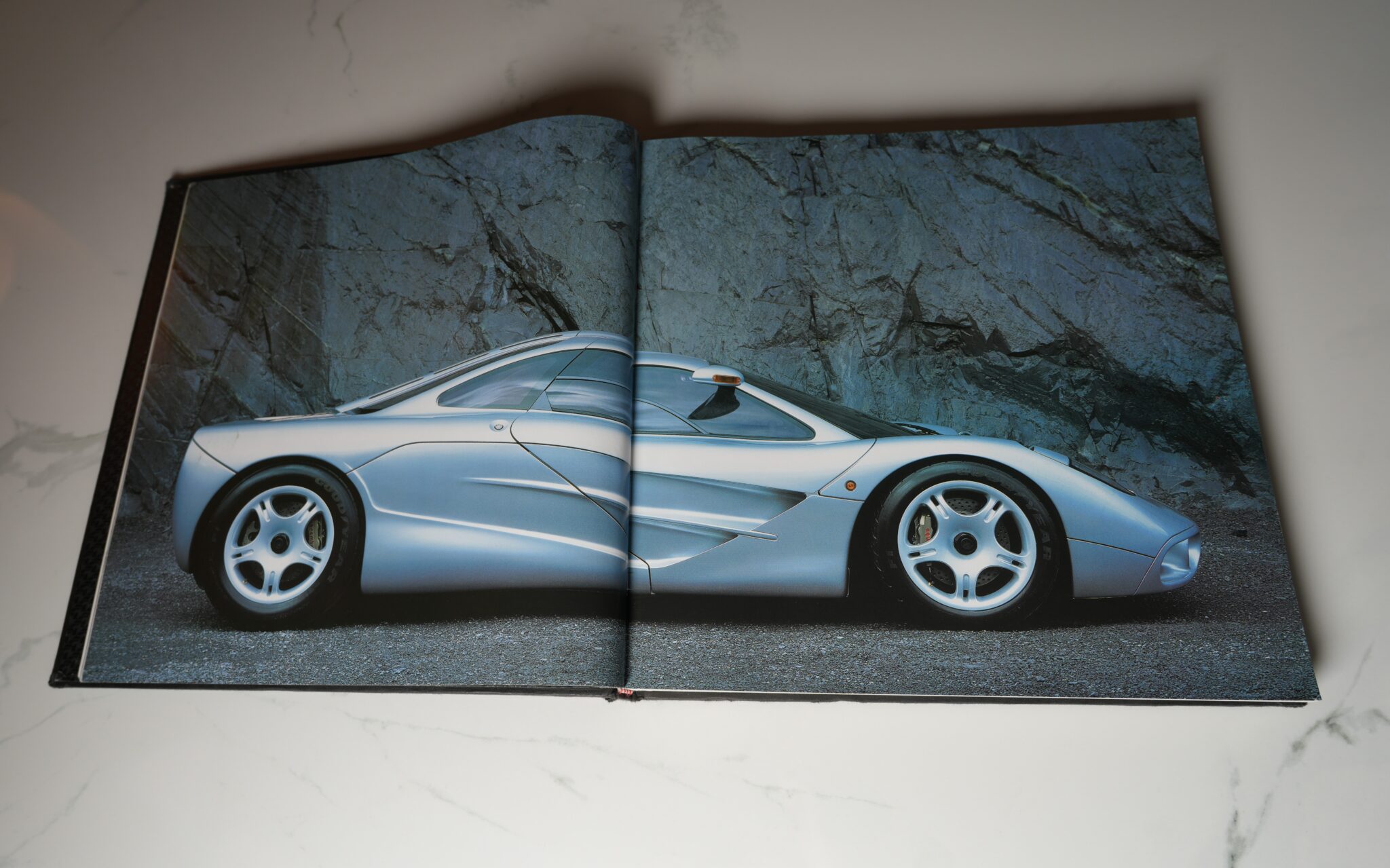
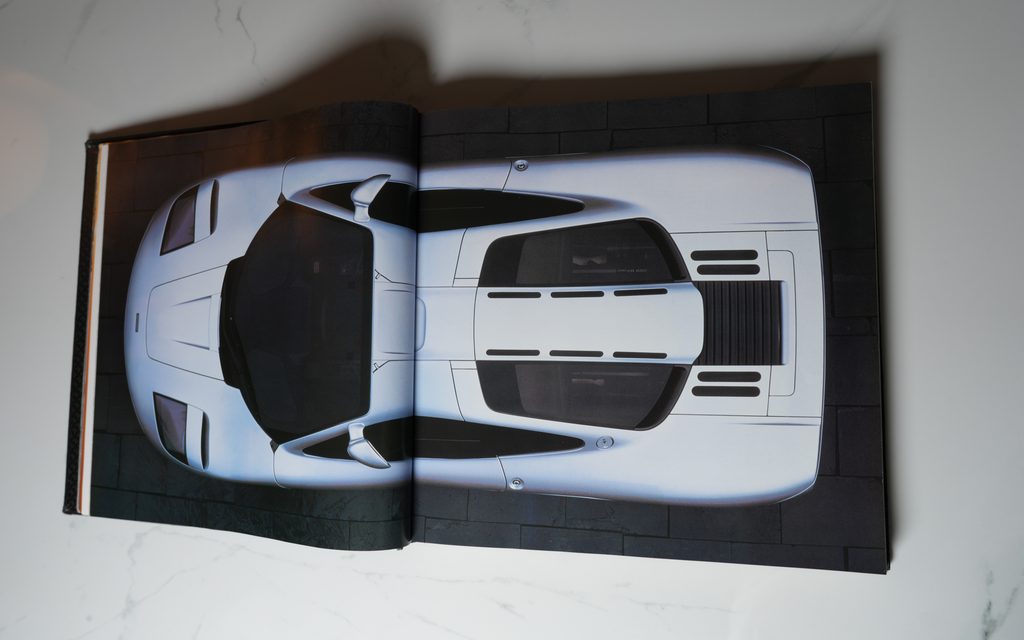
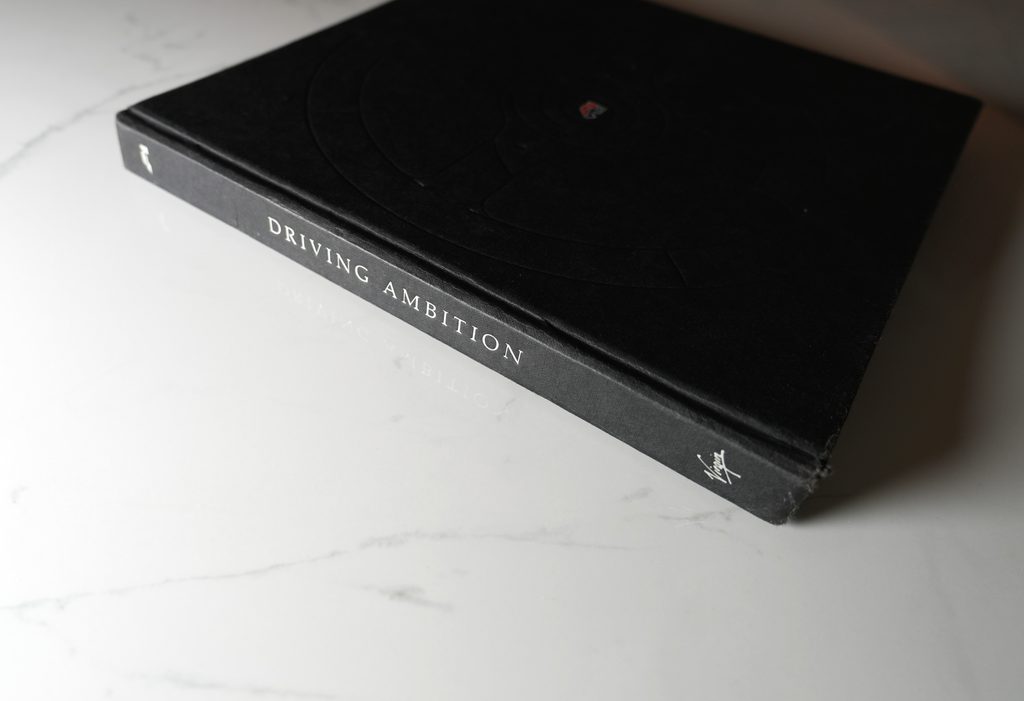
The title of the book, ‘Driving Ambition: The Official Inside Story of the McLaren F1,’ by author Doug Nye. So the book is published in 1999. It’s the entire story of the greatest supercar ever made, the McLaren F1. So this book is an absolute masterpiece. It’s this big coffee table sized book, and it tells the full story in great detail from start to finish, but it also includes photos of the entire process.
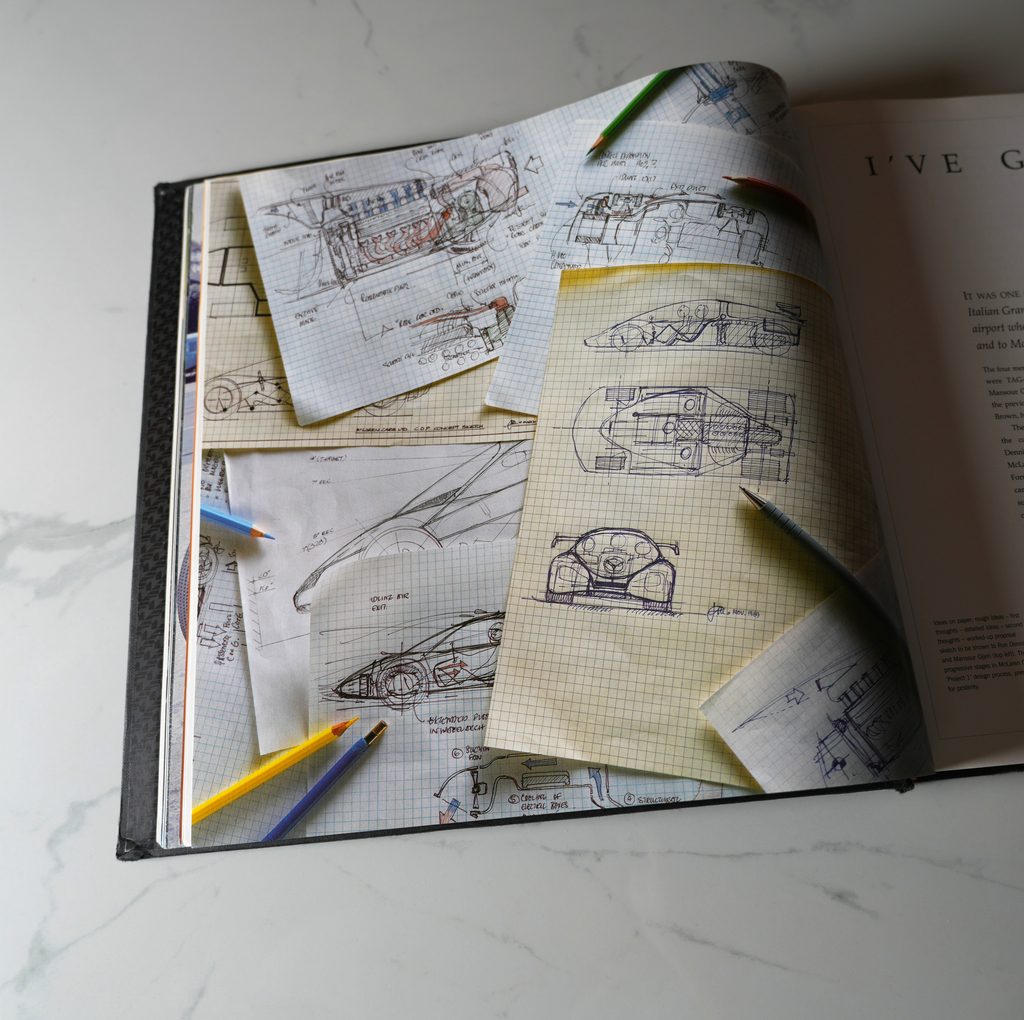
Every step along the way, from when the first idea came about for this car all the way through for about a decade, all of the 1990s, the entire story of the McLaren F1. There’s hundreds of photos and graphics packed inside this book, not just photos of the McLaren team and the car that they built, but actual photocopies of all the historical documents and notes and sketches.
And then this is when I found something really cool. Just two chapters into the book, there’s the original photocopied pages right from Gordon Murray’s notebook. And they detail his first proposed design ideas and the plans for the new supercar when it was still just an idea between the four directors at McLaren.
So let’s back up a little bit. How would anyone come up with the idea to create a car, like Gordon said in his notes, that would transcend existing standards and vehicle design by a large factor? So this wasn’t a McLaren boardroom decision. This all started with four guys just sitting around at an airport waiting for their airplane during a flight delay in Milan in 1988. It was Creighton Brown, Mansar Ojjed, Ron Dennis, and Gordon Murray.
The Milan Delay That Started It
They were all waiting for their plane to show up at the airport. They start casually talking about what’s next and the possibility of building the very first McLaren road car. So once they boarded the airplane for the flight home, the idea began to grow a little bit more with each one of them.
They were all big-time car enthusiasts, not just racing executives, but also lifelong racing fans. Here’s how Creighton Brown described that first conversation at the airport in Milan. It says,
“The simple truth of it is that all four of us there that day were essentially car nuts. I think Ron was keen to see a kind of British Ferrari appearing at some time. And Mansur absolutely agreed, saying, Why do I have to go to Italy to buy a supercar?”
So they’re all sitting around and they’re talking about building the greatest road car ever created. And that would sound completely crazy, but it doesn’t sound crazy if you consider the backgrounds of these four guys right here. If anyone could pull it off, it was the four of them. It was this insane challenge to create the ultimate car. That was the attraction that caught everyone’s attention, and each one of them knew they had the potential to build something really special. It all started with this simple conversation.
So here’s how Ron Dennis explains it from the book. He says,
“It began as an off-the-cuff conversation, simply finding a practical use for what could have well become nothing but dead time. The discussion was not fine detailed at all. It had been in my mind for some time that we could not allow ourselves to be confined simply to a Formula One operation.”
So Ron Dennis, he’s been thinking about what’s next for McLaren beyond racing. And it turns out that everybody else was thinking the same thing. What’s next? Over the next few months, the casual conversation turned into much more of a serious plan. So just after the 1989 Formula One racing season, Gordon Murray was heading up the very first design meeting for McLaren Cars LTD, the new company that they created for this very first McLaren production road car.
So Ron Dennis goes on in the book, it says,
“I really appreciate being associated with an achievement or a product of which one can be proud. Mansour shares that appreciation, and I believe Creighton and Gordon too. As the discussion developed, we all agreed that one of our motivations was to leave something worthwhile behind us at the end of the piece.”
So one of the things I love about this book, probably one of the reasons the book costs hundreds of dollars now, because all of the photos and the original notes from the notebook of Gordon Murray, all the sketches and the checklist and the design proposals, they’re all handwritten right from Gordon. So it’s really cool to look at all these notes from before the car was even started, that the intention was to completely change the game from the very beginning, and then they go out and do it.
The very next thing that would happen was the McLaren co-directors, they turned to Gordon Murray to propose a design for the car. You can’t just start building a supercar from scratch without a full design in place first. Here’s what it says,
“Gordon Murray was allowed the luxury of a clean sheet of paper to design and build his ultimate car. It must be the dream of any designer to be allowed to chase the ultimate.”
So they’re not building yet. He’s got to propose a design, and then he’s got to get approval first. So designing cars is nothing new for Gordon Murray. He had over 20 years experience developing and designing Formula 1 race cars. He was with Brabham as a chief designer, and then he was with McLaren as a technical director. And his race car designs were not just good. They won championships. There was anyone you would want to design the greatest car of all time in the 1990s, it was Gordon Murray. But even with that said, it’s still an incredible task. After all, this would be a McLaren built for the roads, not for the track. This is a new challenge for Gordon Murray and for McLaren.
Here’s how Ron Dennis describes it from the book. It says,
“The more we discussed it, the more it appealed to me. It would not be easy, which made it appeal to me even more. And one thing was certain, if we as McLaren were going to build a sports car, it would have to be not only the finest sports car the world had ever seen, but also the finest sports car the world was ever going to see.”
And so as crazy as that statement sounded back in 1989, this still holds true decades later. Ron Dennis just said it would have to be the finest sports car the world was ever going to see. And that was a totally ridiculous statement to make at the time. But that actually still holds up to this day in what they did.
One of the main takeaways from the McLaren F1 creator’s story is the goal from day one, just like I said, to build the greatest car ever. They knew how giant of a task this was because their competition had been at this for decades. All the other supercar builders had some amazing cars. So how are they going to beat them? That was the challenge. How do you bring something new and fresh and different that customers could get excited about and at the same time better than anything else on the road?
Here’s how Creighton Brown describes it in the book. He says,
“The prospect of, in effect, taking on Porsche and Jaguar and Ferrari and Lamborghini, all on their own territory and exceeding anything which they might have been liable to achieve was a fantastic challenge, and one that I believe really appealed to the racer in each of us.”
So here’s another key takeaway from learning all about Gordon Murray over the last few weeks. His entire career was just locking into a goal and achieving it and then setting out to look for the next challenge over and over again. It was just this hard work, dedication, and then success, and then what’s up next? Every single interview and article I read about Gordon Murray was the same thing over and over. What’s the next challenge?
And this is a common theme that you’re going to find in all of the racing stories. I did an episode on John Wyer back with the David Brown Aston Martins. Same thing. He’s just looking for that next challenge year after year. Colin Chapman, same thing. What’s up next? What are we going to do next? That’s one of the reasons I love these racing stories. They’re just relentless on looking for that next challenge. So McLaren has the right guy to lead this design right here, Gordon Murray.
Freedom From F1 Rules
Now here’s another fascinating quote as Gordon begins to seriously consider this design. You might be thinking about how challenging it would be to create a road car from scratch with all these strict regulations. But as Gordon Murray learned more about the rules that he had to follow for this new design, he began to get even more optimistic.
And this is from the book right here. It says,
“For him, the broad idea of creating a McLaren road car had ever-growing appeal. After a working life entrammeled by the often pedophiling regulation requirements of Formula 1, when Gordon began to delve more deeply into regulation requirements, governing production road cars, he found a virtual promise land.”
So he says, “It was staggering to me, like being let out of jail. Although most car enthusiasts might believe that with all the much hype talk about Road Traffic Act requirements and EU road safety requirements and American EPA anti-pollution measures and so on, road car design must be really closely prescribed. They ought to try designing a car for Formula One. Then you really appreciate how confining regulation requirements can be.”
All right, that was Gordon Murray out of the book. He’s talking about how optimistic he was once he’s learning about road car design. So he had 20 plus years in Formula One racing and dealing with all those crazy design rules. Now he’s feeling pretty good about making a road car once he’s starting to check into it.
Here he is. Again, he keeps going. He says,
“The reality is that in contrast to Formula One, or indeed to almost any kind of modern motorspir, road car regulation is fantastic because, in effect, there isn’t any within only very broad bounds, you can do virtually whatever you like, any way you like. And that is just so liberating, it’s almost unbelievable.”
Gordon Murray, right there, he’s finding out, this is my dream come true right here. So he’s starting his initial design. He’s looking at all these requirements for a road car, and he’s just like overjoyed at the ease of the regulations compared to this strict world that he was coming from in Formula One.
The Center Seat Breakthrough
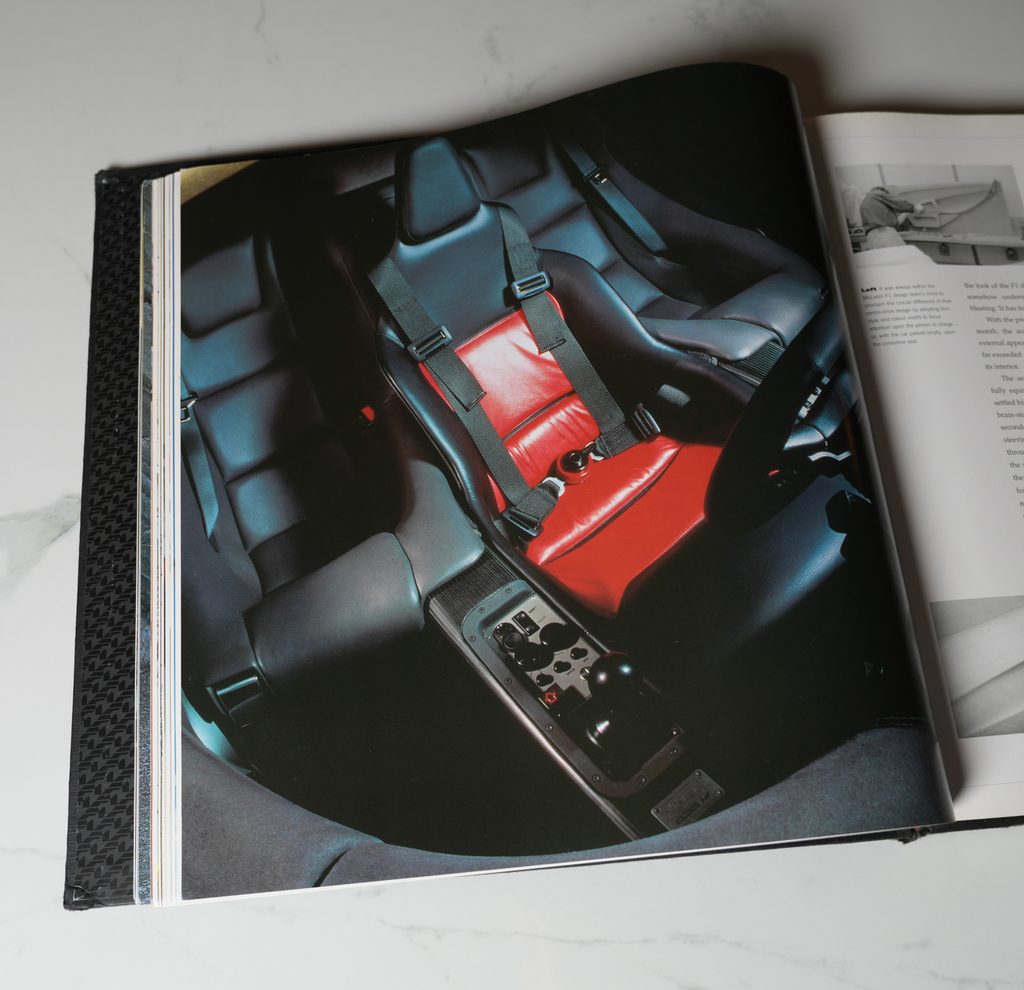
He gets a little bit further into the design and he reveals what would become this foundational layout of the car. It was the seating arrangement, and he nails this decision. Looking back all these years, it’s this iconic one plus two seating layout that Gordon had thought about for decades. Now he gets to use it finally. And it turns out to be this totally perfect layout for this car.
The book says,
“From his college days in Durban through the 1960s, Gordon had been an invertebrate doodler of design schemes. One of them would now provide the basis for the new McLaren road car.”
So he goes on and he explains what he’s talking about here. He says,
“My old college books are jam-packed with doodled designs for cars, motorbikes, electric guitars, gearboxes, engines, all kinds of things. I’ve always been fascinated by packaging, by the challenge of trying to combine the maximum in accommodation with the minimum overall demand on space. And one of those schemes I sketched in those very early days was for a mid-engine sports or GT car, which combines seating for three with the package size of a GT car normally designed to carry only two.”
And this is it. This is the one plus two layout. And he goes on, he says,
“The trick was to put the driver in the middle, with the passenger each side of him, and to set the passenger seats back just a little on either side, so that their widest points, the hips and the shoulders, could overlap slightly, just behind the space occupied by those same widest points of their driver.”
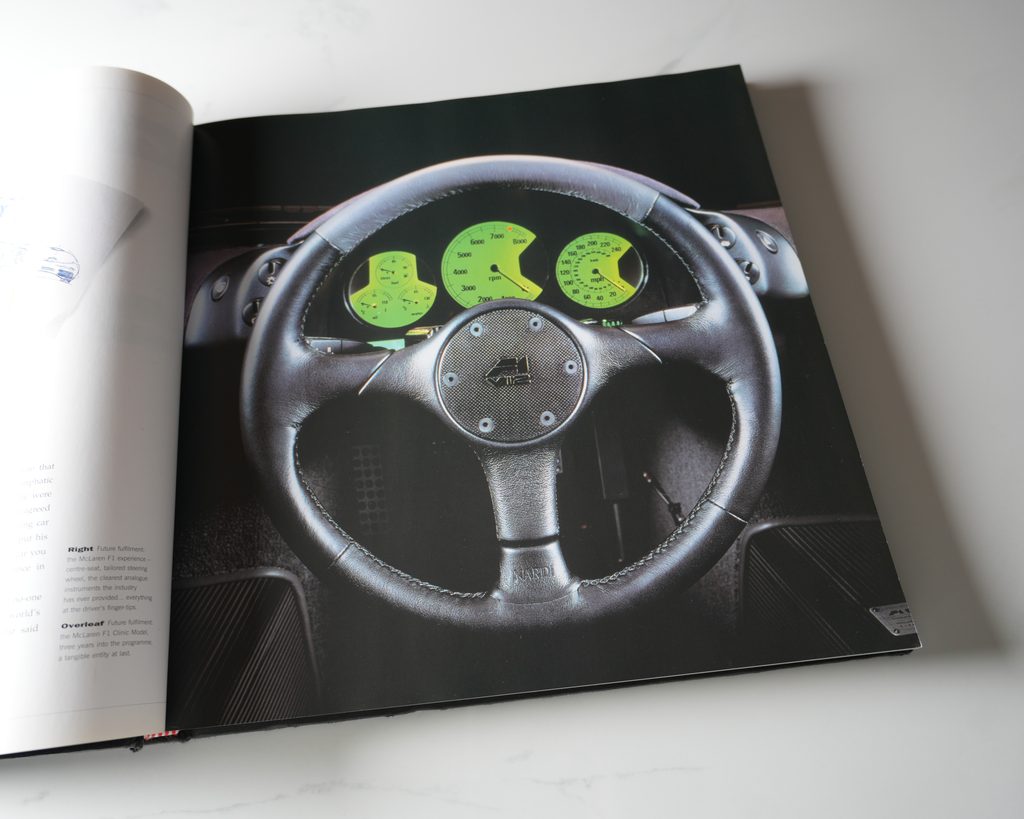
So this is a big decision to put the driver’s seat in the middle of the car and then not just make it a one-seat car, but add two seats behind the driver. So it’s a car for three passengers. And once he makes this decision right here, all the other design is influenced by the seating layout. So, like I said earlier, this book shows all the old sketches that Murray drew when he was in college. And it shows this three-seat layout dream that he had. So from the book right here, it says,
“One basic design tenants of what would become the new McLaren production car had been fixed in its designer’s fertile mind. Now, into the winter of 1988 and 89, the proposed project would rapidly gather pace. But company principals Ron Dennis and Mansur Ojjed still needed to hear more in detail before they would give it the green light.”
Okay, we’re still in the very early stages of the planning and design. This is a big investment for McLaren. Even though there’s a lot of exciting meetings and discussions going on, this company still needs to carefully plan and propose all the details before they fund the project. So all this work had to be done up front to come up with this great initial design so the company could approve the budget and then they could start to spend real money to actually build this car. So Gordon Murray needed to lay this plan out.
Testing Rivals By Listing Flaws
He’s got to explain how he’s gonna achieve the biggest challenge of them all. How is he gonna make the new McLaren car better than anything else that existed? So he starts out by researching everything that he didn’t like about all the great cars that were already out there. And of course, this meant testing and driving the competition. So they round up every great supercar to find out exactly what was wrong with each one of them. Then they could simply remove those things that he didn’t like from his design for the new McLaren.
He started out by testing these cars right here. It was the Ferrari F40, the Porsche 959, the Bugatti EB110, and the Jaguar XJ220. These were the current supercars considered to be the very best. So he spent a few days both on the track and on the road with all these cars. And then he started to make notes about what he didn’t want in his own car. And of course, all these handwritten notes that critique these cars, they’re all in the book. All the original notes.
And as a cool bonus, you can actually read his writing. It’s all like this very neatly printed, all caps writing. Very neat, and it’s all on graph paper. It’s like just exactly how you would picture Gordon Murray taking notes. Very precise and clean and neat. And these are all the original notes that he took. He’s comparing and critiquing all these great supercars of the late 1980s.
Then Gordon Murray proceeds to do what he would talk about in all these interviews that I’ve watched. He does an exorcism. That’s his word for what he did. He’s removing what doesn’t work, all the design flaws that he finds in these other cars. He’s finding out what to get rid of. And so I checked out all these interviews at Gordon Murray. Every one I could find. I watched them all. And every time somebody asks him about testing these other supercars, all these interviews, they say, “so you just went and drove a bunch of these other great cars, and then you just picked out what you liked in each one, right?” And every single interview, he always corrects the interviewer. He says,
“No, not really. I actually made a list of what I didn’t like.”
So he points that out every time he’s asked about that in the interviews. Anyways, then in the most of these interviews, he’ll just go down the list and he’ll start to explain what he didn’t like about all these other cars that he was testing. And as you can imagine, it’s a very long and very detailed list. So here’s a cool thing that I wasn’t expecting.
Why The Honda NSX Won
Through all of his research and testing, he stumbled on a car that would actually become his benchmark for his own design. He found a car that was packed full of traits that he actually liked. And this was a surprise for me. I wasn’t expecting this to be the benchmark car, but it was the Honda built NSX. So that led me down this long path to learn more about the NSX and what made it so great. Because if Gordon Murray can’t stop talking about this little NSX, then I wanted to learn more about it too. So that’s what I did. And I ended up finding this really cool old article on the exact subject right here.
From what I could tell, this article was first published on the Honda website.co website. And it was actually originally published in Japanese. So once it was translated over to English, the article was actually written by Gordon Murray himself on how much influence the Honda NSX had on the McLaren F1 design. So the title of the article, it’s called ‘A Car Dear to My Heart,’ by Gordon Murray. Here’s how Gordon sets up his article here. He writes that when he was considering what would make a great road car, he wanted something that when you hopped in the driver’s seat in downtown London, the experience would be so good that you’d want to keep driving it all the way to south of France. And that’s like a 12-hour drive.
So what he’s saying is he just wanted to build the best car that just was a thrill to drive, and you never wanted to get out of the thing. Anyway, so he writes in the article that in his mind, there’s a few key features that a car needed to have. So it would have to be a car without a high dashboard that limited your view of the road. So great visibility. And also plenty of headroom, so you’re not smashing your head on the roof every time you hit a bump. And this was a big one for Gordon Murray because he’s six foot four, so he’s a tall guy, and I’m sure this was a big issue for him.
He wanted a car with a functional air conditioning system. And it seemed to him that supercar makers were always neglecting the AC just because they could. He talks a lot about the air conditioning. The car also has to be compact and not too big and bulky. So these were a few of the things that he was looking for that the other supercars didn’t have until he spotted the NSX. Murray continues in the article and he’s talking about how he was in Japan visiting Honda, and he wanted Honda to possibly build an engine for the new McLaren F1. Then he sees the little NSX prototype sitting over in the corner at the test track. Well, then he hears that Arton Senna was helping Honda develop the car. So I’m sure that caught Gordon’s attention. This is one of the greatest race car drivers of all time, Senna.
Now once Gordon got the opportunity to drive the NSX on the Honda test course, so his article, it says, this is Gordon Murray’s quote. In his article, he says, after driving the NSX, he remembers thinking, quote,
“It’s remarkable how our vision comes through in this car.”
Here’s another great excerpt from the article about the NSX. How it became the benchmark for his design of the McLaren F1. Here’s what he says in the article.
“When working on the development of a new car for years, it’s easy to be caught in certain pitfalls. When you drive the car under development for testing every day, in truth, I was responsible for two-thirds of the testing for the McLaren F1. In that time, you can unknowingly convince yourself you are making progress when in fact you are not. For example, it’s human nature that at the end of a long day you may want to think that your efforts to reduce low speed harshness are working better than they are. It is at times like this when you need a car to compare with. In those situations, the NSX time and again showed us the path in the areas of ride quality and handling, and also helped us recognize when we weren’t making as much progress as we thought.”
This was really cool to read this article by Gordon Murray. He goes on to describe all the engineering that he really loved in the NSX. From the aluminum suspension, the lightweight design, the handling, the ride quality, he just goes on and on about the suspension. And then the drive-by-wire throttle system, which he ended up using in the McLaren rather than using an electrical signal for the throttle. And then even the air conditioning system really left an impression on him. He just wished that NSX was built with more power, but it was because at the time Honda was trying to serve a lower price point. They just weren’t interested in building a larger engine for the NSX. So this is what he says in his article. He says,
“Of course, as you know, the engine has only six cylinders. However, the NSX very rigid chassis is excellent and would easily be capable of handling more power. Although it’s true I had thought it would have been better to put a larger engine. The moment I drove that little NSX, all the benchmark cars, Ferrari, Porsche, Lamborghini, I had been using as references in development of my car vanished from my mind. Of course, the car we would create, the McLaren F1, needed to be faster than the NSX. But the NSX’s ride quality and handling would become our new design target.”
That’s huge praise right there for the designers and the creators of the Honda NSX. Gordon Murray just loved that little NSX, what he called it. So back to the McLaren design, now that Gordon Murray has his baseline, that benchmark car for what he wanted, the NSX, and what he called the class of the field in his notes. And now he could go out and build the absolute best. Like he says in a lot of interviews, he says, to “build the best car on the planet to drive full stop.” So here’s a great caption from the book under a handful of his notes that lists out what he didn’t like about each of those supercars. It says,
“First evaluate the opposition. Gordon Murray’s contemporary Castlecombe Circuit Group test assessment notes on Porsche 959, Ferrari F-40, and Lamborghini Countash. 1990. Each had good points, but respectively, each offered the least impressive engine, the poorest finish, and the worst ergonomics.”
And so he’s critiquing all these big supercars of the time. He adds this little gem right here. He thought that the supercar manufacturers were not delivering to their potential. Here’s what he said.
“Manufacturers could get away with murder in a supercar because enthusiasts would make allowances. We became determined to need none.”
One more thing here from the book. With all the meetings and discussions that went into the planning for the McLaren F1, there’s one thing that wasn’t on the list of goals at the beginning. So they, of course, they wanted the high performance, but it was never a goal to break any speed records. Here’s what Gordon Murray says in the book.
“As far as I can recall, at that point, no one mentioned any possibility of it also becoming the world’s fastest production car.”
And now their McLaren F1 would become the fastest production car ever made. There’s a really cool YouTube video on the McLaren F1 breaking that speed record. It would go like 240 miles an hour. So you gotta check out that video. Now they get full approval to move forward. They can begin to spend money and build out their team. And now the fun starts right here. It says in the book,
“Having been given the go-head in principle, both Gordon Murray and Creighton Brown were elated as they settled down in Woking to decide a serious plan of campaign. Gordon had in his head the development concept for the new McLaren supercar, fully intending that it should exceed all existing and accepted parameters for such vehicles, and simply redefine the term for future generations, and perhaps in perpetuity.”
And now here’s some more notes. Looking at the book, there’s these amazing notes that I’ve been talking about, and the four-page memo of exactly what Gordon Murray wanted. I read that first paragraph at the beginning of the episode. Let’s take a look at some of these other notes. This is what the book says on the notes.
“The Murray way of working commits almost everything to paper. Jobless for himself and others, thoughts, considerations, pros and cons, equipment requirements for the new factory, which would have to be found, design concepts, the distinctively neat hand printing, which again had become habitual in his college days, covered dozens of tear sheets from squared graft paper notepads, thoughtful but loose styled, exploratory freehand sketches covered more.”
Again, the coolest thing is just to see all of these original notes from Gordon. What he wanted in the Ultimate Car, let’s look at a few of the notes that he took before he even got started. This is what he said about the styling. He said he wanted on the styling, “stunning from all angles, a combination of contemporary and classic without any pronounced angular lines, grills, scopes, etc., which tend to date a vehicle quickly.”
Here’s his notes on quality. This is what his goals were for quality. He said, “to set new standards, to be instilled in the staff, design production and marketing from day one. Quality from design and material choice. No plastic moldings in interior.”
All right, so number of seats. Here’s what he said. “Although the single-seater concept has some attraction, it will probably limit the market too much. I have been studying a three-seat layout for several years now. This will need a comprehensive layout and legislation investigation, but could be the best of both worlds.”
That’s what he was writing about the possibility of using this one plus two seating layout. He said it might be the best of both worlds, and it absolutely was. One more note here: ergonomics and comfort. Here’s what he said. “Must feel solid and stable, reasonably quiet, but must have the correct exhaust note.” And that’s what he wanted. He wanted the correct exhaust note, which means the sound of the engine.
Murray’s Memo On Quality And Speed
Now there’s a big section here on the engine in his notes. This was a big question for a while. And they start building this car before they even had an engine completely nailed down, which is like just terrifying to even think about. In the notes, Gordon says for the engine, if possible, he wanted a Honda 3.5 liter naturally aspirated engine, high reving, multivalve medium capacity, non-turbo engine.
He didn’t want a turbo. And he lists a bunch of reasons why he was not doing a turbo engine. But here’s what he said about the power that he expects to have in his new car right here. He says, quote,
“3.5 liter in high-tune form combined with a high efficiency, aerodynamic shape should provide 200 miles per hour plus.” And then in parentheses, it says, “investigation needed. Using Honda could be a useful tool in maintaining and extending our relationship. Plus, RD could strike a good deal for engine supply. Honda would also get an immediate outlet for their current excess in design build capacity. Long-term consideration should be given to McLaren engine manufacturer.”
Okay, he’s talking about trying to make a deal with Honda because they already had a relationship going on in the Formula One. And of course, they would not end up going with Honda. So this is really cool on the engine. They would not even know what kind of engine they’re putting in this car for a while. But then they end up making a deal with BMW to build the engine for the McLaren F1. Another thing that I love too in his notes, he says 3.5 liter engine should provide 200 miles per hour, but more investigation is needed, he says. Of course, they would end up building the fastest production car ever that goes 240 miles an hour.
I love that little note in the beginning. They just weren’t sure they hoped to get maybe 200 miles per hour plus. So now the last page of his notes on the initial design. He lists out special equipment, and this is a few of the things that he wanted. He says he wanted personalized pedal position and personalized gear change position. And then he adds he wants a leather-bound book with history of design and development with photos and drawings.
These are all the things that he wanted to customize for each buyer, just to really go that extra mile for every buyer that bought one of these cars. Here’s a great quote in the book about the car by uh auto journalist Frank Page. Here’s how he sums it up. He says that,
“Yes, it accelerates like a strike fighter, corners as if permanently glued to the road, and breaks as if by some titanic hand.”
Now it seems that Gordon Murray and his team accomplished the mission that they set out to do. And if we’re here still today talking about this car and trying to make sense of this timeless car, obviously they achieved their mission. So you’re not going to believe this, but we only talked about the first two chapters of this book.
Engine Uncertainty And The BMW V12
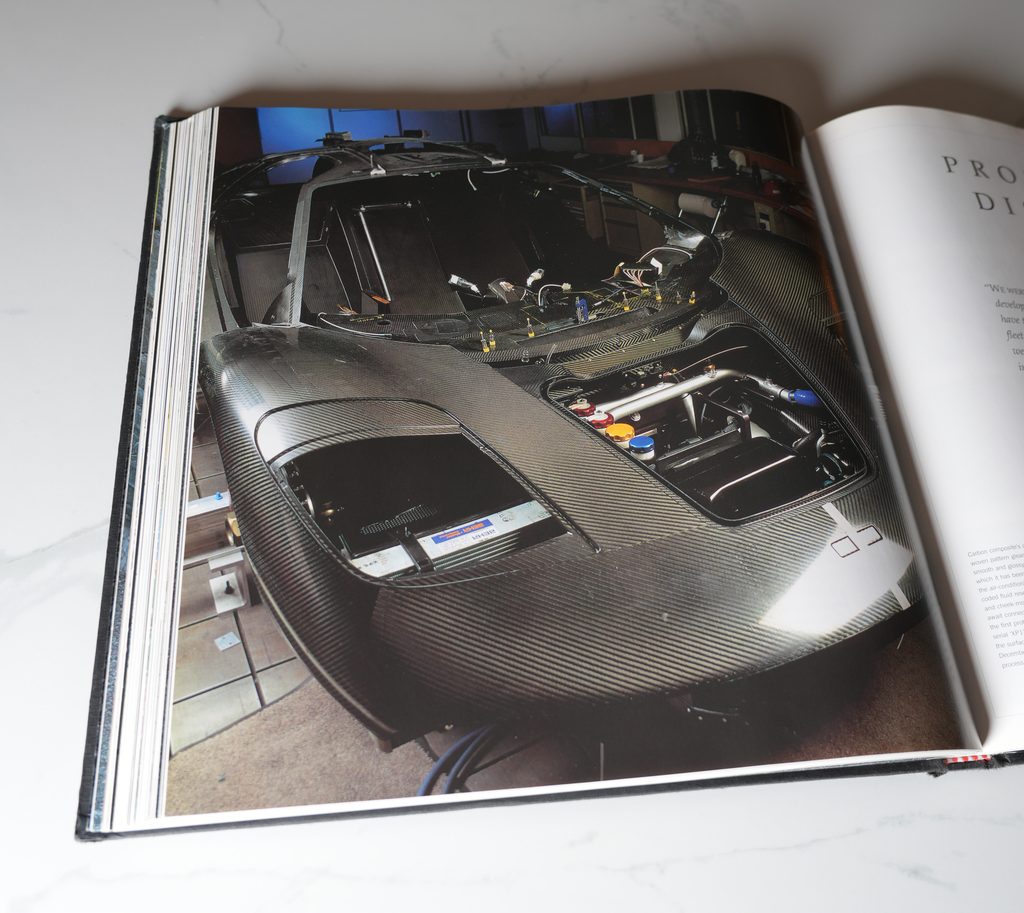
We just barely scratched the surface. There’s still 20 more chapters that we haven’t even talked about. The entire manufacturing process, step by step, all the testing, finding the engine, which is a huge story, how they made that amazing deal for the V12 monster engine with V with BMW. And then they’d eventually build a few F1s to race on the track.
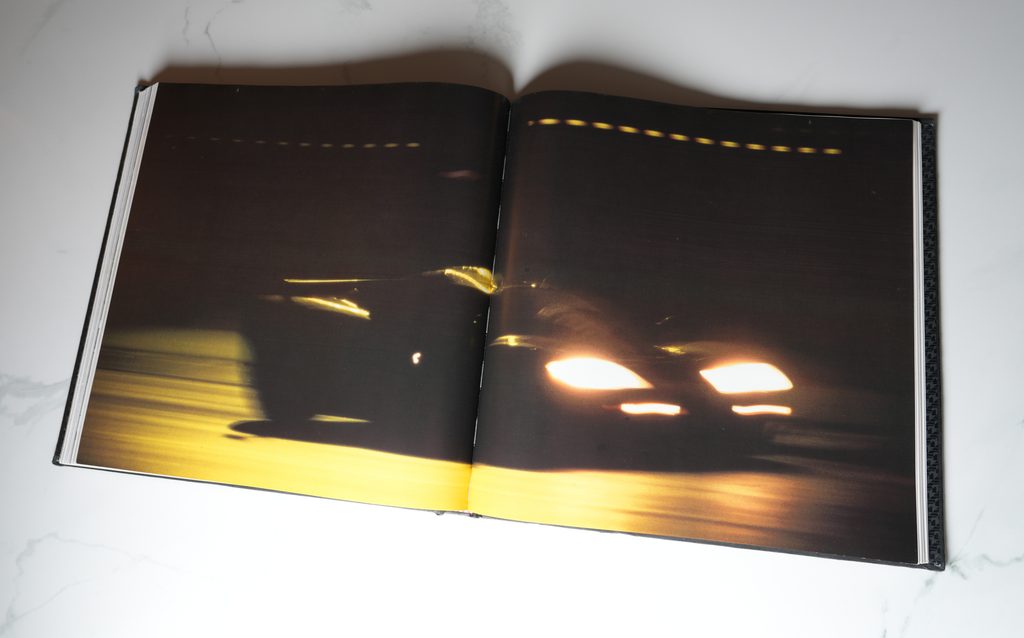
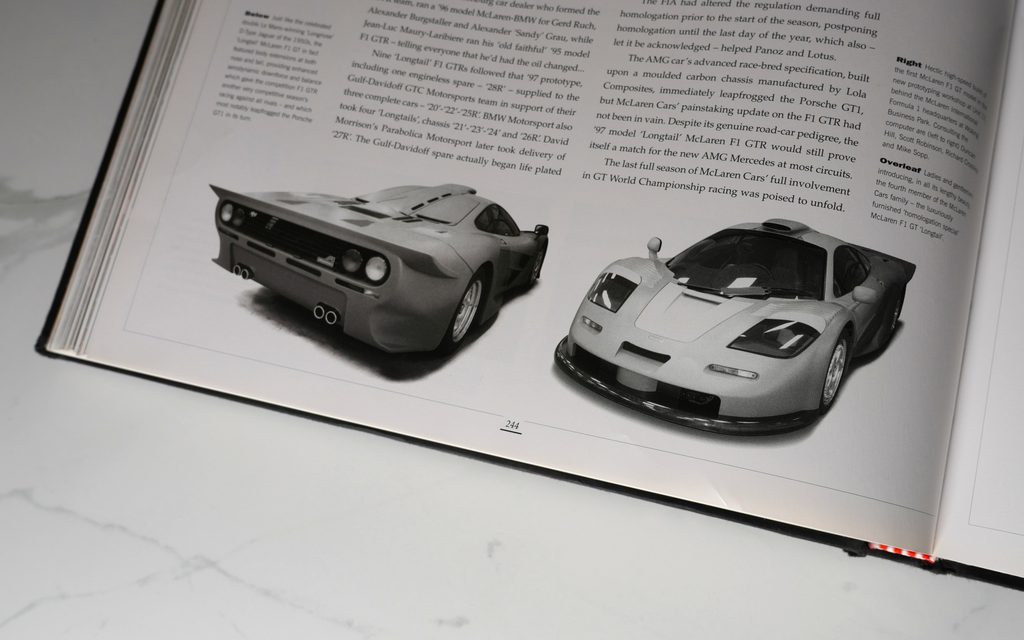
And then they win the first major race they enter with the new car, the 24-hour Le Mans in 1995. Gordon Murray says it was one of the most exciting and proud moments he had on a racetrack in his entire career was winning that 1995, 24-hour Le Mon race. Here’s another quote by Ron Dennis. This is actually the foreword in the book, but here’s how he says it.
“The seeds of the McLaren F1 sports car program were first sown in 1989, and the entire project spanned the following 10 years. Its evolution and development mirrored the wider character of the TAG McLaren Group through its commitment to excellence and refusal to compromise or tolerate second best.”
And then I talked about the record, the 240 mile per hour fastest production car record. Well, here’s a road tester, Andrew Frankel. Here’s an excerpt from the book. He talks about testing this car at high speeds. Listen to this. This is what he experienced in this car. He says,
“Above 190 mile per hour, it all changed. The F1 was the same, stable in the crosswind, steering light but meaty. It was I who had changed. Above 200, my eyes started taking in the track in manageable chunks rather than as a blurred hole. As we neared 210 miles an hour, I became possessed with not missing the safe braking marker. There, survival instinct overruled the urge to accelerate forever. I lifted 211 miles per hour on the quartz, accurate speedo.”
So that’s one road tester talking about just how amazing it was to get into this car.
Le Mans Glory And 240 MPH Reality
Okay, so one more thing. I started off the episode. I talked about that owner in Germany who brought in his car. They hook it up to the machines and they find out 12 of the last 14 days, this car had been driven 200 miles an hour plus. This is a civilian bringing in his car for some maintenance. And this is what they find. So that article keeps going on. And what they’re trying to do, this F1 owner, this McLaren F1 owner, he’s writing this at the end of this book, and he’s trying to talk about like some of the criticism of this car and why you would need all this power. Like, this is just a ridiculous amount of power to have in a car. You can’t use it. So what’s the point? That’s what some people would say.
Well, this is his answer to that question right here. Here’s what he says,
“I will acknowledge that you have to limit your outburst. It is difficult to indulge for long on the public roads, frustrating to some who have driven the car. This frustration is compounded by two factors. The performance, once sampled, is so addictive, so exhilarating, and so intoxicating that it is maddening not to be able to indulge it as much and as often as you like. And secondly, a journey in, for example, a Honda NSX, the car to which, in my view, the McLaren F1 is spiritually most aligned, might satisfy some drivers more simply because they are more likely to be able to derive that special satisfaction, which can only come from regular use of full throttle. Slamming the pedal to the metal and holding it there is a rare indulgence in the F1 on public road. Your right foot is more likely to be in constant feathering mode, akin to driving a Formula One car in the wet.”
Why The Power Still Matters
All right, so he’s trying to make the argument for this car. He’s saying, you want this car. It’s not too powerful. It’s not absurd. You just want this car because it is so good. This is what this the basis of this whole part of this article is. So he keeps going on here. He says,
“However, as long as you are not the sort of driver who needs to kick against the bulkhead before he believes he is achieving something, I promise that a good run in an F1 is never a frustration. You need not delve very deep into that bottomless pit of power to derive real delight. This was the attribute I most cherished when I first drove the car. The joy it continues to provide, even when driven slowly. To poodle is a pleasure.”
So again, he’s gonna make his final case right here. And he pulls out the Ferrari F-40 that he wants to talk about. It’s a different experience. Here’s how he compares the Ferrari F-40 to this McLaren F1. Here’s what he says.
“Once I had a week with the Ferrari F-40, which I thought a delightful companion as long as you were driving it like a man possessed. However, to follow a traffic queue down a country lane for 10 miles or to sit on a motorway at constant 70 miles per hour were deeply aggravating experiences.”
He’s talking about driving his Ferrari F-40. Now, he comes back to the McLaren F1. He says,
“Whenever an extremely fast motor car is launched, some pundits will inevitably describe it as a road racer or a thinly disguised racing car or some such. The McLaren has much racing technique and experience behind it and incorporated within it. But first and foremost, it is a road car with road compromises. It’s quiet, it’s comfortable, it’s leather trimmed, and it’s got luggage space. It has a fine stereo system which you can actually hear at high speed. The fact that it also goes faster than any other road car on the planet is a quite remarkable achievement.”