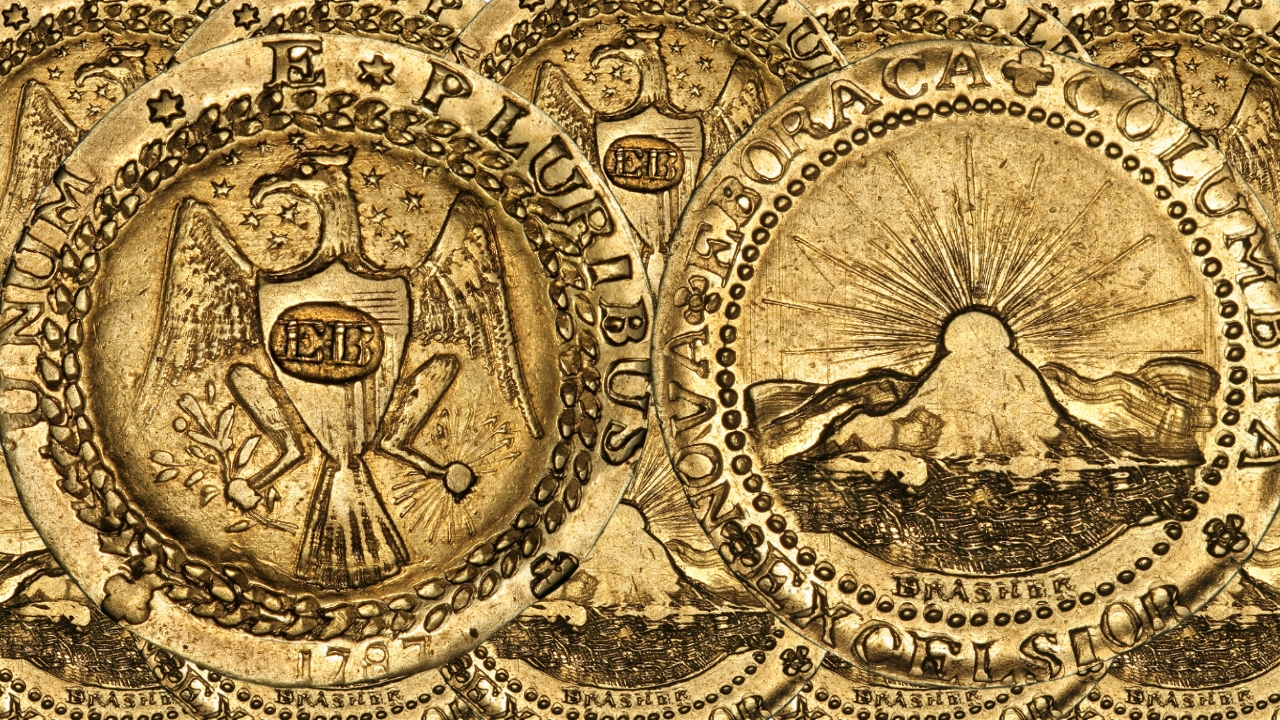
1787 Brasher Doubloon
1787 Brasher Doubloon
5.6.25
The 1787 Brasher Doubloon
I found an amazing old book published in 1858 and I was sure this book would have everything I was looking for. It was written by a guy named John H. Hickcox. I grabbed the book, I flipped through every single page and I’ve never been so disappointed in my entire life.
So usually I like to start out each episode with that big moment that kicks off the story and it’s an incredible story that we’re going to get into. And I thought this book would be packed full of amazing insights.
But of course it wasn’t what I was hoping for at all. However, after I thought about it for a while, the book really helped me figure out a key to this incredible coin that we’re gonna talk about and how it became one of the most valuable coins in the world.
The story of the 1787 Brasher Doubloon has everything. All the traits we look for in the world’s greatest rare coins.
Not only was the coin mostly forgotten and ignored for 50 to 60 years after it was made, But all the themes we talk about in these old coin stories, they’re all here again. But let’s go back to that book, the one that I was hoping would have the big moment. This is what I found in the book published in 1858.
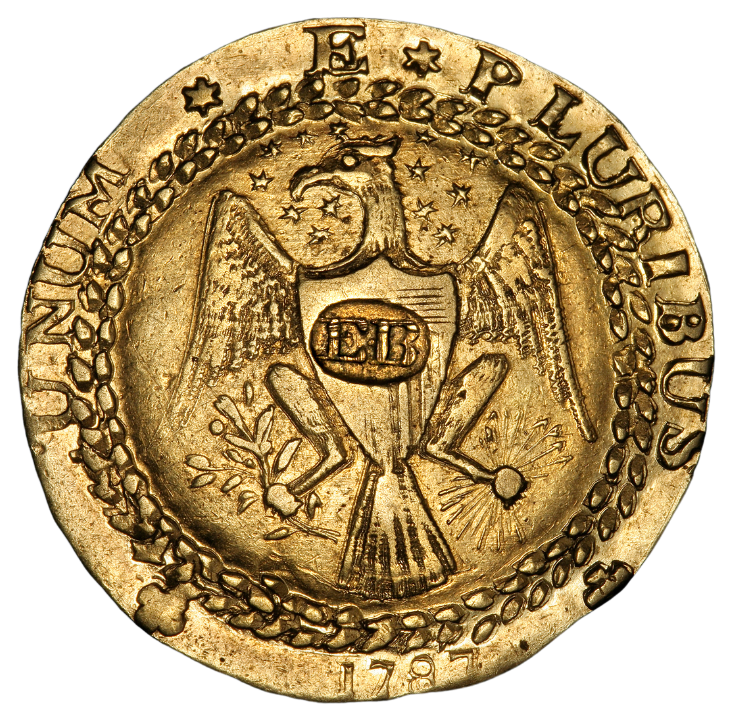
“Reverse, a wreath encircling a spread eagle holding in its right talon a bunch of 13 arrows and in its left an olive branch. Unum e Pluribus, 1787. It was struck in New York by Ephraim Brasher, a goldsmith, whose place of business was #1, Cherry Street.
That’s it. That’s all it said. Nothing else.
So the title of this book is, “An Historical Account of American Coinage,” by author John H. Hickcox. And this book was supposed to be the authority on early colonial coins. And I Guess it was. But it was page after page, it probably took Hickcox 10 years to research and write this book.
I mean, it has every single coin that was ever made in the early American colonies in the 1700s. In incredible detail, he goes state by state describing every single aspect of early American colonial coinage. Every single aspect except what I was looking for.
It just didn’t say much about possibly the most historic and important coin ever created, the 1787 Brasher Doubloon. The book had just one short paragraph about the coin, but Hickcox even says it himself in the preface of his book. He says, “Nothing as comprehensive has heretofore been attempted, nor is there any separate publication on either are colonial or early federal coinage.”
All right, so the Brasher Doubloon is one of the most rare and valuable gold coins to ever exist. There’s only seven known coins and each one is worth anywhere from five to $10 million or more. If they were to even sell again, that puts these coins right at the very top of the list of most valuable coins in the world.
So surely this book written by John Hickcox back in 1858 is going to have tons of information on the amazing Brasher Doubloon, right? That’s what I was hoping. The coins were created in 1787. That’s over 70 years before Hickcox wrote his masterpiece on all the early colonial coins. Today we know the Brasher Doubloon is the biggest and baddest coin to come out of the early Colonial period and Hickcox says the book he wrote, “nothing as comprehensive has heretofore been attempted.”
So what else does the book say about the coin? Nothing else. I just read it. That’s it. There’s just that one tiny paragraph that I read earlier in the entire book about the Brasher Doubloon. And I scoured every page. I went through the entire book a few times looking for that chapter on the doubloons, on the Brasher Doubloons, and it just doesn’t exist.
So now I was scratching my head and I’m thinking, let me get this straight. The most complete book on coins ever written with firsthand accounts of every single copper and gold piece that anyone made back in the 1700s and they only have one paragraph on the Brasher Doubloon. Is that even possible? Am I missing pages out of this old book? And I was not missing any pages. There’s only that one small mention of the epic Brasher Doubloon in the book.
And because it took a really, really long time for anyone to recognize the significance of this incredible coin, they knew it existed. Hickcox talks about it for just a few sentences. He knows about it, but he just quickly moves on to the next copper coin that somebody created in New Jersey. He didn’t even flinch when he wrote about the Brasher Doubloon for a couple quick sentences. I mean, he completely missed it, but everyone else did too.
It just took some time to sink in. And when I say time, I mean many, many decades. But eventually everyone would start calling it the most valuable coin in the world. And so that’s why I started the episode off with the description of the coin from this book by John Hickcox. It’s a perfect representation of this coin. And it’s the moment I found when everything just clicked for me about this incredible Brasher Doubloon. And the coin was created in almost complete obscurity, but not by an obscure guy as we’re going to see in just a minute.
Ephraim Brasher
Ephraim Brasher was an amazing character and it just took a long, long time for his coin to become famous and respected. And I know this because if anyone cared about the coins when they were created, they would have written something, anything about it. Even in the late 1700s, people were really into writing and documenting the news and what was going on. There would be something written about these coins, but there’s not.
It’s really, really hard to find original sourced information about this coin. In fact, now that I’ve studied this coin and read all about it, searching for every piece of material I could possibly dig up, it’s now obvious to me that this coin went almost completely unnoticed for at least five decades. And then it was another 50 years after that when collectors started paying big money to own it. What would turn out to be at the time the highest price ever paid for a single coin?
So what happened here? How do we know anything about this coin if nobody cared about it for so long? Well, luckily from the tiny amount of information that I read at the beginning of the episode, which was John Hickcox’s summary, coin experts and collectors, just like they always do, they began to piece together the mystery of this amazing coin. Now part of what I read in the beginning excerpt, there’s a key phrase and you might not have picked up on it the first time I read it, but it says,
“It was struck in New York by Ephraim Brasher, a goldsmith whose place of business was number one, Cherry Street.” Okay, so now we know Ephraim Brasher was a goldsmith among many other things, which we’re going to get into, but it also gives us a dress in New York City. And that was number 1 Cherry Street. And that just happens to be right next door to George Washington, who lived at 3 Cherry Street.
Ephraim Brasher, 1 Cherry Street
It turns out that Brasher knew George Washington. So from there, we have evidence of Brasher’s work as a goldsmith and a silversmith. And in addition to that, over the years, he became a well-known assayer. And what an assayer did back then was inspect foreign gold and silver coins and then approve them if they had the correct weight and fineness. Banks relied on assayers to test coins and then physically stamp their initials on each coin if they passed inspection.
They had to be checked for proper weight and consistency just because there was a lot of shenanigans you could say that were going on when these, when it came to altering coins. They would try every trick in the book to manipulate coinage back in the day. It was total chaos really when it came to coinage. Every state was making their own coins randomly. And then the colonies also use mostly Spanish gold coins, but really they were using foreign coins from all over the world.
So coinage was a mess in the colonies, as you can imagine. And then the scammers were trimming gold and silver coins where they would snip a tiny corner off each coin, then melt all those little tiny pieces down to make one big coin. And then there was also counterfeiting coins and you get the idea. So there was a huge need for to certify these coins. And the essayers inspected and then they stamped each coin to guarantee they were legit and especially gold coins. They stamped their initials right on the coins.
So Ephraim Brazier’s EB initials, they became really meaningful, showing the legitimacy of coins and even silverware. He’d stamp his initials of approval on these items and the EB stamp became an accepted guarantee of value. So that’s an amazing power the essayers had and Brazier was known as one of the best.
So here’s an example from an article I found by David Alexander and it was from Coinage magazine back in 1987. And he wrote this, he explains this same idea and how important the assayers were back then. “In the late 1700s, silversmiths and goldsmiths were particularly respected members of the community, often acting as bankers, assayers and authenticators of the babble of gold and silver coins of the world, which circulated in the bullion starved colonies of the new Republic.”
There’s an interesting part of the quote there. He says bullion starved colonies. And that’s another big part of this story. There was not much gold floating around at the time. Not like there would be after the gold rush later on. So gold coins were a serious deal. Big time bank transactions were made with gold coins between merchants and businesses.
Ephraim Brasher the Assayer
So the role of the assayer was crucial to bless these coins and then put their stamp of approval and they would press it right into the coin. So we know Brasher was one of the best because George Washington had items in his house with the EB stamp of approval. And these silver items can be traced back to Washington through paper receipts that they found.
So if the EB stamp of approval is good enough for George Washington, you know that Brasher was an accomplished assayer in Goldsmith back in the day. The other reason we know that Ephraim Brasher was a respected assayer was that there’s proof that he did a saying work for the US Mint right after it was established in 1792. And they found records of payments made to Brasher by the US Mint for his work as an assayer.
So as the mystery behind Ephraim Brasher is uncovered and the great coin collectors began looking at his life and all his accomplishments and it turns out he’s one of the great essayers and goldsmiths and silversmiths of his day back in New York City. Why’d he create the coins? The seven Brasher doubloons that we have record of, why did he make the coins? What’s the real story? There’s a few theories why he created the coins, but here’s what many coin experts would agree on.
Ephraim Brasher Works at the U.S. Mint
Ephraim wanted to create gold coins for circulation to be used in circulation. Coins that could be used for transactions. He wasn’t just making trinkets for fun. He wanted these coins to be legit currency. His coins followed exact weight and composition as other Spanish doubloons in use at the time. Now his idea wasn’t uncommon. People were making their own coins left and right. Remember this is 1787, five years before the US Mint was created.
Think back to the book we talked about at the opening of the episode, John Hickcox’s book on early colonial coinage. That book is packed full of every coin that was made before the US Mint was started. Most of these were copper, so Brasher already experienced in the assay community and knowing that banks needed a stamp of approval on their gold coins, Brasher saw an opportunity to get his design into circulation.
And the design is really amazing. If you think about the Saint Gaudens Double Eagle episodes I’ve done, the story of the Saint Gaudens Double Eagle began with President Theodore Roosevelt. He wanted to revive U.S. coinage in the early 1900s. And he talked with the famous artist Augustus Saint Gaudens about designing coinage that was as beautiful as the ancient Greek coins. And I think this Brasher doubloon fits right into the same description as well.
The design is really amazing and it really stands out from what the other coins that were created at the time. And it shows that same inspiration as Roosevelt had just to create a memorable and inspiring coin. So Ephraim Brasher creates these gold coins hoping they’ll catch on as legitimate currency for use. And I’m sure he was eyeing the banks and the big merchants hoping they would use them for trade transactions, because each of these coins was worth $16 back in 1787.
The 1787 Brasher Doubloon, $16 of Gold
That’s a large amount of money for one coin back then. So it’s not gonna be a common coin for the average citizen. Gold coins were just not very common for anyone other than the banks and the merchant ship owners back then. And you can see too at this time there’s talk of the colonies establishing their own currency and standardizing the coins, a single uniform currency for everyone to use.
And when you read the book on colonial coinage by John Hickcox, he goes year by year and details every account and new coins as they were proposed. And right at this time, it’s 1786, 1787, there’s a bunch of new coins made all over the colonies.
Most of them are copper and a few were silver, but just a couple that were gold. But the talk is swirling around about a lot of stuff and establishing a uniform currency to be used throughout the colonies. That’s one big topic. So people were excited and then also trying to get in on the action to propose and design coins and to land these contracts to make the coins.
That would be a huge business deal back then and a lot of people were pursuing that line of work. Now check this out. Here’s one big event that you have to know about this coin and just another reason why it’s such an epic coin. One of the greatest coins ever. It’s dated 1787 and that just happens to be the same year the Constitutional Convention is held in Philadelphia.
It’s James Madison, George Washington, Ben Franklin, Alexander Hamilton, they’re all at this convention and James Madison shows up with a document. They called it the Virginia Plan at the time, but at this convention is where they draft it up from this Virginia Plan, it would turn into what would become the US Constitution.
So this was a big year, 1787, maybe one of the most important years in US history as it turns out.
The Brasher Doubloon and the Constitution of 1787
It was September 1787 when they signed the Constitution. And this is the same year Ephraim Brasher created his beautiful doubloon gold coins. And another really cool part of all this, the Constitution document actually outlined the structure of the federal government and then how it would be set up. And it would have a Congress, a Senate, a House of Representatives. This is the document that begins with those famous three words, “We The People.”
But one of the topics they also wrote into the constitution was the creation of money and who could do it. And of course they said, we do it. The government does it. It’s article one, section five. And this is what it says, “The Congress shall have power to coin money, regulate the value thereof and of foreign coin and fix the standard of weights and measures.”
That’s the U S. Constitution right there. That’s what they wrote in 1787. So everything Ephraim Brasher was working on, his goldsmith business, his essaying, his own coins he was making, this passage in the constitution relates directly to everything he was into. Of course, then just a few years later, the newly created government passed the Coinage Act of 1792, officially establishing the U.S. Mint in Philadelphia.
So Brasher was right there, seeing all this play out, all these developments in US coinage up to this point. He was a saying for the banks in the same neighborhood as George Washington and selling him silverware for his house and then creating his own gold coins. He was right in the middle of this entire scene. It’s insane. And then as I learned as much as I could about Ephraim Brasher, I found out he was way more than just a goldsmith, silversmith and assayer.
Ephraim Brasher the Patriot
That was just the start. He was also a lifelong patriot and dedicated to the effort of the free colonies. He was born in New York City and he lived there his entire life, but he did a lot more than coinage. Before he designed his own gold coins, he was a lieutenant for the New York Provincial Army and he fought in the battles of Brooklyn and Manhattan Island.
And then Brasher served on the New York Evacuation Committee in 1783. And that’s when British troops were escorted off the island after the Revolutionary War. So he rose to the rank of Major and he remained in the militia after the war. And then Brasher continued to serve the city of New York in a bunch of different roles the rest of his life. So there’s still plenty of mystery about the creator, the man, Ephraim Brasher.
But there’s also mystery about as to how many doubloon coins he made back in 1787. And I’ll just tell you the punchline right now. Nobody knows how many he made. There’s no way to know, at least not yet. Until a newspaper or a notebook or a ledger is discovered somewhere, nobody knows for certain what Brasher’s plans were for the coins. We can’t say for sure, and they definitely don’t know how many he struck.
But we do know that $16 was a lot of money back then for one single coin, even if you’re neighbors with George Washington. Gold coins were not common at all, like we said earlier. And there’s another reason why we don’t know how many were made. Because nobody had these coins on their radar until the mid 1800s, at least 50 years later. So the coins were just not tracked from the beginning. It was a lot of work to go back and connect the dots after the fact.
Discovery of the 1787 Brasher Doubloon Gold Coin
And that’s when collectors first discovered how amazing these coins actually were once they began to surface, but they had no idea how many were created. And this might be my favorite part in the study of these super valuable and rare coins, how they were first discovered. And in most cases from my other coin episodes I’ve done, it’s usually the work of the great coin collectors and all their detective work.
I’ve said it in my last episode on the 1849 Double Eagle. These great coin collectors back in the day, they were a dedicated bunch. They were very, very smart and they were dead serious about their craft of collecting rare coins. I can give you some amazing examples. One of my favorites that I just learned about recently with my 1849 Double Eagle story. It’s the story that there’s only one Double Eagle coin to exist with the date of 1849.
And so I was reading all about the very first double eagle coins. 1849 happened to be the very first year the US Mint produced double eagles. It was a brand new denomination that year and I was reading all about the very first sample coins they made and they struck a handful of samples, quote, handful of samples. But then the Mint officials quickly said, they go, yeah, sure.
We have one sample that passed the test, but we destroyed the other samples that didn’t pass the test. But this one sample, we’ll put that in the mint cabinet. And when I read that, I was like, all right, call me crazy. But knowing a little bit about these stories now and how the folks working at the mint back in the 1800s, they were also some of the same great coin collectors we read about today. I’m thinking, there’s probably a 50-50 chance those other sample coins were actually destroyed, like they said.
And then I kept reading and sure enough, there’s sightings of another 1849 double legal coin in some dealer’s collection in Ohio. So it’s pretty amazing to read all these stories, but as much as I laugh about these shady deals that may or may not have occurred at the Mint, the great coin collectors have done some amazing work to solve so many of these mysteries. Tracking the greatest coins around the world and back again.
The Great Coin Collectors of the Brasher Doubloon
Anyone who’s owned them and then even tried to buy one, it’s all documented and tracked by these great collectors. So luckily we have the great coin collectors again. In this case, they’re putting the pieces of the puzzle together.
So with the mysterious beginning of the Brasher Doubloon, coin experts traced the very first mention of the coin back to a collector named Robert Gilmore Jr. And he’s the guy credited with owning the discovery specimen, as they call it, the very first coin. And their evidence is from a letter that mentions the coin in the Gilmore collection in the 1830s. So the next coin was discovered just after that in 1838 by guess who?
Someone who’s sort of a star in these episodes. It’s none other than Adam Eckfeld, who’s not just a worker at the Mint, but he’s the chief coiner. If you know Rare Coins, you know Adam Eckfeld. He goes way back to the very beginning of the Mint back in 1792, and he’d be there for 25 years.
It was Ekfeld who was crucial to the creation of that mint cabinet where the country could preserve some of the very best coins to display. And back in those early days, they’d even trade and sell coins right out of the mint cabinet with other collectors. So this mint cabinet that Ekfeld started up, it was sort of a meeting ground for the very first coin collectors. They’d look over all these great early coins and they’d learn all about them.
Adam Eckfeldt and his Brasher Doubloon Discovery
And then of course they debate which ones were really were very rare and valuable. then collectors would talk about how to buy, sell and trade for them for their own collections. So not only was Adam Eckfeldt a highly skilled chief coiner, but he also had an eagle eye for the great coins. It’s amazing that his name pops up in almost every rare coin episode I’ve done.
But check this out. Eckfeldt pulled an 1822 half eagle coin from a stack of deposited gold coins that were just about to be melted down. And this was the very first sighting ever of the 1822 half eagle. So he spotted the 1822, he grabs it, and he sets it aside for the mint cabinet. There’s only three known 1822 half eagles to exist today, and two of those are in The Smithsonian, and one single coin is out there in a private collection somewhere.
I just did the full story on the 1822 half eagle. It’s an amazing story. Okay, but it doesn’t stop there. Eckfeldt was also in charge of cranking up the mint presses and striking 1804 silver dollars so they could be given out as gifts for foreign trade deals with other countries. And he did this in 1834.
So some some people say that he forgot there were no 1804 silver dollars that were actually struck in that year There so there would have been none But then he starts up the presses and he strikes a handful of 1804 coins 30 years later in 1834 and that of course that starts the incredible 1804 silver dollar story that you’ll have to check out if you don’t know about that coin, you should check out that story, I have an episode on it, but we’re not done with Eckfeld.
Of course, what does he do after he creates the mint cabinet in 1838? In another pile of gold coins heading off to the mint furnace to get melted down, he spots a 1787 Brasher Doubloon. He grabs it out of the pile and he sets it in the mint cabinet.
And it’s still there today. Since then, the mint cabinet actually became the Smithsonian, but that coin is still in The Smithsonian right now. And so now we have two coins, the discovery specimen, is the Gilmore coin, and then the Eckfeldt coin. These two doubloons appeared in the 1830s, but the coin was still pretty much a mystery.
Eckfeldt and the Mint Cabinet
Now, just like we talked about earlier, the great coin collectors would congregate at this mint cabinet once Eckfeldt set it up. And now there’s a Brasher Doubloon from 1787 sitting in the cabinet, the coin that Eckfeldt pulled out. Now all the great collectors are checking it out and that’s when the coin begins to rise to fame. Of course it takes a while, but now that it’s in the cabinet out in plain sight, it’s officially on the radar of all the great collectors going forward.
And if it wasn’t that great of a coin, if the significance didn’t mean much, or if the design wasn’t amazing like it is, the coin would have just sat there completely ignored. Nobody would have gave it any attention. But that’s my big point here. The great coin collectors are dead serious about their trade. You see this over and over. They just don’t miss a thing.
They were a smart and studious bunch. They hang out in the mint cabinet talking coins and I can just imagine them wandering over to this Brasher Doubloon that’s sitting there. And then a group starts to gather around it and I bet their gears just started turning in their heads as they’re standing there staring at this coin. By 1860, the very first sale of a Brasher Doubloon was recorded and collectors started to finally give this coin its respect.
Like I said, they’ve been staring at it in the mint cabinet and the coin is drawing them in. So the first sale on record is for $400, which was actually the highest price ever paid for an American coin up to that point. So now it’s on. The word is out and the search begins. Collectors everywhere are finding out how rare and amazing this coin actually is.
The Rise of the Brasher Doubloon
Over the next 50 years, a few more specimens are discovered and the 1787 Brasher Doubloon is earning its reputation now as the most valuable coin in the world. Still to this day, there’s only seven known examples. One is in the Smithsonian, that same coin that Adam Eckfeld pulled out of the pile of gold coins heading off to be melted down. That same coin still sits in the Smithsonian and then six others are in private collections.
One thing to keep in mind of the seven Brasher Doubloons, six of the coins have the historic EB stamp that is the year stamp that we talked about earlier. Six coins have that stamp on the left wing of the eagle on the coin. And there’s only one coin with that EB stamp on the shield that covers the breast of the eagle. And that coin is known as the punch on breast coin.
The others are called the Punch on Wing and that punch is where Ephraim Brasher stamped his initials to certify those coins. We love to study the most valuable rare coins in the world because what appears to be just one little gold coin, it leads to so much more. It’s history, art, business, politics, finance, revolutions against the British Empire.
The Amazing Rare Gold Coin
It’s all there when you look at the 1787 Brasher Doubloon gold coin. So what I was saying earlier, I like to start out each episode with the big moment that changes everything. And with this coin, the big moment, at least for me, was when I realized that nobody really cared much about this coin when it was made. And the only way I could find that out for myself was to get that really old book, the one that I thought would have an entire chapter on the Brasher Doubloon, but it ended up having just one short paragraph. That was the big moment for me.
So one thing that I’m really having fun with is discovering that moment in each one of these episodes. I don’t really know what it’s going to be until I’m completely done learning everything I can possibly learn, then it just sort of jumps out. I can give you one really quick example.
If you’re checking out these episodes for the very first time, I just did an episode on the amazing collector car, the most valuable car to ever sell for over $140 million. It’s the Mercedes-Benz 300 SLR Uhlenhaut Coupe. So the defining moment for that car, the moment that stood out over all the others was when this car was made available to the public for the very first time for testing. Less than one year after it was built in 1956.
Two auto journalists were able to test drive this incredible beast of a car and then they wrote a full review of what they just witnessed. And that was the big moment for that car. And so I started the episode out with a quote from that awesome review written by auto journalist Gordon Wilkins. So check out that episode if you want to learn about one of the greatest cars ever created.
One more quick example. I also love to study the old baseball legends, why we talk about them and collect their sports cards all these years later, we still love to talk about and remember these old time baseball players. So this is a really fun thing for me to do, to figure out how these amazing athletes became larger than life. And when I began my episode on Ted Williams, I started with that moment, that moment where the legend was born.
And so I read an excerpt from the book that Ted Williams wrote back in 1969. It was titled, “My Turn at Bat.” But anyway, check out that episode for the entire story. It was an amazing story to learn about Ted Williams.
The ‘Creators’ Podcast
With a podcast called Creators, why spend time on the stories about rare coins? Why do I pick these stories to focus on with this Creators podcast? Out of all the creators stories out there, why these coin stories?
I mean, it’s just stamping metal with a machine and there’s your coin. It’s not too difficult to create a coin. Maybe drawing the design and making the mold might be the most difficult part of creating coins. But I’m finding out it’s not really about physically making the coin. It’s everything that comes along with it. It’s the story and the creator story of the greatest rare coins happened to be some of the most fascinating of any story out there.
The story of coins traced back to the earliest civilizations, back to like 700 or 600 BC is when the first coins were used as a medium of exchange and the idea of coins for commerce that started to spread to the Greek world and then on from there. And you can go almost anywhere in history with the coin story. Any country, almost any period of time just to get a feel of what life was like at any point in world history.
You can start with the coins and it’ll lead you to almost any topic you’re interested in. I always think about that great quote by Virgil M. Brand, one of the great coin collectors of all time. He loved to write about the benefits of collecting coins and especially the intellectual benefits. So he said this back in 1905, he said,
“To arrive at a proper and thorough comprehension of coins. Research and study, more or less exhaustive, is imperative. To the collector’s zeal is now added a craving for knowledge, and his cabinet becomes a powerful and valuable influence in favor of education.” That’s Virgil Brand, back in 1905 talking about the craving for knowledge.
Virgil M. Brand, Coin Collecting Legend
And that’s definitely a theme you see over and over with these great coin collectors. I mean, if there’s not a better message to try to keep alive than that, what else could there be? Back in 1905, this guy was preaching about a craving for knowledge that you get from collecting coins. You’ve got to be kidding me. How cool is that?
That’s one message that I can get on board with and I’ll try to keep those stories alive a little bit longer here too. There’s not a lot written about Ephraim Brasher, but just hearing about what he spent his time on, you can tell he was someone who wanted to contribute. He wanted to get into the mix. He was a man of action, you might say. From fighting in the Revolutionary War, then escorting the British soldiers out of Manhattan after the war, and setting up shop right next to the most famous guy in the colonies, George Washington.
Then his work as a silversmith and goldsmith and being so talented that the banks asked him for his EB stamp of approval to guarantee their coins were legit. And then designing his own coins and hoping they would get used as currency. Brazier doesn’t have any books written about his life, but he was an amazing creator, and he was right in the middle of some of the most historic years in American history.
One final thought and I saved this for the end of the episode, but I think it’s pretty cool. I found out that Ephraim Brasher actually designed a copper coin just a few years before his 1787 gold doubloon coin that we’ve been talking about here, but he proposed to the state of New York. He applied to have his copper coin used as an official state coin.
But after some time passed, his application was denied. And I’m not sure what the reason was, but one thing I picked up on as I went through that old book by John Hickcox, he went coin by coin and he gave a super detailed account on how all these early colonial coins were made. All of them except Brasher’s Doubloon, of course, but he goes into crazy detail on a lot of the early copper coins produced by each state.
And maybe it was just me, but reading through all these stories, it sure seemed like there was a lot of politicking going on for granting the permission or for getting these permits to make certain coins. These were business contracts. Basically, you would apply to make coins and then once approved, you’d basically get awarded a contract to produce X amount of coins for whatever state or jurisdiction that you’re in.
And there seemed to be lot of lobbying efforts going on here and partnerships and side deals just reading through the accounts from that book. And it made me think that maybe Ephraim Brasher for all of his accomplishments as a soldier, a goldsmith, and in a seer, maybe he just wasn’t great at playing the games, playing the politics like some of the other coin makers that got approval.
Brasher Gets the Last Laugh
I mean he lived right next door to George Washington for crying out loud, but he couldn’t call in a favor to George for his permit to be approved? It really made me think about my episode that I just did on the amazing baseball legend Ted Williams. And in his book Ted Williams admits, he couldn’t play politics like the other players. He just didn’t know how to play the game and act fake just to manipulate people and get on their good side.
Which turns out how you’d have to be just to handle the Boston sports writers. But he couldn’t do it. He talked a lot about that in his book. He knew it was the smart way to go, but he just couldn’t stomach it. So I’m just taking a wild shot at this, maybe Ephraim Brasher was a similar way. He just couldn’t play the political games to get his permit approved to produce copper coins. Even with his stellar resume, they declined it.
Early Colonial Coinage
Meanwhile, they’re approving all these other coiners’ applications all around him. So maybe he said, okay, you declined my copper coin permit. I’m going to create the most insanely beautiful gold doubloon coin worth $16 each. How about that? How do you like them apples? I mean, you have to think how competitive the colonial coin producing game was back in New York City before the mint.
Can you imagine that racket he was dealing with? I mean, you have to assume it was cutthroat, right? Like sometimes literally cutthroat. And now over 200 years later, his name’s printed on that coin and the greatest collectors in the world are paying $10 million for each one. If they can even get a chance to buy it, which most of them can’t and will never own it.
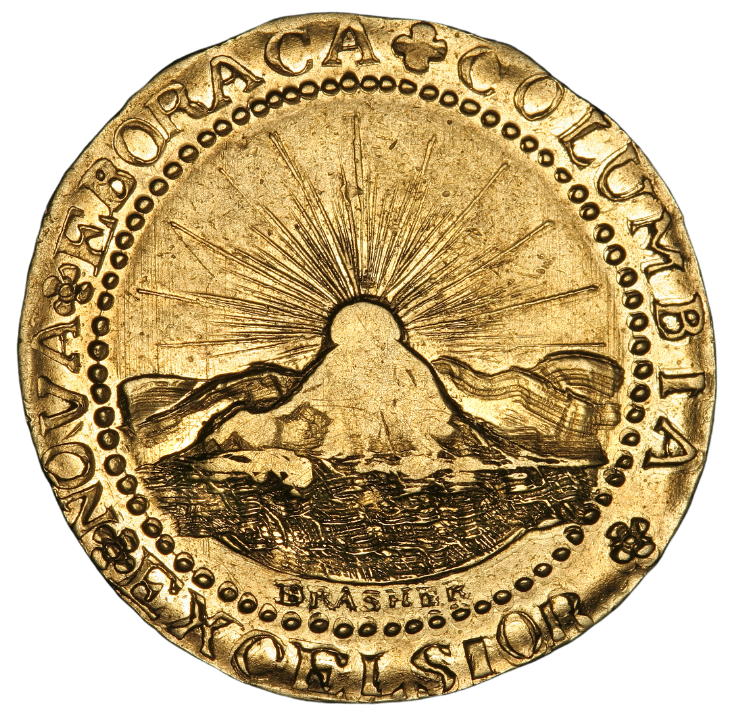
And one sitting in the Smithsonian for everyone to see right there and, on the backside of this coin, right under the sun rising up over the mountains, it’s printed right on the coin. Brasher. So from all his work in colonial coins, where there’s this mad rush to get in on the action by every single coin maker in each of the 13 colonies, Brasher gets the last laugh.
And that’s one of my favorite aspects of this coin. I love the comeback. Everyone loves a comeback, right? The artists that nobody cared about, who died broke, the painter that everyone thought was insane. And then a hundred years later, their works are worth millions. It’s a fundamental theme in art. And in life.
I remember when I was a kid, I found out that famous poet Edgar Allan Poe, he lived in poverty and died without making any money from his writing. And I couldn’t believe it as a kid when I found that out. And then that just sort of grew his legend even more, just to think about that fact.
So I love the underdog story here, even if it took 60 or 70 years for anyone to notice Brazhyr’s doubloon coin. Now they’re world famous coins. Van Gogh, Vermeer, Paul Gauguin. They weren’t recognized or super famous for any of their work when they were alive. It was only after they were gone that their legend started to grow. But it’s always fun to explore these stories where the world finally came around to someone’s creation.
Then it grew just off the pure greatness of it, even after they were long gone. That’s a fascinating concept to think about here. I love the creator’s story of the world’s greatest rare coins. It’s history from an entirely new and unique perspective. And I can’t say it any better than one of the all-time great collectors, my main man, Virgil Brand.
Way back in 1905, he already said it perfectly. So here’s how he explains it. He says, “The branches of learning to which the science of numismatics is related are numerous. Its relation is closest to history. In fact, coins have been freely employed in revisiting the latter and much valuable historical data rests entirely upon their testimony.”
That was Virgil Brand back in 1905. He was an enthusiastic coin collector. So have a great rest of your day wherever you may be. My goal with these stories is to inspire you to dig a little deeper and then take a look at history from a slightly different perspective.
Do me a favor and share this episode with someone who might enjoy a story about a talented goldsmith and a loyal patriot, who was right in the middle of a revolution, trying to find a way to contribute his many talents to the bold vision of becoming a free land, totally independent from England, and then pitching in whatever way possible to the creation of a new country.