
Jasper Johns
Jasper Johns
Episode #33
12.06.2025
“Then came the day when he tore everything up. It coincided with what he had called a spiritual change. Before, whenever anybody asked me what I did, I said I was going to become an artist. Finally, I decided that I could be going to become an artist forever, all my life. I decided to stop becoming and to be an artist.”
Here’s a big turning point in the life of a great artist from a book that I just finished reading published back in 1977 authored by a legend who sold over 200 million copies of his books over the years, Michael Crichton.
What’s happening in that opening quote, there’s a mindset shift.
Someone’s ready to lock in.
The painter who decided to stop becoming and to be an artist, Jasper Johns. One of the most original and creative artists I’ve ever read about.
Jasper Johns
As a young artist in New York City for the first time, in his early 20s, Jasper Johns wasn’t looking to fit in. He didn’t want to join the crowd, but to stay away from it. His mindset was focused on originality and figuring out what he could do different than anyone else.
After one year in the army, Jasper Johns headed to New York City. He’d always wanted to be an artist, but as a shy Southern kid from South Carolina, he attends one day of college and then he quit.
Jasper Johns Finding His Way
He worked in a local bookstore and he continued painting, but he didn’t have much direction. At the age of 24 years old, there was this incredible moment. And in these creator stories that I’ve been doing here, it seems like there’s always this big moment that just jumps off the page as I’m reading these books. And that’s what I read to start the episode off.
Author Michael Crichton explains it. He just said, “then came the day he tore everything up.” Jasper Johns said he was finished telling people he was going to become an artist.
Because he might be saying that his entire life. And then he drops this incredible line that I read at the opening. says, I decided to stop becoming and to be an artist straight up. mean, it’s that simple.
Now he’s an artist and that marked a huge change, but it wasn’t just something that he said as important as that was to be an artist. There’s something else he did that was just as meaningful at the same time. He destroys all of his artwork. He tore everything up.
Here’s how Michael Crichton says it in his book right here.
“One day in 1954, Jasper Johns, then 24 years old, methodically destroyed all the work in his possession. This was the first of several acts of self-destruction by an artist who would eventually be known for his skill and daring at rebuilding his past.”
All right, so both of these things happen at the same time. He destroys all of his artwork and then he says, I’m an artist. No more trying to become something. He was ready to level up.
The book called it a profound change, but it wasn’t something that just happened on its own. This was a new commitment to discovery, but it took a lot of work and a more intense search for different methods.
Jasper Johns Searching for Uniqueness
Now for a young guy in New York City with nothing, his natural instincts and his desire was originality, fighting that temptation to fit in. He didn’t want to be just another artist. The fight was for uniqueness.
This is the opposite for most people. They want to fit in.
Think about being in your early 20s, not much money, not a lot of direction. Most instincts would tell you, get out there and join a group or network or connect. This is advice you hear from wise old folks all the time.
They say, if you want to do big things, if you’re driven, you got to network and join a group, seek out experts, connect. That’s the worst one right there, connect.
Get out there and find like-minded groups who are also doing art. This would be the logical advice. Go figure out what art is selling and what everybody’s interested in and then just do more of that.
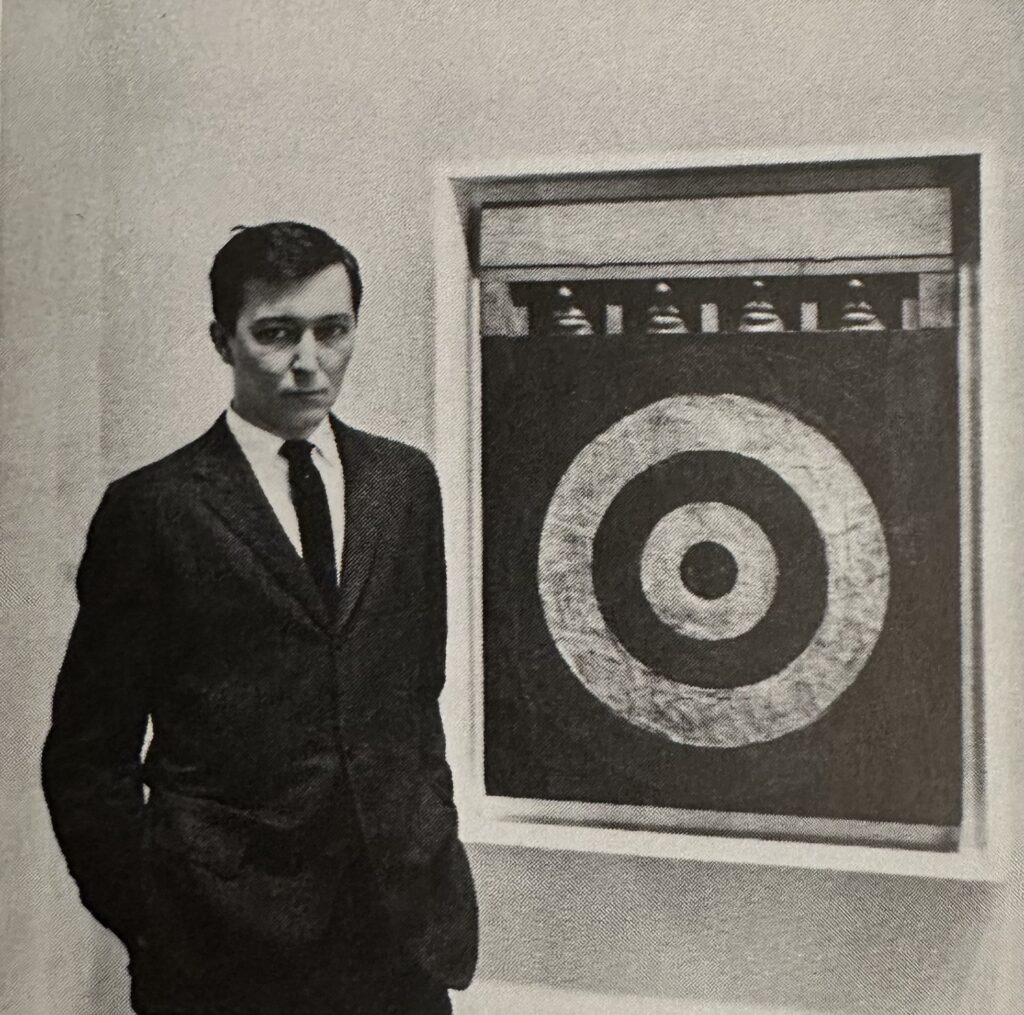
One of the many amazing pieces of this Jasper Johns story. He didn’t want anything to do with it. His instincts were guiding him away from the popular scene. And with this new commitment to his work now as an artist, a clean slate, he wanted a different direction.
Listen to this from the book, he says,
“I decided to do only what I meant to do and not what other people did. When I could observe what others did, I tried to remove that from my work. My work became a constant negation of impulses.”
Negation. That’s a great word right there. It means the act of denying or the absence and opposite of something or the rejection of an idea that’s negation.
I love that word now after reading this book, negation. It’s an amazing insight for a young painter pretty much alone in New York City. Jasper Johns explaining it. He wanted to remove anything from his work that he observed others were doing.
Now, Crichton adds this too. He says,
“His attitude recalls the views of another southerner, Edgar Allan Poe, who said, the fact is that originality demands in its attainment less of invention than negation. But Johns has never showed much interest in novelty per se, and by his own account his negation of impulses was not so much a search for originality as it was a young man’s quest for self-identity in work. I had wished to determine what I was. I had the feeling that I could do anything, but I wanted to find out what I did that other people didn’t. What I was that other people weren’t. It was not a matter of joining a group effort, but of isolating myself from any group. I wanted to know what was helpless in my behavior, how I would behave out of necessity.”
Confident and Searching
End of passage right there. That’s from Michael Crichton’s book. This is when the story completely hooked me in. Like I said, it’s incredible insight for a 24 year old and what turns out to be a potent combination. The confidence that he felt he could do anything and then looking to test himself, what I was that other people weren’t.
Once I got to this part, now I’m hooked on this book. Just in the first few pages, I couldn’t put this book down.
So when I started in on this story, I was hesitant. I had this crazy feeling like I really had no business trying to tell a story about Jasper Johns. I didn’t know much about him. I’m definitely not an expert on art, especially post-war art. I have no background in painting. I have no credentials.
So I wasn’t sure if I had any business trying to do an episode on one of the greatest artists in all of modern art. I just felt like I was way out of my league here, just way out of my element. Until I started reading the book. By the time I finished reading it, I felt really comfortable.
The All-Time Great Creator
Why Jasper Johns is an all time great, why collectors pay tens of millions of dollars for his paintings, and why people are mesmerized by his work. He wasn’t an insider. When he started, he had no connections, hardly any money, but an unbelievable curiosity and creativity and a desire to be unique.
So it wasn’t long before I felt totally comfortable with the thought of making a creators episode on Jasper Johns. Like almost like he wouldn’t mind me doing this episode for some reason.
I just had this feeling of relief. I had no goals to understand the meaning of every one of his pieces of artwork. I just wanted to hear the story as told by Michael Crichton, one of the greatest authors of all time. And it turns out I was loving every single minute of this Jasper Johns story.
So there’s this early desire and quest for originality like I read earlier. He saw what others did and he removed it from his work. He said his work became a constant negation of impulses.
Encuastic
In the book he talks about trying everything he could think of, just experimenting with all these different methods in his work. He stumbled on one method and it came from a problem he was having with the paint smearing. He wanted to show the layers in his painting, but when the second stroke smears the first one, he’d have to wait until the first layer totally dries. Then the friend says, try using wax. So he starts mixing wax into his paint and the wax dries the first strokes faster and the layers of strokes after wouldn’t smear the first.
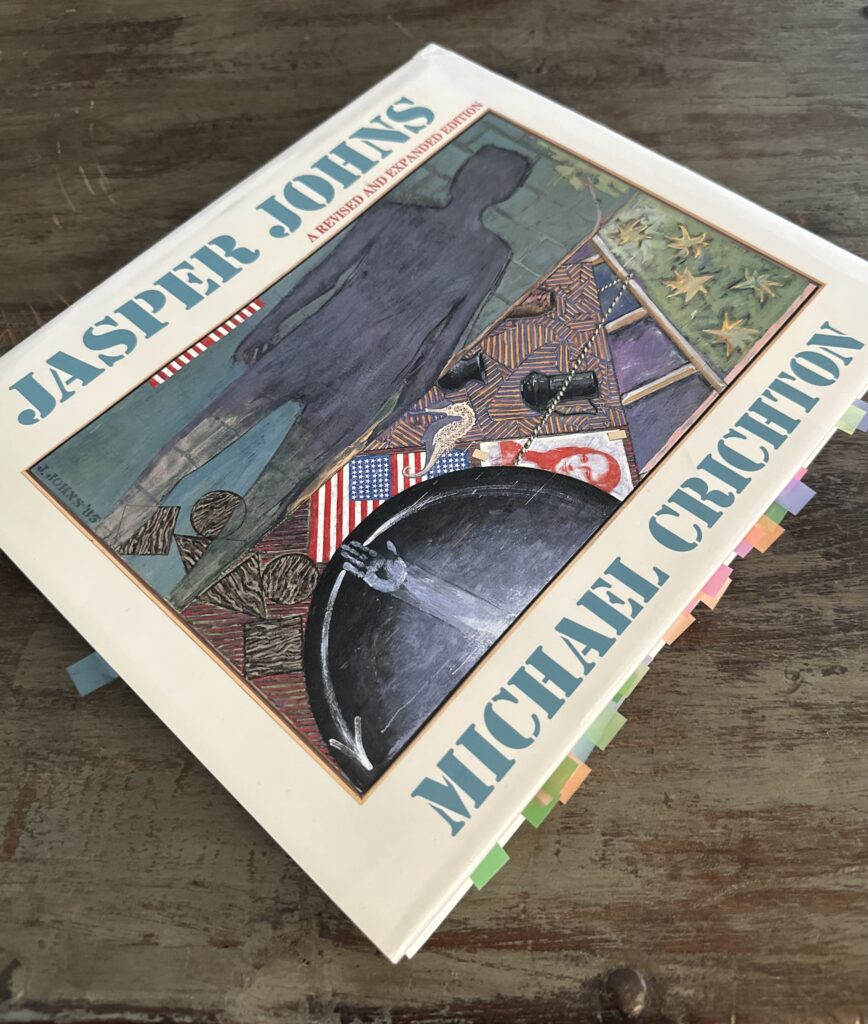
And this was a method called encaustic. It’s an ancient painting method. It’s a Greek term, encaustic, and it means, “to burn in.” Jasper starts doing this. It’s not an easy method to use, and which some said that that’s what attracted him to it. But Jasper says in the book, he just said simply, “I wanted to show what had gone before in a picture and what was done after.”
Plaster Casting
So now he’s doing encaustic. But what else? How about plaster casting? He casts faces of all sorts of different objects and he integrates plaster cast pieces into some of his paintings. Now he’s combining these methods. This is not what other painters are doing. At the same time as he’s exploring encaustic and defining himself as an artist, he has a dream.
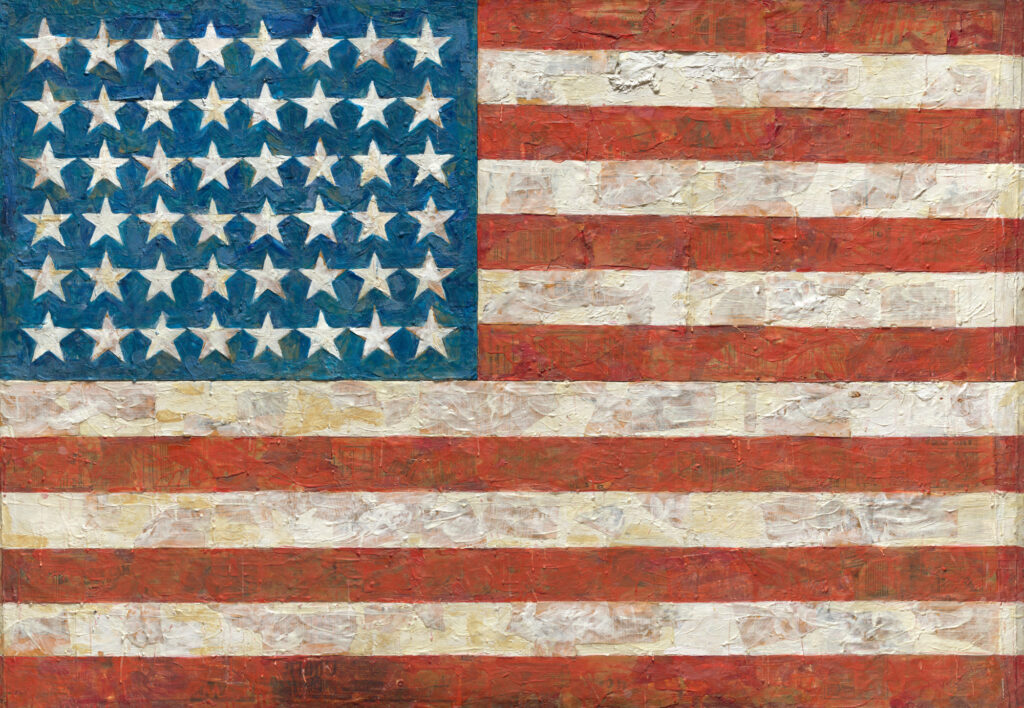
He saw himself painting a big American flag in his dream. So what does he do? He wakes up and he paints a large American flag using encaustic. This very detailed and layered painting.
But it’s the American flag. Like it’s just a common symbol that everybody knows. He didn’t change the flag. He just painted the flag. And this was another big turning point in his work. By using this image that was already known,
Michael Crichton says in the book it was an impersonal image, but with this common everyday image that was known by everyone Jasper Johns found his self-identity because it gave him a bunch of other ideas that nobody was thinking about at the time.
The Dream of The American Flag
He said by painting the American flag, he didn’t have to think about what to paint. It was already done, and now he could focus on his method and how he was going to do it, by painting a known image. He said, “That gave me room to work on other levels.”
And this turned out to be a big deal right here because at the time, famous artists were busy creating their own original images. It was abstract work. This was not something a legitimate artist would think to do, to just paint an American flag.
His earliest works were also targets, like a target that you would shoot a bow and arrow at. A very simple image of a target, but painting in the encaustic layered method. What he discovered was by using a known image, it catches the attention of the viewer but also draws them in to examine the surface a little closer from these encaustic brush strokes.
Common Images
At the time, back in the 1950s, this was just so confusing for people. A common image of a target or the American flag, they were known images, but they weren’t art. That was the thought. But with Jasper’s work, it was like, well, now I’m not so sure. Now that I look closer at this amazing encaustic detail in the flag or this painting of a target. Now I’m not sure. This might be art after all. So he was playing around with these tiny thoughts. Is it art? Can you do that? Can you just paint an American flag and hang it up on the wall? It was totally different than the popular art at the time, which was abstract art.
The 1940s and the 1950s, it was non-representational. Abstract art did not represent images. This was Jackson Pollock, Mark Rothko, William DeKoning, the goal of the abstract artists to evoke emotion and feeling by not referencing any known objects at all.
So when Jasper Johns created his American flag painting, it was like, what is going on here? This is not anything close to abstract art. The exact opposite of abstract. This is just straight up a flag. So can you imagine how different it was, against the grain at the time, and that’s exactly what he was trying to do.
Something different and unique. But people were just like, you can’t do that. Or can you? I don’t know. So in the book, Michael Crichton makes this entire point perfectly what I’m trying to say. Here’s how Michael Crichton says it in his book.
“One concerns the idea of painting a flag. In the 1950s, that act seemed to many observers an absurdity. An American flag might be many things, but it was certainly not art. Yet Johns presented a carefully worked, elegant, executed painting. Such a painting was surely art. Or was it? That became a problem for the viewer alone. Johns is gone. He has already made the painting. He has already presented the problem. The viewer is left to resolve it as best he can.”
The Creative Genius
So you can see how this is going here.
Jasper Johns is just on a different level. Like it or not, the work is already done. Johns is gone. It’s totally different, opposite from the popular art scene at the time. He’s toying around with ideas that not many people were thinking about. And maybe people liked this new idea. Maybe they didn’t. Resolve it however you want. It’s already done.
Just like Crichton was saying, by this time, abstract expressionism had been around for a while almost 20 years. By the late 1950s it was getting little tired. So the timing was absolutely perfect for something new and fresh.
Rauschenberg
Around this same time, Johns meets Robert Rauschenberg, who moved into the same building right above him. Rauschenberg was also an artist, but he already had a name for himself and he had his work in a few different shows by then. So the two became close friends and they shared similar beliefs in art and in life.
They were both from the South and both struggling to pay the bills. So they would design window displays for stores whenever they needed extra money. They worked for Tiffany Jewelry Store and then another store called Bonwit Teller.
So these luxury retail stores, this happens to be the first time Johns’s work appeared in public in one of these window displays. Soon after that, a friend urged Jasper to show one of his paintings in an upcoming show at the Jewish Museum.
That was the first time anybody saw Jasper Johns painting at an art show. He included his painting from 1955 called Green Target at this art show in 1957, which leads us to the discovery of Jasper Johns.
His work Green Target is hanging at the art show and there’s a guy who sees it who happens to be interested in opening his own art gallery. The guy’s name, Leo Castelli.
Leo Castelli
So art people are going to know Castelli. But if you’re not an art person yet, let me just say I could do an entire episode on Castelli. Trust me. His story is amazing.
But it turns out that Castelli attended that show and noticed a painting called, ‘Green Target.’ And then he also sees an unfamiliar name next to the painting. And it’s a name that he couldn’t forget. It said Jasper Johns. Listen to this. I found this from another book that I have on Leo Castelli that I’m going to get into here.
Here’s what it says.
“When Leo came back from the Jewish Museum exhibition, said Alina, I asked him if he’d seen anything of interest. I’m not sure about the show, he replied, but I did see a green canvas. I can’t say I understood it, but I liked it immensely. It intrigued me so much that I can’t think of anything else.”
That’s from a book that I have called, ‘Leo and his Circle,” by Annie Cohen Solal. And that book is all about the life of Leo Castelli. It’s incredible.
But I need you to try to imagine this scene. Leo Castelli is planning to open his own art gallery. He’s trying to figure out how he’s going to do it. He wants into the business to be an art dealer. And it turns out that Castelli already knew Robert Rauschenberg. So he goes to his house sometime after this Jewish museum show.
The Big Meeting
He wanted to get some of Rauschenberg’s paintings for his new gallery that he’s going to open up. So Castelli is over at Rauschenberg’s house and I got to stop right here. We have to talk about Castelli for a second before I can keep going on this story.
I have a lot of fun reading these books and trying to figure out these stories. So I had this book by Michael Crichton all about Jasper Johns. I had it for a while. And when I finally got a chance to read it, I could tell immediately that it was going to be a great story.
But then I get halfway through the book and this name pops up, Leo Castelli. And that’s where this story really took off. I had this book on my shelf called ‘The Art Dealers,’ published back in 1984. And it’s all about the 30 biggest art dealers of the post-war era.
Every single dealer featured in that book talks about Leo Castelli more than their own careers. It’s crazy. I started reading this book and I could not believe it.
The Great Art Dealer
You know you’re good at your job when every single one of your competitors can’t keep from name dropping you every five minutes. Go look for yourself. Go find this book called ‘The Art Dealers’ and you can read all about the biggest art dealers ever talking all about Leo Castelli the entire time.
So I noticed every single art dealer can barely shut up about Leo Castelli. That’s when I ordered that other book called ‘Leo and his Circle,’ but I never even opened the book until now.
I had it on my shelf for a long time and I didn’t even open it until I did this story this week. So now I flip the book open and I go right to the index of the book and I look up Jasper Johns and like half the book mentions him.
And of course, at the very start of Leo Castelli’s journey in becoming one of the greatest art dealers to ever live, there’s this same exact story about how he saw the green target painting hanging in that first show.
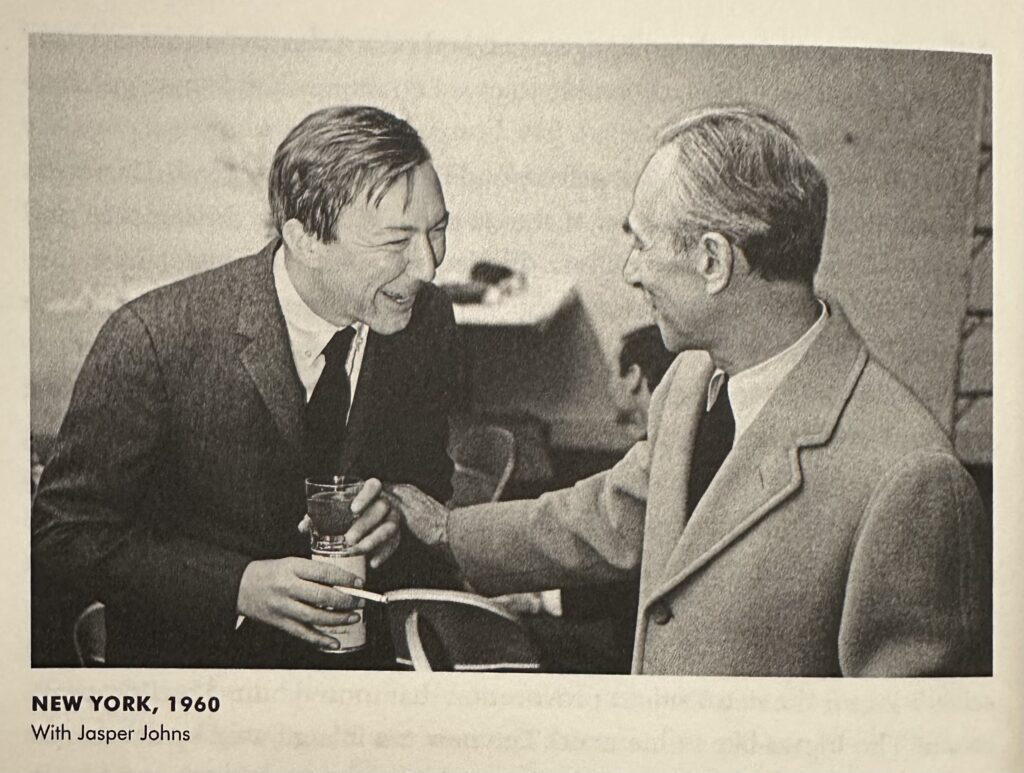
And then he goes to Robert Rauschenberg’s house for a visit.
So why am I telling you all this? This is a big deal right here. It’s one of the defining moments in all of contemporary art or American art, maybe ever.
The planets align, these worlds collide, lightning strikes, whatever you want to call it. This story has been told a million different ways, I’m sure, because I have three books right here in front of me and each book tells the story slightly different. But this is the story that changed the art world forever.
Castelli Visits Rauschenberg
So back to the story, Leo Castelli is at Rauschenberg’s house.
And somehow he mentions the green target painting he saw at that Jewish museum show. And then he says, it was by some guy named Jasper Johns. Castelli said, I’d sure like to meet this artist Jasper Johns someday. And Rauschenberg says, well, that’s easy, Leo. He lives right downstairs. Why don’t you go down there and say hello?
And that’s from Michael Crichton’s book. So my other book, Leo in a Circle by author Annie Cohen-Salal.
That book has the most detailed account of this story. So let’s take a look at that book real quick. It says,
“After the usual pleasantries, Rauschenberg offered his visitors a drink with or without ice “with,” Castelli answered. Then I’ll be back in just a moment because my neighbor Jasper Johns owns the common fridge.
Did you say Jasper Johns? Castelli said the one who’s green painting is at the Jewish museum. I perked up. Can I come with you?”
And so Castelli described this encounter in another way. So right here, Castelli says,
“We went down to his studio and there I was confronted with an astonishing sight. Paintings of flags, red, white and blue, plain and a big all white one. Targets with plaster casts above them, alphabets, numbers, and all in a material I hardly knew. Encaustic.”
And then somebody asked Castelli, they said, “Was it love at first sight? And Castelli, goes, “Yes, total and absolute. The like of which I had never experienced before and rarely since. I asked him, do you want to join my gallery? His answer was simply yes. He was 27 at the time.”
Okay. So that was the famous story from the book Leo and his Circle.
Now here’s another version of that same meeting between Castelli and Jasper Johns told from Michael Crichton’s book. When Castelli goes downstairs to meet Jasper Johns for the first time, here’s how Crichton says it in his book. It says,
The Discovery of Jasper Johns by Leo Castelli
“I walked into the studio, Castelli recalled, and there was this attractive, very shy young man and all these paintings. It was astonishing. A complete body of work. was the most incredible thing I’ve ever seen in my life. For Johns, who did not want to be associated with any particular group of painters, Castelli’s gallery was ideal, since it was new and had no specific identity.”
End quote from Crichton’s book. This is a perfect match from a chance meeting. Leo Castelli, he’s opening a new gallery and he’s not committed to anything yet. All he’s really committed to is something new. He doesn’t want to show the same old tired art.
Castelli also sees a complete body of work like he just said. This is a dream come true for Castelli. He’s gonna fill his gallery with these creations from Jasper Johns that nobody’s ever seen before.
Listen to this description of the opening first shows from Castelli and Jasper Johns from Crichton’s book right here.
“Castelli showed Johns his flag in a group show at his gallery later in 1957. And in 1958, he gave Johns his first one-man show. Here, Johns displayed the result of more than three years of sustained effort. His flags, his targets, his numbers and alphabets. Johns became an overnight sensation and was immediately plunged into a critical controversy that continued for several years.”
So that’s from Crichton’s book. So this controversy comes from the uniqueness of this art and how hard it hit, how quick it took off.
Castelli’s shows are a big success and they’re bringing out the abstract expressionists and all their opinions on these shows who were reigning over the art world in New York. They’re not digging this new style from Jasper Johns. They’re trying to say it’s not even art. They’re just everyday objects. It doesn’t look anything like a Jackson Pollock or a de Koenig. And that’s exactly the point. It was so unique and different. People were starving for something new and fresh. And here it is.
Jasper Johns Controversy
And it’s not just new and fresh, but Crichton says in his book, it’s also provocative because it was so opposite of the abstract paintings. There was a well-known abstract painter who was quoted in the book. This was their reaction. They said, “If this is painting, I might as well give up.”
I’m sure there was jealousy because of all the attention and how quick this took off. Johns had years of work that Castelli just unleashed on the scene. There’s jealousy because the paintings were selling.
Crichton’s book says almost all the paintings were sold at Castelli’s shows and the biggest collectors were buying. Rockefeller, Sobey, Johnson, Miller, Alfred Barr, who was running the Museum of Modern Art at the time, bought three.
And here’s the amazing thing, this goes on for almost five years. Jasper Johns is a big star. In 1955, Time magazine wrote this about the artist.
“Jasper Johns, 29, is the brand new darling of the art world’s bright, brittle avant-garde. A year ago he was practically unknown. Since then he has had a sellout show in Manhattan, has exhibited in Paris and Milan, was the only American to win a painting prize at the Carnegie International, and has seen three of his paintings bought for Manhattan’s Museum of Modern Art.”
So that’s what Time magazine was writing about Jasper Johns as a 29-year-old. So he’s made it.
His art is selling for big prices to famous collectors and hanging in museums.
So this is the dream, right? If this was you, what would you do? I bet you’d keep on painting flags and targets with encaustic. This is what the people love. That’s pretty clear. Well, we talked about this already. Do you remember what I said? My new favorite word, “negation.”
Jasper Johns doesn’t want to be part of any popular crowd, remember?
So what does he do? He changes his methods and stops using encaustic. He uses oil. He stops painting flags and targets and recognized images. Now he starts painting color. Johns was known as an intellectual artist, but now his work didn’t have the insights that drew people to his work in the first place. And Crichton’s book says it best right here. says,
“Thus we are presented with a young artist having just attained international renown, abandoning the techniques and imagery that had made him famous.”
Jasper Johns Changes Methods
What is Jasper thinking here? He’s 29 at the top of the world. He’s got the Rockefellers buying his art. It’s hanging in MoMA. Finally getting recognized in the magazines and he’s starting an entire new art movement away from abstract art that dominated the scene for 20 years. He’s the main attraction.
But just like Crichton said, he just abandoned the techniques that made him famous. His fans couldn’t believe it when they saw his latest work. There’s a painting called “False Start,” and it’s all just colors. And there’s no familiar image, no encaustic.
Has this guy lost his mind? He’s going to lose all of his fans. What is he thinking? Well, check this out. Crichton’s book explains it like this.
“John’s himself saw no radical break. Two years earlier, he had become aware of certain limitations in my work, and I had the need to overcome those, to break with certain habits I had formed, certain procedures that I had used. The flags and targets have colors positioned in a predetermined way. I wanted to find a way to apply color so that the color would be determined by some other method.”
So Leo Castelli, his art dealer now, talks about this change. He said there were big collectors and very important people in the art world and they just couldn’t believe it. Castelli said, Alfred Barr, the director of the Museum of Modern Art, “he was disappointed in the change. He didn’t understand it at all.”
There’s a pattern I started seeing in this story where over and over, Johns didn’t concern himself with the critics, but he went much further than that.
Johns insisted that there was no correlation from his paintings to how he was feeling. Again, so different from the abstract artists where the art was supposed to have this narrative and emotion behind it. Not Johns.
Here’s what he said in Creighton’s book, “I diidn’t want my work to be an exposure of my feelings. He was really divorcing himself from the tenets of abstract expressionism, where the point of the work was to make some statement of subjective emotion. Johns never had this goal. Quite the reverse. When Johns first received public attention, he refused to be drawn into a critical dialogue. In 1958, he told a Newsweek interviewer, said, have no ideas about what the paintings imply about the world. I don’t think that’s a painter’s business. He just paints without a conscious reason. This is an attitude Johns would consistently express all his working life. More than two decades later, he said, my work has no conscious goal in relation to the viewer. Of course, such statements could be viewed as disingenuous. Johns is a highly self-aware painter. Jasper is much too intelligent to think that a piece of art means what he says it means. Nor does he believe in telling you what it means because for him, meaning is always in a state of flux.”
So this brings us now to the last thought I want to cover and we get a little deeper into the process of Jasper Johns.
The Creative Process of Johns
Beyond the brush strokes with wax and the moldings and the colors. This part of the book blew me away. It just made me sit there and think for a bit after I read about this the first few times in the book, John says his work is final. Whatever happens happens. So I’m like, okay, let’s see where this is going. Check this out. John says in the book,
“There are no accidents in my work. It sometimes happens that something unexpected occurs. The paint may run, but then I see that it has happened and I have the choice to paint it again or not. And if I don’t, then the appearance of that element in the painting is no accident.”
So there’s no accidents in his work, but there’s more. Michael Crichton’s book really digs into this. I love the way this conflict occurs. The longer you dig into Jasper Johns, it’s amazing, so check this out. The book says,
“Observers are put off by ideas such as these. The artist does not seem to be struggling to bring forth a pre-existing vision, but rather is engaged in a process where the outcome may or may not conform to the initial idea and where accidents along the way are incorporated. The idea of following a process in artistic creation makes people uneasy. The idea of a struggle birth pangs is much more acceptable.”
So the book keeps going now. Crichton continues in the analysis and I found this fascinating. He’s talking about the artist’s vision, trying to produce this thing that’s already in the mind. Here’s more of this conflict that people talk about with his artwork. Crichton is saying, yeah, Jasper Johns doesn’t think like that. You’re getting this all wrong.
And Crichton is trying to explain this thought process. says,
“Thus the cliche that the artist is never satisfied with his work, that it never turns out to be what he had in mind. The usual explanation for this state of affairs assumes that imagination has a richness beyond what the fingers can actually perform. so disappointment inevitably follows. Much has been written about the eternal striving of the artist to reproduce the wondrous visions of his brain.”
Alright, so Crichton, talking about the surprises that happen along the way. He says, if you live with the surprises long enough, they begin to seem like an ordinary feature of the work. He said, soon there is little useful distinction between what you intended and what you are doing.
But now listen to this. This is the part that just melted my brain. was just not expecting to get to this level of insights into the creative process when I started reading this book. But I should have known. One of the greatest authors and storytellers of all time, Michael Crichton, he delivers. Listen to this. He’s talking about Jasper John’s painting, but anyone who’s out there creating anything, this might hit home. Here’s Crichton with a brilliant quote.
Crighton on Creativity
“Work is the outcome of a thousand apparently accidental events that are permitted or not permitted to enter the final work. Seen in this way, creation is only a process and the idea has no significance beyond its ability to set the process in motion. The relationship between the initial idea and the final creation is always doubtful. As psychologist Jerome Bruner said, you are more likely to act yourself into feeling than to feel yourself into action. Johns himself echoes the idea. He says, sometimes I see it and then paint it. Other times I paint it and then see it.”
All right, so I got to read that one more time right here. Maybe my favorite passage from the book, Crichton just said, “In this way, creation is only a process and the idea has no significance beyond its ability to set the process in motion.”
Something that I really would have trouble putting into words and Michael Crichton just nails it with two sentences right there. John’s takes away the critics ability to critique. It’s the ultimate trump card. I didn’t have a plan when I started so there’s no intent. The work is the work. I just took an image and I did something to it. You could call this the conflict in this story.
Fans of the artist want to know what’s the story? What was the motivation? What’s the intent behind this amazing art? What’s the vision behind the amazing painting? Tell me. That’s a fan’s reaction to this art and they’re not going to get it. And they’re conflicted. We saw this in my last episode. I did it on the Lamborghini Countach, the amazing car that was created back in 1971.
Most of that story was the vision behind that insane car. What was the goal? It was to create power and emotion and a visceral driving experience. There was a great story behind that car and the designers and the builders explained their intent and the reason why they did it. And so now, Johns is not giving you that explanation. And then Crichton keeps going with this idea. Here’s what he says.
“To emphasize the process of creation is to cast doubt on the significance of the idea behind a created work. There is a long-standing debate among artists themselves about whether the underlying idea is central or peripheral to the finished work.”
So I was talking earlier about how little I knew about modern art when I started reading this book by Michael Crichton on Jasper Johns.
The Amazing Story of Jasper Johns
But then I got into this story and I felt comfortable. Like it was okay not to know. I wanted to understand and learn and become an expert. And I don’t want to fake it. I read a great book, but I’m still just an amateur. And that’s okay now. Why did I suddenly feel so comfortable making this story? When I wasn’t sure how to approach such a brilliant creative mind.
Not one ounce of pretension. And maybe that’s a common fear when people think about art. Like they’re unfit or they’re not worthy. Or maybe that’s just me. But I found a great little video and it was actually from the auction house, Christie’s. And it was from a guy named Tobias Meyer. And he absolutely nails this thought that I was having. Here’s how he described Jasper Johns.
“There’s a kindness to not lecturing as an artist. Because it actually acknowledges the viewer as intelligent. It’s a very respectful gesture. He gives you the paint, but he doesn’t give you the solution.”