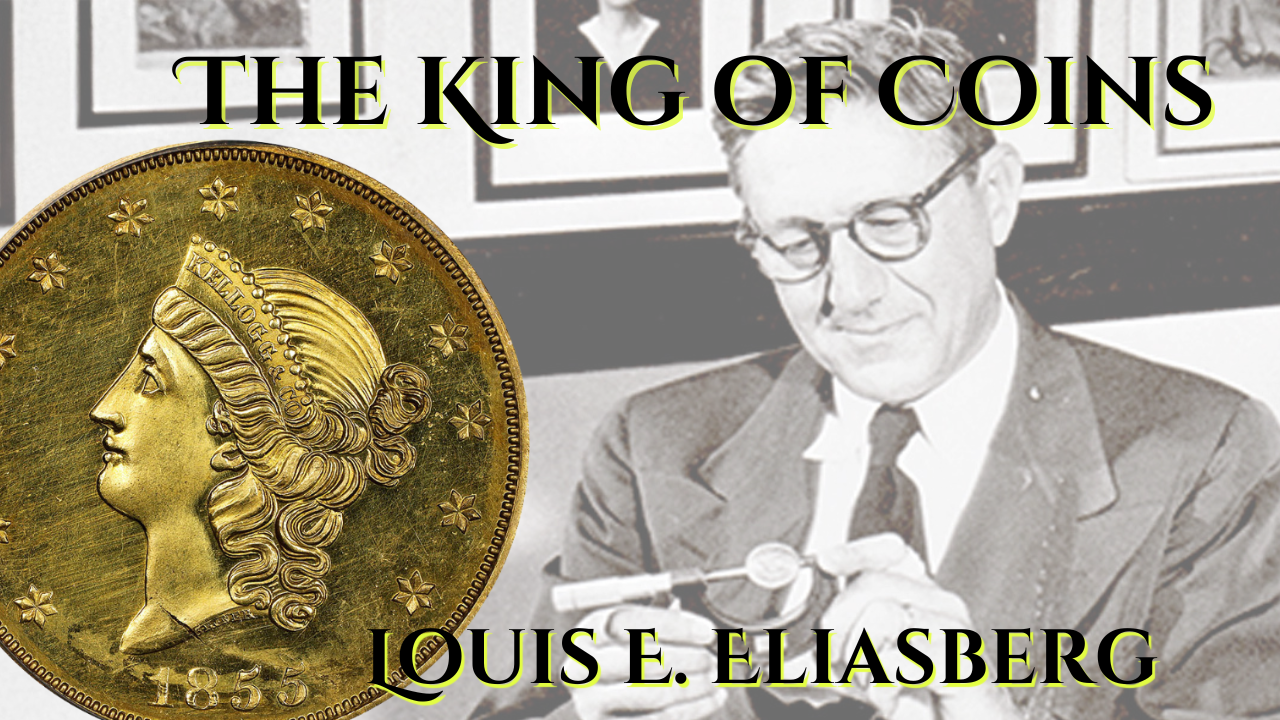
Louis E. Eliasberg
The King of Coins, Louis E. Eliasberg
08.18.2025
“One of the few business losses he experienced came from shorting some stock in 1928. But he took his loss and closed his position. He foresaw the 1929 stock market crash, but was too early. He was proud of the fact that the Finance Company of America had a lower bad debt charge-off rate than did most banks. The pleasures of his life were his family, his personal relationships, and the simple things such as golf, bridge, baseball, and fishing.
He was unimpressed with travel, lavish dinners, or pretense of any kind. Coin collecting excited him and awakened his interest in history, events, and the people commemorated on coins and medals. Coins became a historic education to him, and over a period of time, he became an expert on American monetary history.”
Louis E. Eliasberg, King of Coins
So that was an excerpt from a book I just finished reading by Q. David Bowers. And I have a stack of books here written by David Bowers.
This was another great one. The book is all about one of the greatest coin collectors of all time, Louis E. Eliasberg. And we’re going to get right into this opening quote that I just read. And then we’re going to look at this book by David Bowers.
But here’s the deal. I wanted to read this book because when you’re learning about rare coins, there’s one name that comes up over and over again. It’s Louis E. Eliasberg. Over 50 years of collecting coins, Eliasberg was the only coin collector ever assemble a complete collection of every single date and mint mark of US coins from 1792 right up to 1950 when he accomplished this feat.
The King of Coin Collecting
So coin collectors know this name, Lous E. Eliasberg, and I thought I did too, but what I’m learning over and over again here is that there’s so much more to the story than I thought originally. It’s only after I read a great book and then spend a few days thinking about a subject that I can really start to understand the full story.
And so we’re going to look at this life of Eliasberg and his passion for collecting. And here’s another thing I’m learning. These great coin collectors were pursuing much more than just valuable objects. There’s a few themes that pop up with these great collectors. And we’re going to get into that too. What I’m discovering about the greatest coin collectors of all time. There’s a depth to their story that goes way beyond valuable coins. It’s really their life’s work to put these collections together.
And the actual coin in their hand, that’s just a fraction of this entire story that they’ve crafted over their entire lifetimes. But it’s the story that runs through these coins, which is really interesting. And I’m learning that over and over again with these coin stories. So this story about Louis Eliasberg is amazing.
Q. David Bowers and the Book
And I have the book right here. Luckily, Q. David Bowers wrote a complete book on the life of Eliasberg. And then he chronicled the entire collection in this book. Like I said, the book is titled, “Louis E. Elizberg Sr. King of Coins,” published in 1996 by Bowers. And if you don’t know already, you’re going to find out here why he was The King of Coins.
So the quote I read to start this episode, it was from the very first chapter. The son of Eliasberg, Richard, he wrote an introduction about his father for this book. And so the opening quote was written by the son of the great collector and his son Richard goes through his father’s early life growing up in Baltimore and how his father got into the banking business in the early 1920s.
That was his career in the banking business. And then he got interested in coin collecting through the 1920s.
But then here’s the first reason I wanted to start the episode with this quote that I read, because he talks about the roaring 20s. In the opening quote, he mentions this rare loss in the markets for his father in 1928.
A Rare Market Loss and a Lesson
And that really caught my eye. Richard says his father had a rare loss in the markets from shorting some stock in 1928. So the stock market is getting a little wild. It’s getting a little crazy. And Eliasburg thinks the market’s getting overpriced. So he shorts the market, but he has to close out that trade with a loss because of course the market is climbing in 1928.
But then his son Richard, says that he was just a little early to the market crash that would happen the very next year in 1929. So you can see already, and this comes up later on too, but Eliasberg was known as a conservative banker back in the day. And it turns out this is a very good time to be conservative as a bank owner heading right into what would become the Great Depression. He actually loses a partner during the mid 1920s.
The Roaring 20s
It’s the roaring 20s and his partner was complaining that Eliasberg wasn’t taking enough risk in the banking business. And this partner goes off to start a rival bank. And then of course that rival bank would eventually fail in the market meltdown just a few years later in 1929. And a lot of other banks got hit too, but not Eliasberg. He makes it through the market crash and the depression.
And then his son Richard in the opening quote is he says that his father’s bank had a lower charge off rate than other banks because of his conservative style, which set him up for growth and success later on in the 1930s and into the 40s.
So then the opening excerpt I read, it gets into why Eliasberg loved to collect coins. And I said, we’re going to get into these themes that we see over and over again, and we’ll get into that in a minute. But there’s another reason why I like the opening excerpt. And it’s this very last line. said,
“Coins became a historic education to him. And over a period of time, he became an expert on American monetary history.”
Coins and Monetary History
So that was the end of that opening quote. So this was fascinating because Eliasberg was a banker. That was his career. And he makes it through the stock market crash of 1929 when many of his competitors were blowing up and he’s already into collecting coins. But then a crazy thing happens here. We talked about this in a few different episodes I’ve done already on the Saint-Gaudens Double Eagle Gold Coins. I did an entire episode on the 1933 Double Eagle, the most valuable coin in the world, and the crazy events that created that super rare coin.
Well, Eliasberg is going through this same period as an owner of a bank and an aspiring coin collector. Then here’s what happened. If you haven’t listened to my Double Eagle episode, it’s the depths of the Great Depression and Franklin Delano Roosevelt wins the election in 1932 as he’s sworn into office in March of 1933.
The inauguration is on a Saturday. Well, the very next Monday, President Roosevelt closes the banks and he puts these drastic banking rules into effect, trying to save the entire financial system from collapse. And then the government recalls all the gold.
Illegal Tender and the Depression
So this is fascinating because I learned all about this crazy time from a book by David Tripp.
And the title of that book, was called, “Illegal Tender.” And it’s a really cool book on the 1933 double eagle coin. And if you’re into coins, you need to read that book if you haven’t already, because it goes through this entire period step by step. But now I find out the guy who would become the greatest coin collector of all time, this guy, Eliasberg, the king of coins is what he would be known as. And he’s going through the same exact time as a banker.
And he sees what the President just did. He’s recalling all the privately owned gold from the public. He sees that the US is no longer going to be on the gold standard.
So as a banker, he knows that this changes everything. The money’s no longer backed by gold, so all the rules change. And he’s trying to figure this all out. How much inflation is coming? Eliasberg was a student of history, and he knows what could happen when the paper money is no longer backed by gold.
The Gold Standard
So this is all going through his head. He’s thinking every single time a country has currency that’s not backed by gold, there’s inflation and higher interest rates on the way. This is what he’s saying in the book. So, Eliasberg is seeing all this unfolding right in front of him, and he’s trying to figure out how to run his bank.
With these new rules, and to stay afloat, first and foremost, I don’t really think he’s focused on collecting the next great coin at this very moment. Like, the entire financial system is on the brink of collapse and Roosevelt’s changing all the rules to do whatever he can to get confidence back into the banking system.
William Woodin
So with all these new rules that are put out, there’s something that Louis Eliasberg notices. And you have to go back and hear my full story on the 1933 double eagle, because in that story, I talked about a guy I call him cool headed William Woodin. In that story, this guy Woodin was just appointed.
Secretary of the Treasury when Roosevelt takes office in March of 1933. And Woodin basically saves the entire global financial system at this moment. He’s behind the scenes drafting all these new rules for President Roosevelt. He tells Roosevelt to issue a bank holiday for three days right after his inauguration. Then he drafts rules to ban the payout of any gold at any of the US mints.
He drafts the Emergency Banking Act like, within a few hours he drafts that up and Congress passes the act almost instantly. And then this is when the government begins to recall all the gold. But there’s a couple of things you need to know about William Woodin.
Saving the World Economy
The guy who’s drafting all these new rules for President Roosevelt? He’s behind the scenes basically saving the entire world economy? Let me read you a quote from the 1933 Double Eagle episode I did. Here’s how one colleague described the scene at the time.
He said quote, “Capitalism was saved in eight days and no other single factor in its salvation was half so important as the imagination and sturdiness and common sense of Will Wooden.” That was Raymond Moly, who’s a politician watching all of these events unfold. So now we call him cool headed Will Woodin. But there’s another thing you need to know about this guy.
It turns out, William Woodin was also a long time coin collector himself, and after a few weeks of this gold recall that they issued, Woodin adds this. They draft Executive Order 60102, which added an exemption for quote, “Gold coins having a recognized special value to collectors of rare and unusual coins.”
Exemptions for Coin Collectors
That’s what they added in a few weeks after all this stuff goes down. So Woodin was probably getting an earful from all of his coin collecting buddies after this gold recall that they put into law. So he goes and adds this exemption, making it okay for coin collectors to own gold coins. And I’m telling you all of this because the banker who eventually turns into the king of coins, Louis E. Eliasberg, he’s watching this whole thing play out right before his eyes. And he’s wondering how he’s going to run his bank without holding any gold now, which needs to be turned in.
He sees this exemption on gold ownership is added in only for coin collectors. And the light bulb goes off in his head. He says, it looks like I’m about to officially become a very serious coin collector. Here’s how it says it in David Bauer’s book. It describes this decision by Eliasberg.
Here’s what it says, “Mr. Eliasberg’s purpose in collecting coins was that of a numismatist to appreciate their history, romance and art. But at the time, his efforts also had a more practical application. This is Eliasberg explaining this decision here. He says, “Feeling as I did about gold, I realized that the only way I could legally acquire gold was by becoming a numismatist.”
That’s a coin collector, numismatist. “So in 1934, to the extent of my means, I started buying gold coins at as close to their boolean value as I found them offered. I did this from month to month and year to year. I maintained a small book in which I recorded the cost of gold coins, which I purchased the various denominations, the years and the mint marks.”
Eliasberg’s Big Opportunity
So, Eliasberg sees the opportunity as a banker, he knows the importance of gold. He’s watching what’s going on in the banking system. Now gold has just been outlawed and recalled, and he’s already interested in coins. But with the ruling from fellow coin collector and secretary of the treasury, cool hand William Woodin, there’s now a loophole for gold ownership that’s created specifically for coin collectors. And I’m sure Eliasberg is not the only one who’s noticing this.
But Eliasberg starts to buy gold coins just like he said, he’s buying gold coins right at their bullion value. And it’s not just because he loves to collect coins. It’s not just for the amazing designs on these coins. He wants the gold. He sees what’s happening with the government and the gold recall. And he knows enough to recognize that it might be wise to have some gold stashed away on hand when everyone else has to turn theirs into the government.
The Great Speech by Eliasberg
So this is really cool. Later in the book, there’s a speech that Eliasberg delivers when he’s 79 years old. This is in the mid 1970s and he’s looking back on his amazing life and the time he spent assembling this incredible collection. Something nobody’s ever done before and probably will never do again. Owning one of every date, denomination, and mint mark of every US coin. He gives this speech looking back.
And the reason I’m bringing this up, he talks about the gold standard and the events of the early 1930s when he decided to buy gold coins and the importance of gold through thousands of years of history and why it’s so important. Here’s what he said about gold at this speech. This was his feelings on gold.
The Importance of Gold
Here’s what he said, “The reason that this precious yellow metal is God to so many people in various parts of the world today and will continue to be, is that there are too many governments that are trying to cure their social ills with printing press money. Unless some far-sighted, unselfish, and courageous political forces gain the power to stop the printing of this unredeemable currency, many collectors of gold and silver will possess the equivalent of hundreds of thousands or even millions of dollars within the next two decades.”
So let me interrupt myself for a second. This is a speech that Eliasberg is giving in 1975. But it sounds like it could be something you’d hear today. The same things are going on, and the same concerns are out there for people who’ve studied financial monetary history. And now you could even say it’s gold and Bitcoin now. People are looking for something that’s solid, sound money, or a scarce resource. Just something that’s not unlimited like paper money. But… anyway, let’s keep let’s finish this quote by Eliasberg. Here’s how he finishes.
“Most politicians haven’t any knowledge of the problems of money and are generally more interested in their personal careers and personal greed than in the creation of monetary stability.”
Again, this could be a quote from someone today, but it’s 1975. Some things just never change.
Inflation, Gold, Banking in the 1930s
Eliasberg is saying there’s no will in Washington to rein in the printing of paper money. He says it’s just politicians interested in getting re-elected and lots of personal greed. So the book continues on. got to read this too. The book explains it like this. It says,
“Mr. Eliasberg had the foresight to observe that great government deficits would lead to greater interest rates. Several years later, during the presidency of Jimmy Carter, inflation reached unprecedented high levels of modern times, causing widespread fears about monetary stability. Those who held gold either as a collection or an investment were to see a tremendous profit. It is to be remembered that in 1933-1934, while others were turning gold coins into the government, Mr. Eliasberg accelerated his acquisition of them. He had a low regard for government repudiation of obligations concerning the yellow metal. He went on to relate the United States had brainwashed its citizens by denying them the right to own gold for 41 long years, from March 1933 until December 1974. During this period, most colleges and universities deleted from their textbooks all references to gold as a medium of exchange.”
So that was David Bowers in his book. I’m not sure if all universities deleted from their textbooks, references of gold as a medium of exchange. I have not fact-checked that. That’s how it reads in the book.
And then in this speech that Eliasberg gave back in 1975, he shows that he really was a student of history. He goes into his concern for all this paper money that’s being printed and the importance of gold throughout history. So he talks about the Civil War and how Congress issued compound interest notes to pay for the war.
Monetary History of the U.S.
And then Eliasberg goes right up through the history of monetary policy in the United States. talks about the national banking act, treasury notes, then the federal reserve act in 1913. And then he gets into the gold notes and the silver certificates and how the holders of these certificates had to redeem them or lose their rights to the underlying hard money.
So he had a lot of thoughts about all of this. He was a student of history and he was right in the middle of it during his entire career as a banker.
He’s trying to run a bank and he’s seeing all of this going on. And then he also becomes the king of coins on the side. Now I think this is pretty amazing. In his speech, he keeps going and he gets into the national debt and inflation. And again, you can mistake this speech as something that was delivered last week. It’s the same stuff. A lot of this sounds really familiar and it’s pretty cool to see the king of coins himself, talking about all of this back in 1975. That’s 50 years ago.
Eliasberg Sounds Off
And what he’s saying is if you’re going off the gold standard, then if you use history as a guide, it’s just not going to end well. So Eliasberg talks about the continental notes during the Revolutionary War back in the 1770s. And even though they helped the colonies fund this war, the continental notes eventually collapsed, these paper notes.
And then here’s really what I wanted to get to. This is, I love this part. Check this out. So, Eliasburg says back in his speech, he says, back in 1932, the national debt was about $20 billion.
And then he says, once Roosevelt was inaugurated on March 4th, 1933, FDR said that he was going to chase the money changers out of the temple. And then that’s when they closed the banks the following Monday. And some of the banks were not allowed to reopen if they didn’t meet these certain capital requirements.
Gold and Currency
So there’s a lot of work behind the scenes to try to get these bad banks out and then keep the good banks and then get the confidence restored back into the system. And then they also recall the gold at this same point, like we just talked about.
Here’s how Eliasberg explained it in his speech back in 1975. He goes, “Keynes held that (1) once started, inflation must continue at an ever increasing rate or otherwise a recession will set in. And (2) under a managed currency, politicians and money changers use irredeemable currency as a means of gaining favor with the people by printing more and more of it until it eventually becomes virtually worthless. His theories are known to have had a strong influence on the Roosevelt administration during the depression years.”
So this is still Eliasberg. He’s talking about all of this at this speech and he keeps going. He says, and this is amazing. listen to this. He says,
“During the administration and those of all the presidents that followed him, period of only 43 years, we added $513 billion to our national debt, making our total national debt at June 30th, 1975, $533 billion. Remember, this is exclusive of many contingent liabilities. To look at debt another way, the increase in debt of the last 43 years was 26 times the total debt in 1932. The projected deficit for the fiscal year alone is $76 billion or four times the outstanding debt in 1932.”
Eliasberg on the National Debt
And so all of this is his speech still. There’s a lot of exclamation marks in this part of the speech. He’s basically standing up there sounding off about all of this debt that he’s seen, this big growth of debt over the last 43 years as he’s standing there in 1975 talking about it. And he’s pretty astounded by all of this debt, as you can see from these exclamation marks in this part of the speech.
So the king of coins, Louis Eliasberg, he’s breaking it down and he’s giving his take on the monetary situation of the U S at the time. Now, just to give you an idea of where we’re at now, if you haven’t checked recently, but Eliasberg was saying that the debt was $20 billion back in 1932. Then we went off the gold standard and the debt rocketed up to $500 billion over the next 43 years when he gives the speech.
And he’s saying it while he’s talking like that’s a lot of money.
Well, over the next 50 years from his speech, to today and this is, and this number is changing by the second, but at last count, just checked it. The national debt is currently, wait for it, $37 trillion.
So, so here’s a fun thought. What do you think Eliasberg would say if you went back 50 years to his speech when he was saying the national debt went from 20 billion to 500 billion over his career in banking and collecting coins?
Eliasberg, The King of Coins
What if you were to interrupt him in the middle of his speech and say that 50 years later in 2025, the national debt is 37 trillion. And we’re still going. I bet he’d get a kick out of that for sure. I would love to see the face on the king of coins when you explain to him that our national debt is 37 trillion. So anyway. It’s pretty cool to see these great collectors.
Eliasberg, he’s the king of coins and he was the first and probably the only coin collector who will ever assemble a complete collection of coins. One of each date and mint mark from the very beginning of the US Mint all the way up to 1950 when he completed his collection.
It’s a crazy accomplishment and it’ll never be done again. And so that’s why we call them the king of coins.
And then to look back and read Eliasberg’s thoughts about how he made it through an entire banking career that started in the 1920s and then all the way up through the 1950s as a successful owner of a bank.
An Amazing Career
It’s a pretty incredible career navigating the treacherous waters of banking through the Great Depression and then those events really that led him to a passion for gold coins and then of course the ultimate goal of collecting one of every single known US coin.
There’s one more cool story that Eliasberg tells in his speech that he delivered, and I thought it was pretty cool, but it just shows you how crazy of a time it was back in the roaring 20s and then into the Great Depression of the 1930s. He tells this little story. I think it was pretty neat.
He says, “A story which I once read that impressed me was about two men who in 1932 walked through the streets of Baltimore, one carrying a pint of whiskey on his hip and the other carrying in his pocket six $20 gold pieces. In 1932, the man who carried the whiskey was violating the prohibition law, and the man carrying the double eagles was within the law. Consider their plight when two years later, in 1934, the man carrying the gold pieces was violating the law, and the man with the pint of whiskey was within the law.”
End of story. I like that story by Eliasberg because he’s trying to make the point of what a crazy time it was back in the early 1930s. There’s prohibition outlawing alcohol, and gold’s legal to own. And then in just a few weeks, as FDR is sworn into office in 1930, there’s the gold recall making gold hoarding illegal. And at this exact same time, FDR ended prohibition. So it was a wild time. And I’ve been through this story. Like I was saying, the 1933 double eagle story I did a while back. It’s fun to see these stories told from different perspectives, the same events, but from different books and different accounts.
Historic Events in Banking and Coins
And it’s wild to think that Eliasberg is running his own bank through this entire crazy time. I mean, he talks about buying $50,000 in gold in January of 1933, just because things were getting a little dicey in the economy. And that’s what everyone was doing. They were just holding on for dear life as these banks were just collapsing all around them. Everyone was scrambling for gold because it’s the only thing that made sense at the time.
And then just a few months later, his bank had turned in that $50,000 worth of gold once that ruling came down that outlawed the ownership of gold. And then he realized that the coin collectors were going to have certain privileges for gold ownership. And that’s when he really stepped up his collecting activities. So I love it. He’s just paying attention. He was a student of history and he saw what was happening and he made it through this time because of his conservative mindset when it comes to banking.
And then he really managed to buy a couple monster collections later on because he was so successful at banking and he makes it through this time and then a few big collections come up for sale. He ends up buying one of the biggest collections of coins for a hundred thousand dollars. I think is right around 1940, and that really gave him a boost to this quest to collect one of every coin.
Eliasberg and His Life’s Work
So it’s really his success in banking that gave him the resources to go out and pursue these coins now. And it’s pretty cool because it’s all tied together and that’s what’s really fun to learn as you go through these stories.
So I mentioned earlier there’s a few themes too that pop up over and over. With the king of coins, Eliasberg, it’s here again. There’s more of these themes that I see.
And it’s really the craving for knowledge and the connection of history through these coins. Eliasberg, he said it himself. He said, coin collecting, “Awakened his interest in history and events.” And then he goes on, he says, “Coins were a historic education.”
And that’s what a lot of the great coin collectors were thinking too. And then look at this line Eliasberg wrote about coin collecting. He said,
“Engraved on the face of the coins of the world is a panorama of man’s history from the dim reaches of the ancient times right down to the present.”
The Legendary Coin Collectors
So these legendary coin collectors, they took their education very seriously about history and coins. They were also great writers. Many of these collectors, they were also like prolific authors.
They wanted to share their thoughts and they wanted to share how much fun they were having collecting coins. There was another great collector, his name was Virgil Brand. He wrote about coin collecting. He was very prolific. He said the same thing though. He said about collecting coins, said quote, “Much valuable historical data rests entirely upon their testimony.” Like I said, these collectors are great writers too.
Virgil M. Brand
This guy Virgil Brand, he’s got some great lines about the importance of coin collecting as a way to connect with history. He said this, check this out. This is an amazing coin collector quote right here. He said that they, “Furnish instantaneous ocular proof of the attained stage in its development at all times and are unimpeachable contemporaneous witnesses to its progress.”
And that’s an incredible coin collecting quote right there by a coin scholar, Virgil Brand. There’s a lot more of those quotes where that one came from too. It’s so much fun to stumble on these writings of these great collectors. He was talking about how coins tie into world history at certain points. You can look at the coins and learn so much about what was happening at that time throughout history. So this is really cool. Brand would also say that coins are not just about history.
Thomas Elder
He said they’re also archaeology, mythology, heraldry, iconography. So he goes on and on. So Brand has a lot more to say about coin collecting as you can imagine. There’s another one, Thomas Elder. And he was back in the early 1900s, right around the same time as Brand. But Elder was a passionate advocate for the hobby to say the least. He wrote a lot about collecting coins, and how it allows individuals to gain, “A remarkable fund of out of the way information.”
That’s what he was saying that you get one of the benefits of collecting coins. Who doesn’t want a remarkable fund of out of the way information? That’s what you’re going to get when you collect coins according to Thomas Elder. So it’s an ongoing theme here with the great coin collectors.
They’re having a lot of fun and then they’re writing about how important coins are. These coins connect us with history and a lot more. Another theme we keep seeing pop up over and over again with the great coin creator stories that I’ve been learning about. It’s just the mental break and the relaxation that collecting provides. So back to Virgil Brand again. He wrote this back in 1905. An interest in coins provides much needed rest for your mind. Here’s how he said it. “Compensating mental recreation is more difficult to find than that of a physical character.”
That’s how he said it. Then around the same time, Thomas Elder said it like this. He goes, “A well conducted hobby is a necessary auxiliary to every man’s business or profession.” And he was saying like, easing the strain and the pressure of everyday life.
Elder on Staying Young With Collecting Coins
So one of my favorite lines Thomas Elder goes on to make the argument that collecting coins, quote, keeps people young is how he said it, by fostering a positive mental attitude. And it’s hard to argue with that too. With all we’re learning about how the mind works, Thomas Elder noticed this over a hundred years ago, that the positive attitude and something to look forward to, just something to work on, these things affected your health and wellness. And now we know that with all these studies, we know that to be true, but Elder knew this back 120 years ago.
So Elder’s a legend and there’s a lot more to read if you want to hear more about Thomas Elder, a great coin collector and a great writer too. It’s my episode on the 1804 silver dollar. If you want to hear more about Thomas Elder.
So we get another example of this same thought with the king of coins, Eliasburg. And he said it like this on spending time collecting coins. He said the pursuit was, “Priceless, impersonal satisfaction.”
Legendary Collectors
So you get the picture here. These collectors wanted to share their experience because they’re having so much fun and they wanted other people to enjoy the benefits of collecting just like they were. I’m really trying to do these coin stories from a totally unique point of view, something that you won’t find anywhere else. I guess that’s one of my goals, but one thing I was not expecting is just how much there is to learn about rare coins.
And one thing I can’t forget, they called Eliasburg the king of coins, but I can’t wrap this episode without talking about Q. David Bowers, the man behind so many great books that I’ve read on the legendary coins. Bowers is not just a writer, but he’s one of the great coin dealers of all time. He was also close friends with Louis Eliasberg, and it was Bowers who represented the family of Eliasberg after he passed away. They called on David Bowers to auction off this entire collection.
An Impressive Return on Investment
And over the course of three separate sales, the Eliasberg collection brought in around $45 million. So just to give you an idea, this collection was assembled by Eliasberg over the years, and he spent around $400,000 $500,000 to acquire all these coins. That’s about a 100 X return on the collection over several decades.
There’s an ongoing effort right now by collectors, and it’s called the ‘Eliasberg Project,” to track these coins that were sold off. Some of these coins from the original collection have been graded and marked as the Eliasburg collection, but there’s coins out there that have not been tagged yet, even though these coins were from the original collection.
And so by going through auction records and catalogs, collectors are tracing some of these coins back to that Eliasburg collection. And I guarantee you they will find them. If I can assure you that one thing I’m learning about coin collectors, they’re relentless and some of the best detectives and historians anywhere that you’ll find. So they will find these coins.
The Eliasberg 1933 Double Eagle Coin
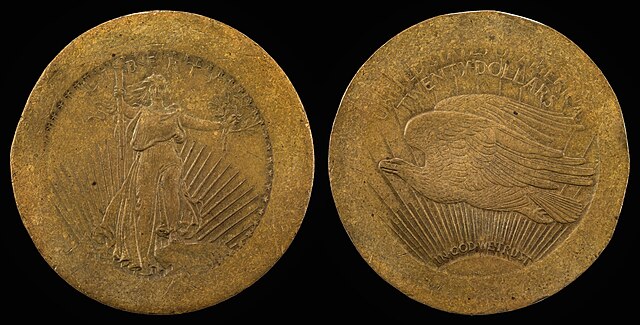
So that reminds me to my final point. Back in 1952, a mysterious envelope showed up at the FBI office in Washington, DC. The return address on the envelope said, Eliasberg, Baltimore, Maryland. And inside that envelope was a 1933 St. Godden’s Double Eagle Gold coin.
Louis Eliasberg was returning his coin to the FBI and the Secret Service.
But why?
Because there’s a worldwide hunt going on for anyone who owned one of these 1933 double eagles at the time. And nobody knew it back then. But Eliasberg had one. They were illegal to own. Hence the title of the great book by David Tripp that I was talking about earlier, that, “Illegal Tender,” book.
You should listen to my episode on the 1933 double eagle coin for that full story. But Eliasberg returned his 1933 double eagle. He voluntarily turned it in because he didn’t want to be on the wrong side of the law. So the Secret Service now had 10 coins accounted for. After this surprise, Eliasberg coin shows up in the mail. That was number 10. In the letter he sent with the coin, Eliasberg said, here’s the coin.
But if you don’t mind, I would really like it back for my collection. But it’s up to you. He did not get his coin back. The Secret Service kept the Eliasberg 1933 Double Eagle. They melted it down. And then the government at the time, they thought they had every 1933 Double Eagle accounted for. They knew there was one more out there and that was it. So case closed. But I don’t think Eliasburg was too concerned. My hunch?
Is that the greatest collector of all time knew that he could get another one… if he really wanted to.