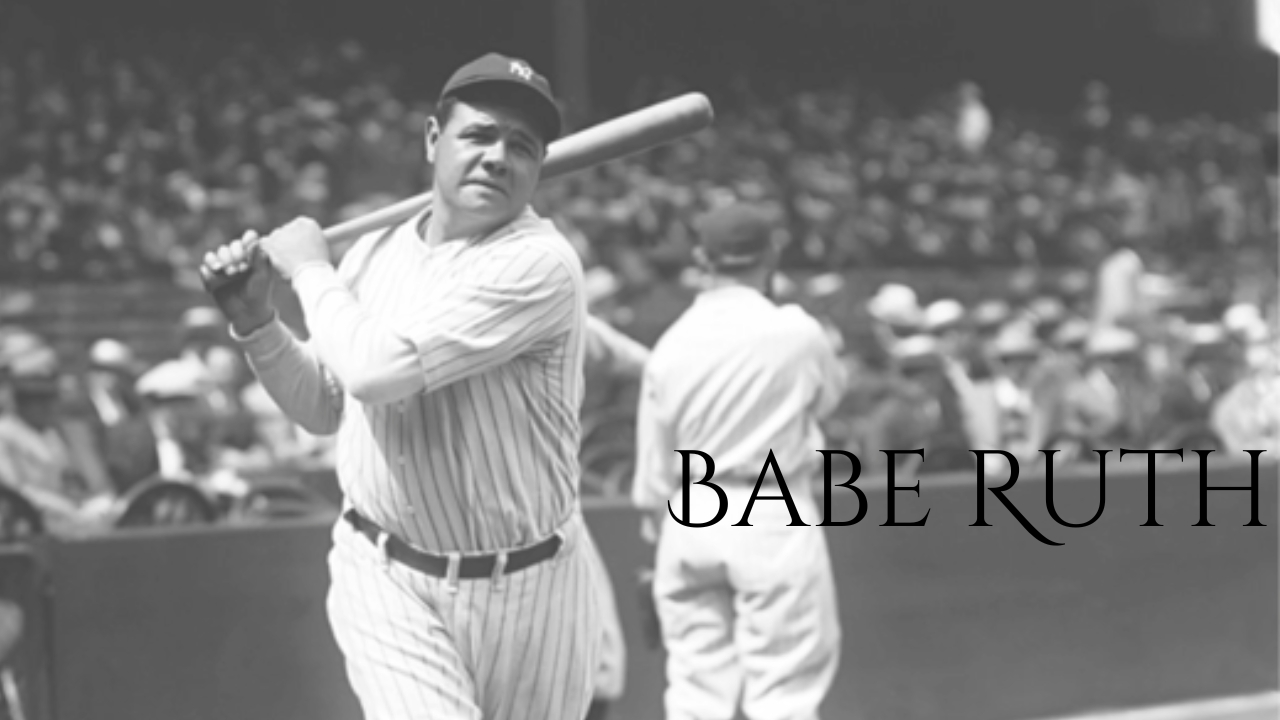
Babe Ruth
Before it was cool to create a brand, there was Babe Ruth.
He’s the all time original creator of a personal brand. So I have a really cool book here published all the way back in 1948. And we’re gonna get into the book in a second, but I remember hearing this phrase, and it might be one of my favorite ways to think about Babe Ruth.
Babe Ruth, Larger than Life
It’s that he had, “A profound human spirit to push boundaries.” And that’s a similar theme that we’ve seen with the other baseball legends. They push the boundaries of what anyone thought was possible at the time. They would just blow people’s minds with what they were doing and Babe Ruth did this maybe better than anyone in professional sports ever.
And his brand, how we think about it today, it might be the most recognized brand of any athlete ever. Another reason it’s been so much fun for me doing these episodes, there’s so many common themes with the old baseball legends I’ve done episodes on now. You see these same patterns over and over, which has been fascinating to see them come up.
Profound Human Spirit to Push Boundaries
So I have a few more common themes to share as we go along in this story. But first I got to get into this book I have right here. There’s a moment in the book when I realized this is it. This is the definition of the babe. He was larger than life. Like we were saying, the profound human spirit to push boundaries. So right here, I’ll set it up. Babe has just broke the record for most home runs in a single season. He broke his own record from the season before.
And the young George Ruth is now The Babe. The legend has been created and the babe no longer feels like he needs to travel with the team on the train to the next city because the babe has his own hot rod. He’s got a red Packard roadster, a sports car. Let’s just hear the story from the babe himself from his book. Here’s how he lays it out. He says,
“And traveling with the Yanks on short hops, nothing doing. I had long since forgotten the day when I bought a bicycle with my first paycheck from the Orioles and rode it around as proudly as any Indian prince ever rode a jewel studded elephant. But now with the Yanks, I had a long, low-packered roadster, painted a fire engine red, and there wasn’t any greater thrill in life for me than stepping on that baby’s gas.”
The Babe continues his story,
“During the 1921 season, I nearly killed myself and four others in that car. We had played the final game of a series with Washington and I had had a good day. Hug didn’t like the idea, but I told him I’d drive my car to Philadelphia for the next day’s game and get there before the train. I had Helen along with me, our coach, Charlie O’Leary, and a couple of players just outside of Kennett Square PA. I hit a turn too fast and we started to skid.
Finally we turned over and rolled like a ball, with bodies flying out of the car in every direction. For some reason, which I can never understand, if I lived to be a hundred, none of us was hurt. The car was completely wrecked. I just left it there and bought a new one. Incidentally, I hit a home run against the Athletics the next day, despite the fact that one newspaper had come out with a big headline story announcing my death.”
-Babe Ruth, from the book, “The Babe Ruth Story”
Just another day in the life of the biggest superstar athlete to maybe ever live! That excerpt I just read was from a book titled, “The Babe Ruth Story,” by Babe Ruth. I have a copy of this book right here. It was published in 1948. And I have an original first edition copy and the pages are falling out from this brittle binding as I turn the pages. But the book was a lot of fun to read.
The Babe Ruth Story
It was my second time reading this little book and on the cover it says, “The Babe Ruth Story,” by Babe Ruth. And then in small letters, it says as told to Bob Considine. And so this is a pretty common way that famous athletes would write their books back in the day. They would enlist one of their favorite sports writers to help them write and publish their book just to make sure everything sounded good. And then on this book, it says at the bottom, it reads, “my only authorized story.”
So this is Babe Ruth trying to put out his own story and it’s 1948 when this book was published. So it’s right at the end of Babe’s life. He ended up passing away in August of 1948. So him and Bob Considine had been working on this book leading right up to the very end of his life. And I did an episode a while back and it was all about the early years of Babe Ruth leading right up to the day he was traded from the Red Sox to the Yankees.
Creating “The Babe”
I wanted to tell the whole story of how this Babe Ruth character was created because in the early years, way back when Ruth was still in the minor leagues, that’s when he picked up the nickname, “The Babe.” And then his childhood was fascinating to read about. The orphanage in Baltimore where he grew up and it was what they did every day at this boys school that he grew up in. They played baseball every day. And that’s where Babe Ruth developed into this great ballplayer.
And then there was Brother Mathias. And he was one of the workers at this orphanage. And this guy, Brother Mathias, worked on baseball with a young George Ruth as a kid. And he became a mentor and an idol of Ruth’s as he grew up. And it was somebody who, in this book, Babe called Brother Mathias. He said he was, “The greatest man I’ve ever known.” So he gets really lucky with a great mentor, but he had a tough childhood. And so that’s kind of what I covered in the first episode, leading right up until this time.
Pitching for the Red Sox
So Babe Ruth is discovered out of this boys school, and he quickly moves through the ranks of the minor leagues. He was a superstar from day one, and then has this nickname that just sticks to him, Babe. And so Babe Ruth now, he’s still known as a pitcher at this point, and he’s playing for the Boston Red Sox.
And he’s just tearing it up as a pitcher. Then these Boston Red Sox managers, they’re watching him hit in batting practice. And the Red Sox are just like, we got to get Babe in the lineup as a hitter. Just look at this guy on the days he’s not pitching. It’s crazy to have this guy sitting on the bench when he’s not pitching. So, Babe becomes a hitter with the Red Sox and he starts launching home runs further than anyone had ever seen before.
Becoming the Slugger, Babe Ruth
He ended up setting the all-time home run record for a single season with 29 home runs while he was playing for the Boston Red Sox in 1919. And now a star is born. So Babe Ruth, he’s 23 years old and one might think he’s on top of the world. He’d already been a dominant pitcher for several years. He switches over to hitting, he’s breaking home run records. He’s getting paid $10,000 a year. One of the highest paid players at the time.
But this is just the start. In 1919, nobody, including Babe Ruth, would have any idea what would happen to his career and to baseball in the 1920s and 1930s. Baseball would boom in popularity and Babe Ruth was the force of nature driving the entire thing.
Babe Joins the Yankees
Because in the early 1920s, Ruth is traded to the New York Yankees in a blockbuster trade deal. And now he’s part of a team that’s on the upswing. They have a good team, but they just couldn’t crack through and win the World Series. And well, that would all change, of course. So I’m sort of picking up right where I left off with my other Babe Ruth episode. He lands at the Yankee Spring training before the 1920 season.
He doesn’t get off to a great start on the field. And of course the New York reporters are going to get all over him right away. So there’s some of this going on here with the press getting on him, but it’s not anything like my Ted Williams episode. If you listen to that episode, the sports writers and the hecklers just lived inside Ted Williams head, and drove him crazy almost. And so they’re on him early as a Yankee and he’s not picking up right where he left off with the Red Sox.
So there’s a story in here in the book on the babe getting heckled by somebody in the crowd at this time. And he actually goes into the stands to confront this guy. He says he was a small guy, but he didn’t run away. So once Babe got up close to this fan, as he’s going into the stands to get him, this little fan pulls a knife on him. So they get Babe out of the stands and luckily he doesn’t get stabbed by this crazy fan when he climbed into the stands.
Babe Was Not Afraid
I mean, Ty Cobb gets a lot of credit for physical altercations, but Babe Ruth is not afraid to get physical either. So the Babe doesn’t even give the sports writers a chance to get under his skin. He starts hitting right away. And remember, he’s coming off a season where he broke the all time home run record with 29 home runs the year before as a Boston Red Sox. Now he’s with the Yankees. And by the halfway point of the season, he already has 29 home runs to match his total with the Red Sox the year before and to tie his own all-time record.
It’s only halfway through the season, so the Babe creates this home run craze throughout baseball immediately after joining the Yankees. And now there’s an entire second half of the 19-20 season where every home run he hits is breaking his own record from the year before. So the fans are going crazy. And every day there’s a new home run.
It’s just like, how many is he going to hit? It’s uncharted territory and this goes on for months. So The Babe ends the season with 54 home runs and totally smashes his own record from the year before. And the home run, the long ball, it’s now part of baseball in a way that was never before experienced. All of these home runs, nobody knew it was possible to hit this many home runs. And everyone was now seeing how exciting it was to have the big slugger crushing home runs in every city he played in and setting new records. So The Babe says in his book, he says, “People were astonished to see 54 home runs in one season.” He said it was like if a player hit 200 in today’s game, which is he’s saying this in 1947. So he’s writing this book and he’s saying this is like 200 today.
Babe Ruth Redefining the Long Ball
And so home runs over time started to be more common, but he’s saying you have to understand how big of a number that was in 1920. 54 home runs was just totally unbelievable – until I did it. That’s what he’s saying in this book right here. And he’s right.
Now hardcore baseball fans know that there was a dead ball era leading right up to the 1920 season. And then the live ball era after that is what they called it. And that era where the baseballs were wound tighter, so they traveled further. This is right at the same time that marks the live ball era.
The Dead Ball Era is Dead
And we’ve talked about that back in my Ty Cobb episode. Cobb liked to point out how he was in his prime during the dead ball era. And if he would have been able to hit those juiced up baseballs, who knows how many home runs he would have hit. So Cobb liked to talk about the dead ball era that he had to deal with. And even the Hanus Wagner episode I did, same thing. He was hitting the mush ball, the dead ball era.
But one thing I like to think about, Babe Ruth led the league in home runs in 1918 and 1919 with the Red Sox. And he was still pitching and hitting back then. And think about this, in 1920, when The Babe crushed his own record with 54 home runs, the next closest player was George Sisler, who hit 19 home runs. They’re all using the same ball. If it’s a juiced ball or not.
The Babe had almost triple as many home runs as the second highest total! He hit 54. The next guy hit 19! Now in 1921, the very next year, Babe hit more than double as many home runs as the second highest total. I guess my point is this is not all about this juiced up baseball. This is The Babe. So let’s get into it. The next season, it would be bigger than the last. That’s a common theme with Babe Ruth. If it’s his home runs, his partying, his quotes in the papers, or even his annual salary, everything was bigger than the year before.
Crushing the Home Run Record
And that’s why all I can think of is that quote now when I think of Babe Ruth. “A profound human spirit to push boundaries.” And that’s The Babe. Larger than life. And it’s only just begun here. It’s 1920. He says in his book, he says, “I don’t think I’m bragging when I say I made the country home run conscious.”
And that’s exactly how it’s going to go right here. He sets the single season home run record in 1919 that nobody could believe, then breaks that record halfway through the next season in 1920. Finishing with 54, a totally ridiculous number of home runs up to that point. Totally unheard of.
The Yankees also crushed their attendance record with over 1.2 million fans attending games in 1920 at the Polo Grounds, their home stadium. Not only was Babe Ruth’s home runs breaking the Yankee attendance records, but fans from all over the country were traveling to whatever city Babe was playing in next, and those stadiums were also filling up.
He says in his book, after a game in St. Louis, he was introduced to three cowboys who rode their horses for three days across Wyoming just to catch a train to get to St. Louis just to see The Babe. He said it in the book. He said these were real cowboys with chaps and cowboy hats and spurs on their boots. All just to catch a glimpse of the babe hitting some home runs.
The Home Run Craze
Anyways, like I was saying, fans are in total disbelief at the Babes’ 54 home runs in 1920. But of course, they’re also thinking this, there’s no way anyone will ever come close to that number ever again. Not even Babe himself. It’s impossible. So what does the Babe do the next season? In 1921, he hits 59 home runs. Not only that, but the Yankees finally win their first pennant in the American League.
So if you see what’s happening here, for several years in a row, Babe Ruth is just redefining what anyone thought was possible with all these home runs. And this is great. I love these little details in these old baseball books that I stumble across. The Babe says, yeah, I got hot in the spring in 1921 and I never cooled off. And then he says, half of my 59 home runs I hit were off bad balls. He said he was swinging at anything close to the plate.
Locked In
Because no pitcher would ever throw him a strike. Which is totally understandable. Why would you throw him a strike? Think about Barry Bonds back in the early 2000s. He broke records for walks and intentional walks. Nobody would throw him a strike, just like Babe. And one of my favorite Barry Bonds crazy stats from back in 2004, Bonds had more hits that season than swings and misses. He had 135 hits, and he swung and missed 92 times the entire season! That’s nuts. So he was locked in.
So anyway, same thing going on here with Babe Ruth. And still manages to launch 59 home runs. And one more little detail that Babe brings up at some point. He says this was all before the ballparks were adjusted to be more home run friendly. Meaning later on the team owners saw how good it was for business to have these home runs at their stadiums.
So over time they began to redesign the fields. They would move the outfield fences in to increase the home runs. And this happened over a long stretch of time. So Babe Ruth mentions that he says, yeah, my records were before any of that. The fences were all the way out, way out. And I still broke records that still stand to this day, to the time that he was writing this book. So he was pretty proud of that fact.
Hard Ball
And another thing I love is when Ty Cobb’s name comes up in these old books. It happens a lot. And The Babe was telling a story about some old pitcher who just couldn’t get him out. There’s some Tigers pitcher named George – something. Here’s what he says. He says, “George, sure was my cousin.” Meaning like he owned him at the plate. He says, “George sure was my cousin. I drove him nuts. No matter where he’d pitch the ball high, low, inside or outside, I was able to belt it. Long hits off him always gave me a lot of fun. Ty Cobb was the manager of the Tigers by that time and every long hit I made was a personal insult to him. He’d run in from centerfield to tell the pitcher what to throw me, but that would only make me more determined to slug the ball.”
So Ty Cobb is out there in centerfield as a player manager, just going crazy trying to get Babe Ruth out and he’s telling the pitcher not to throw him anything good to hit. And then of course, Babe is launching him out of the park anyway on this poor pitcher, George – whoever he was.
So now that with the Yankees winning their first pennant in the American league, the town of New York is going crazy. Baseball fever.
And so the New York Giants win the pennant in the National League. And back then it was the Giants were the powerhouse team in New York. It was the Yankees who were second fiddle. And that’s how Babe put it. But this is a big deal for the Yankees, even just to make it to the World Series. The first time they ever made it this far. And I’ll just spoil the suspense right here, but the New York Giants would win the World Series in 1921. And then they beat the Yankees again in 1922.
New York’s Team
So was two years straight of getting really close and losing to the Giants. But one thing Babe talks about, the Yankees were starting to earn their respect and they were drawing more fans to their games than the rival Giants across town. And so of course, the New York Yankee owners see this happening and now the plans are laid for the new Yankee Stadium. That’s why it was called, “The House That Ruth Built.”
Let me give you another example of why I think about this phrase now every time I think of Babe Ruth, it fits him perfectly. He was, “A profound human spirit to push boundaries.” You don’t become the most popular and well-known name in sports around the world, maybe still to this day, by just hitting home runs and breaking records on the field. He’s not just pushing boundaries in the baseball record books. He’s doing it in every aspect of his life.
After the 1921 season, the Yankees lose to the Giants. But The Babe is not finished playing. He goes on this barnstorming tour, is what they called it. These were like exhibition games where famous players would hit the road and play games around the country. It was almost like a concert tour, how a band would travel and play shows. And this was a great way for players to make some extra money in the off season.
Judge Landis, the Commish
But now the new commissioner of baseball, this guy named Judge Landis. He put a new rule in place that outlawed barnstorming tours. And this is another fascinating character, by the way, Ken Landis. He was appointed as a judge by President Theodore Roosevelt. And I just did my episode on the Saint Gaudens double eagle gold coin, and how Theodore Roosevelt was the force of nature behind that redesigning of U.S. coinage. And this is Judge Landis. He was part of Teddy Roosevelt’s trust busting back in the day.
He was the judge that fined Standard Oil $29 million for the rebates they were paying out on the way to John D. Rockefeller’s monopoly. Anyway, later on, this Judge Landis ends up as the very first commissioner of baseball.
So there’s the 1919 White Sox scandal that breaks loose. So they bring in Judge Landis to create some law and order in baseball. And it worked. Baseball survived the White Sox throwing the World Series.
But they have this Judge Landis as Commissioner. So anyway, back to The Babe. Landis lays down the law on these barnstorming tours. And it turns out The Babe really enjoyed these barnstorming tours and he’s going to do it anyway. He didn’t like the rule. He wanted to make some money and he wanted to hit the road and play some exhibitions. So off he goes.
And of course you’re running into Judge Landis. He’s not going to take anything from anyone, even if it’s Babe Ruth. So they suspend The Babe and fine him for this barnstorming that he did. And it was a pretty big controversy to suspend the biggest name in all of baseball, but The Babe is fully aware of his popularity by now and he’s going to push boundaries. That’s what he does, in every sense of the word and he’s already doing it in 1921.
Babe Pushing Boundaries
So now we come around to the opening passage that I read at the beginning of the episode. The Babe is the biggest thing anywhere. He’s pushing boundaries, of course, and he’s captivating the fans around the country. He’s getting offers to appear in movies. He’s getting endorsement deals. Everyone wants to get close to The Babe. He has to sneak through the janitor’s entrance just to get in his own apartment because of the crazy amount of attention he was drawing.
The Babe is making a lot of money. And he says in his book, he was as good at spending his money as he was at making it. In his book, he called himself, “The boy spender.” When the Yankees traveled, the team stayed at a $3 a night hotel. The Babe went to a separate hotel and he stayed at the $100 a night suite.
So this is how The Babe was rolling. And this is a quote I read at the beginning. He had his own red Packard Roadster. And you could probably call this a supercar back in the day. I’m sure this thing was the fastest car you could find. And he would drive it to the next city instead of taking the train with the rest of his team. He just did whatever he wanted to do. That’s what he did. That’s how he rolled.
The Most Popular Athlete Ever?
And that’s a lot of the attraction with Babe Ruth, how he was able to do whatever he wanted, say whatever he wanted, and he was still the most popular athlete in the world. Larger than life. Everyone loved him. The kids went crazy just to touch him. Everybody wanted to be near Babe Ruth. And he was just larger than life. He would maybe drink too much. He would stay out all night. He’d get into confrontations with his coach, with other players. He crashes his car. Everyone goes flying out. Nobody gets hurt. He’s almost like this untouchable force. Nothing can stop him.
But this is one of the times in his book, and there’s several of these moments in his book where he talks about how he might have been hanging out with the wrong crowd. And maybe he was staying out a little too late. His late night excursions are better documented in other books in much more detail, too.
I have another book, I think it’s called, “The Big Fella,” by author Jane Levy. There’s a lot of books with a lot of details of specifics with The Babe. But what he’s admitting to here in his book, he’s getting at, he realized he wasn’t acting like the greatest role model for the kids. And he does bring it up several times. And you can really tell that he did have some regrets looking back on his younger days.
So now The Babe struggles a bit after this monster season in 1921. He’s starting off the next season suspended for barnstorming. So he only hits 35 home runs and they lose to the Giants again in the World Series. But he signs a new contract for $250,000 over the next five years. And that makes him the highest paid player in baseball. So he puts it like this in his book. He says of the Yankee team of 1922, he says, we played to the hilt.
But he said, “We had more than our share of night riders.” “We kept a couple of Jersey beer barons rich.”
Learning Life’s Lessons
So he’s larger than life on the field and off the field. But how The Babe says it, 1922 was a good thing in the end because he realized he should be a better role model for the kids. So he’s probably learning he needs to dial it back a little bit. 1923, he comes storming back.
Leads the league with 41 homers, and then he calls this one of his greatest honors. He wins the American League MVP award with 64 out of 64 possible votes. A unanimous decision for MVP. And that was only the second time a player had gotten all 64 votes for MVP. The only other time was when Ty Cobb did the same thing in 1911.
Of course, the Yankees would finally beat the Giants in the World Series that year too for their first ever championship, finally dethroning the Giants after all those years. Not only are the Yankees world champions, but there’s a young guy that Babe meets for the first time in 1923. Lou Gehrig was invited to join the team just for a few weeks and The Babe has a lot of nice things to say about Gehrig in his book.
You’ll have to check out my Lou Gehrig episode I did a while back, but this would become the greatest hitting duo in baseball history. Babe Ruth and Lou Gehrig. And this is the start of it. So that’s one of my favorite things about doing these stories on the baseball legends, is that now after a handful of these episodes, each story starts to intersect with another one. Babe Ruth and Lou Gehrig. Ty Cobb and Babe Ruth. Even my Ted Williams episode had some Ty Cobb stories in there.
Ty Cobb and Babe Ruth, Two Originals
It’s a lot of fun to see these baseball legends from all different perspectives, from the perspectives of other baseball legends. So that’s been an unexpected thrill from doing all these stories. It’s really a lot of fun. And one of the things I’ve noticed when the stories intersect with Ty Cobb, there’s sure to be fireworks. It’s like the same perspective from everyone when we’re talking about Cobb.
Here we go.
Ty Cobb is a player manager in center field. The Detroit Tigers and the babe tips off his Yankee teammate Bob Musel that they’re gonna bean him and he sees Cobb call for the bean ball from center field. Sure enough Musel takes a fastball right to the back and immediately he throws his bat at the pitcher and he charges the mound. All hell breaks loose.
Cobb tears in from center field into the melee. Babe tries to take him out. Everyone’s throwing punches. Cobb and Babe are going at it. Then the crowd storms the field. Thousands of fans pour onto the field to join the brawl. They’re fighting police, the players, other fans.
So in his book, The Babe says, here’s his quote about the crazy scene. He says, the fans, “Even ripped seats out of the grandstand and threw them into the general fight.”
So the game is canceled. They can’t clear the field and they just cancel the game. What a wild scene, but the game was so much rougher back then as you learn and read these old books, which is so much fun.
But why am I not surprised that Ty Cobb is in the middle of this pandemonium? Just go back and listen to my Ty Cobb episode if you want to get an idea of what Cobb was all about. I can say this, in my Ted Williams episode, I said Ted Williams had a special blend of intensity that made him one of the greatest players of all time. Well, Ty Cobb was beyond intense.
Anyway, The Babe says after this game with the brawl in it, he says the fans packed the stadium the next day, totally sold out. He says the fans, “We’re hoping for a repetition of the battle royal, but all was peace and quiet.”
Baseball in the 1920s
So that gives you a taste of the passion and the popularity and the craziness that baseball is experiencing right now. The game is becoming so popular and The Babe is the king of this entire scene.
Once Lou Gehrig joins the club and starts playing full time, the Yankees are on their way to forming one of the greatest, if not the greatest teams of all time, the 1927 World Champions. They sweep the Pittsburgh Pirates to win the World Series. They dominate from the very start.
And Babe Ruth breaks his own season record that year by hitting 60 home runs. With Lou Gehrig batting fourth and Babe Ruth batting right before him, The Babe has a chance at seeing some better pitches. No pitcher wants to face Gehrig with runners on base. It just improved the odds of getting a strike to hit for The Babe. And then in his book, the Babe says he wouldn’t have broken his home run record without Gehrig hitting right behind him in the lineup.
There’s a cool story in the book about the 1927 World Series and The Babe said they won that series the day before it started. And what he meant by that is they arrived early to Pittsburgh for game one and as the Yankees are taking batting practice the Pittsburgh players decide to get a look at their opponents.
And this was the first time many of the pirate players had seen the New York Yankees and the way he describes it they were putting on a hitting display almost every pitch was crushed into the stands. And all with the Pittsburgh Pirates watching. And so as the story goes, the Pirates players just sort of squirmed away from the stands, shaking their heads like they just knew they had no chance.
And they didn’t.
They got swept in four games. In his book, The Babe calls his 1927 Yankee team the greatest ball club that ever stepped onto the field. But the next season, not bad either. Another World Series victory for the Yankees and another four game sweep.
The Greatest Team Ever Assembled
So it’s back to back, four game sweeps in the World Series for the Yanks, 1927 and 1928. Babe hits three home runs in game four of the 1928 series. His second time hitting three home runs in a World Series game, by the way, and he said the train ride back from St. Louis after the Yankees second World Series title in a row, he said, “I doubt if there ever was another train ride to match our wild ride out of St. Louis on the night of our great triumph.”
So knowing what we know now, can you imagine that train ride? These guys knew how to celebrate. There’s no doubt. And you can read more detailed accounts of all of that in other books. But in his book, the babe still very subtly, he lets you know that him and a lot of his teammates definitely knew how to celebrate.
So this was an awesome book to read. My second time through it. And it’s such an easy read too. I strongly recommend checking it out. Any baseball fan would love this book. There’s some more good Ty Cobb stories, of course. They’re always good. Anytime Ty Cobb comes up in a book, you have to read it.
And of course, lots of great details on Lou Gehrig and how much respect the babe had for Gehrig. And so I love reading about that.
Legends of the Game
And then there’s the common themes that we see now in the other baseball legends I’ve done episodes on. Many of these legends were coming from almost nothing. Very poor and humble childhoods for a lot of these guys that would become legends.
Lou Gehrig had immigrant parents just scraping to get by in New York City. Ted Williams had almost nothing growing up in San Diego. Honus Wagner, Mickey Mantle, they all had very humble beginnings. And of course, The Babe grew up in an orphanage.
And so the common themes just start to pop up. And that leads me to the next one I’m starting to see over and over. There’s a dedication and a relentless practice of the craft starting at a very young age. Mickey Mantle – his dad and his grandfather were working on his hitting from almost the day he could walk.
Hanus Wagner quit school and he started working in the coal mines with his dad when he turned 12 years old. But he had the love of baseball. So other than mining coal as a kid, Hanus Wagner played ball. He said, “All I lived for was baseball.”
Babe Ruth had Brother Mathias at the boys home like we talked about. He drilled him for hours and hours on pitching and hitting and correcting his mistakes. Babe was just a kid, and he had this amazing mentor, Brother Mathias, who took him under his wing.
I’m No Natural
People like to say somebody’s a natural talent, like they were born with a gift. And they say that sometimes because it just explains the whole story with that easy word, “Natural.” But what I’m finding is – the baseball legends worked as hard as anyone else.
My favorite example of this is both Ty Cobb and Ted Williams. They would snap back at reporters when they would call them naturals. This happened 30 years apart. These guys played 30 years apart from each other, but they both reacted the very same way to that word.
They’d say, there’s nothing natural about what I’m doing. I worked my ass off since I was five years old. Ted Williams goes on about this in his book. He said, he said, “I wanted to be the greatest hitter who ever lived, and nobody worked harder at it.” And then he would say this to, “It was the center of my heart hitting a baseball.”
So you can see here how they might have a problem with people telling them that they were lucky because it just all came natural. So that’s a common theme over and over again.
The Cultural Icon
As many common themes as there are, one thing we see is that the truly iconic legends, they have their own unique style. Babe Ruth was a cultural icon. He was pushing boundaries of what people thought possible in almost every way.
Lou Gehrig though, totally different. He was known and admired for his quote, dignity and high resolve is what they wrote about him. Then you look at Honus Wagner and he was known as a gentle giant, almost like a folk hero and everybody loved him. And then there’s Ty Cobb and they wrote about Cobb. They said he was, “Brooding and bubbling with violence.” And, “Combative all the way.”
So completely different and unique personalities here. And then there’s Ted Williams. Hated to conform. He didn’t care to socialize at nightclubs all night with his teammates, but he was as intense as anyone who ever played.
There’s so many common traits that I’m seeing over and over. But then the totally unique styles that made these legends so memorable.
When the Music’s Over
Wrapping this thing up. So as Babe Ruth gets older and his playing days are up, he wants to stay in the game as a manager, but the Yankees were not interested. Babe was really disappointed he couldn’t get hired as the manager of the team.
The owners told him, look, you could barely manage yourself all those years. How can we trust you leading our entire ball club? Like they saw this guy just run wild for over a decade. How could they take him seriously as a manager? And then Babe would just say, look, I’ve been through it all. So now I know the ups and downs and I’ll be able to relate to the young players and help guide them and keep them out of the same mistakes that I made.
The Phone Didn’t Ring
He was trying to talk his way into this job as the manager of the Yankees, but the ownership was just like, “No. Forget it. You’re not going to do it.” And that really hurt babe in the 1930s as he’s trying to line something up for after his playing days.
And at the end of his book, he says it like this, “I felt completely lost at first. I thought I’d wake up and find it was a bad dream. And when it became apparent that it wasn’t a dream, I felt certain that the phone would ring and it would be the Yankees or some other big league team in search of me, telling me it was all a mistake. But the phone didn’t ring.”
So that’s another big common theme here we see with the old baseball legends. When the music’s over, that phrase is just what pops into my head. I start to hear Jim Morrison singing that song at the end of these stories. The owners want to move on. They want to find the next Babe Ruth. They were not focused on preserving anyone’s legacy. They were thinking into the future. Who’s the next big star they can find to pack the seats of their stadiums and win games?
So this same thing happens to all the baseball legends and they struggle with it. It’s Honus Wagner, Ty Cobb, Ted Williams tried to stick around as a manager for a short time. It didn’t go well for him.
Mickey Mantle. He really struggled with life after baseball and how to organize his businesses and his investments. So that’s one of the big takeaways after reading these books. Even the most legendary baseball superstars, all that work to be the greatest. Then to stay on top. Fight to get paid what you’re worth the whole way through. Deal with the media, and the crazy fans. Try not to go crazy from it all. And then it wasn’t without pain and disappointment and frustration at the end, once it’s all over.
Life After Baseball for Babe Ruth
So these are not fairy tale stories, I guess, is one of my big takeaways so far. And that wouldn’t be a big surprise for me before I started doing these episodes. Even for Babe Ruth, he’s pushed out in the end. He was actually fired.
The Babe was a guy who pushed the limits his whole life. Like I said in the beginning of the episode, he had a profound human spirit to push boundaries. He did whatever he wanted to do, anytime he wanted to do it, and have everyone in the world recognize you. And then suddenly it’s over, and they find out they lost that superpower that they had.
But the legend of Babe Ruth, after reading all about the Babe, I can start to get a better picture in my head about how big he really was at the height of this craze, which lasted over a decade.
Larger than life doesn’t even seem like it describes it enough. Can you imagine those first few years with the Yankees? He’s breaking his own home run record year after year, just melting people’s minds. Double and triple the home runs of anyone else in the league. A profound human spirit to push boundaries. I like that phrase.
Babe Calls His Shot
One thing I didn’t get into, but The Babe tells his version of that famous “called shot,” against the Cubs when he famously pointed to the outfield with his bat or with his hand or whatever it was. Then he hits a home run to almost that exact same spot he pointed. That’s a great story how The Babe tells it.
And there’s a lot to that story. I could almost do an entire episode on that called shot story because it wasn’t the only time he called his shot and he describes each one.
If you didn’t know any better, you’d probably say that was a made-up story. But after reading all about The Babe, you start to figure out that these amazing tales are true.
One thing I was thinking about, if Babe Ruth was alive today, one thing I know is he’d be a great follow on social media. And I’m sure he’d have 500 million followers. And I’m pretty sure the bio in his profile would say, “You can just do things.”