
Racing with the David Brown
Racing with the David Brown Aston Martins
09.24.2025
“It’s a nice coincidence, I feel, that Racing with the David Brown Aston Martins should be published in June 1980, 21 years after our Le Mans victory. It’s a fascinating book, told in John’s lucid, no-nonsense style, and reading it has brought back a flood of happy memories. I’m convinced that the Aston Martin team had about it an atmosphere quite unlike any other. And for that, much of the credit must go to John. Somehow he molded a bunch of disparate personalities into a cohesive unit so that even though we weren’t the most successful team, until the very end, lot of fine drivers and mechanics were nonetheless only too happy to be part of Aston Martin.”
– David Brown, Monte Carlo, Monaco, March, 1980
And that’s the opening forward from this really cool old book that I have, ‘Racing with the David Brown Aston Martins,’ published in 1980.
The forward is from Sir David Brown himself, he’s laying out his thoughts on the book. And he mentions John in the opening quote I just read. He’s talking about John Wyer, one of the greatest racing team managers of all time.
The main reason I wanted to read this book, it’s because the book is straight from John Wyer himself. He’s telling the entire story of the David Brown Aston Martins when he managed the team back in the 1950s.
The David Brown Aston Martins
I’ve been learning a lot about John Wyer in my car creator stories I’ve been doing. I have an episode on the Porsche 917. And of course, John Wyer is right in the middle of that story. And ever since then, I’ve been searching for the best old books on this amazing character.
I read that opening excerpt from the book because David Brown mentions something in that passage that was my favorite part of this story. He said, “I’m convinced that the Aston Martin team had about it an atmosphere quite unlike any other, and for that, much of the credit must go to John.”
John Wyer and Aston Martin
The coolest part of the story to me was to hear John Wyer explain the dynamics of the Aston Martin team and how he kept this crew together and his thoughts about how he managed a racing team. So we’ll get into all that in a second.
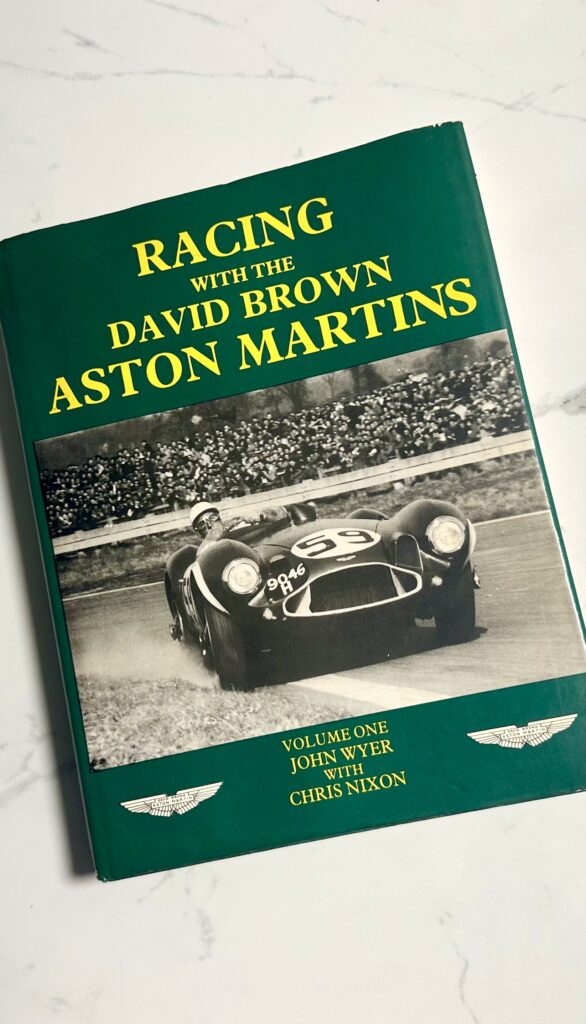
This story also covers the very beginning of the iconic Aston Martin car brand, how it started, and then how David Brown found a race manager for his cars, and how John Wyer managed to deliver the very first ever victory at Le Mans for David Brown. So the book goes through every race, year by year, straight from the old log books and notes of John Wyer, every single detail.
The Aston Martin Story
And when it comes to racing, like we talk about in a lot of my episodes, the car creator stories and the racing stories are not really about victory. And looking back just on the surface, it could seem like it’s all celebrations and success, but why love doing these episodes over and over again?
These stories are really more about failure. It’s brutal. Years and years of work. Then the transmission blows out! These stories are about long-term goals and then just getting pounded with surprises and things going wrong and setbacks, but then it’s constant iteration and overcoming problems and challenges and never giving up. Then, and maybe if you’re really, really lucky, somehow you might taste a tiny bit of victory at some point.
These car creator stories are all about the people who somehow held it together long enough to find some sort of success. That’s what I’m learning about reading these really cool old racing books. It doesn’t have to be racing. We find these types of stories everywhere, but they can be really inspiring, which is why I think it’s important to look back and try to find out exactly what happened here.
David Brown and His Aston Martin Purchase
We have this iconic car brand, Aston Martin. We know that David Brown had something to do with it. He was the businessman who built up this brand. But what exactly happened? How does a brand like Aston Martin rise up to this iconic level that we all know about today?
Because it’s the story. There’s always a great story behind an iconic car brand that lasts 70 years like Aston Martin has. And a lot of the best parts of the story are buried inside these old racing books. So that’s what I’m having fun with doing these episodes.
Before I get into the races and the grueling effort to achieve this ultimate goal, to win the 24 Hours of Le Mans, we have to go back to the beginning. How did these two meet up? David Brown and John Wyer. We got to go back to 1946 when David Brown, he’s already a successful guy working in the family business, but he’s flipping through a newspaper and he sees an advertisement for a car company for sale.
The Aston Martin Name
So he checks it out and he finds out the company for sale is Aston Martin. And he says even back in those days, Aston Martin was a car brand that he recognized. He said in the book, even then it was quite a name. So he’s surprised to see this car brand for sale. And then he says, more or less, he says, just on a whim, he buys Aston Martin for 20,000 pounds. And David Brown adds, he says 20,000 pounds was a lot of money back then.
But now he owns his own car company and he’s got a prototype car that came along with it. It was called the Atom. This car handled pretty well but didn’t have much power. Along with the Atom model car, he gets some old rusty machine tools and then the car’s designer came along with the deal, this guy named Claude Hill.
David Brown Buys Lagonda
Just a few months later, David Brown comes across another company for sale. He buys Lagonda, and combines his two companies. He buys a few airplane hangers and he moves everything into these hangers with some of the machinery. Then he hires a race car driver, Jock Horsefall, to help out Claude Hill. What happens next really kicks off this little endeavor for David Brown and lights the fuse.
These two guys put a couple thousand test miles on the Atom prototype. There’s a few other drivers that test the car out. And now there’s a small group of racers getting a little excited about this car.
So they asked David Brown if they can enter the car in the Spa 24 Hours race coming up just a few weeks away. So DB, that’s what they call David Brown, DB. So at first he says, this car’s not powerful enough yet. Let’s spend some time and get some power into this engine. But then finally he’s like, go ahead, just give it a shot. Let’s see what happens. So they enter this race and they end up winning the Spa 24 Hours in this underpowered Aston Martin. Jock Horsefall and Leslie Johnson.
They win first place with this 2-liter car and David Brown is shocked. But now they want to crank it up a notch. Of course, like every racing story I’ve done so far, they always want to crank it up. It’s always about the next iteration and the next car, the next race.
So they get started right away on this new 2.6 liter engine for the 1950 racing season. And what else does DB know that he’s gonna need? He’s gonna need a manager for his race team if he’s gonna have a serious operation. And he just happens to notice this guy, John Weier, who was running a race team for Dudley Fallen at the Spa race. John Wyer catches the eye of DB working down in the pits. And so DB asked John Wyer, come and manage my Aston Martin team just for one year. Give it a try.
Landing John Wyer
And so John Wyer, he says, okay, as long as it’s for only one year, I’ll do it. How the book describes it, he says, I’ll do it for one year. And then it says, quote, I’ll have to get down to some serious work after that. Little did he know at the time, but this would be a partnership that would last 13 years and create one of the great all time racing stories. It starts out with this little provision, that it’s just only for one year.
So DB hires John Wyer to run his racing team and they have a lot of work to do. This is my favorite part of the story. Like I said earlier, John Wyer would go on to become an all time great racing team manager, but this is where it all started for him. This 13 year partnership with David Brown and Aston Martin. He credits this time for setting himself up and giving him the valuable experience to go on and do everything else he ever did in his career.
Hearing John Wyer describe the challenges of managing a race team was my favorite part of this book. This dynamic came up over and over again. It’s really cool to hear one of the great team managers talk about the very beginning of his career. Here’s John Wyer talking about it in the book. He says,
“In 1950, I was very new to the game, probably due to reading too many books by Sammy Davis and Sir Henry Birkin. I had the idea that you formed a team of drivers. All whom became jolly good teammates, prepared to sacrifice themselves for the common good, play a straight bat and behave themselves. I could not have been more wrong.”
– John Wyer
So here we go. Wyer gets into it. Think about the great coaches in sports or any top CEOs at a company or a top leader in anything. They’re great because they’re surrounded by other super talented people. Imagine Phil Jackson back in the day, trying to coach Michael Jordan. You think Phil had a few challenges and keeping all the players in line and trying to keep great players happy and motivated managing giant egos is not something that comes naturally for most people. So how do you learn to do it? You just dive in head first. So John wire talks about his experience. He keeps going in the same passage. He goes on.
“One of the first things I discovered was that there was always tremendous rivalry between the drivers. There was a good deal of jealousy if one driver thought another had been given a better car and so on. It came as a bit of a surprise at first. But it must have been very naive because just by definition, motor racing is an extremely competitive sport. One of the most difficult and dangerous activities in the world and it calls for very exceptional people. If they are any good, they’re not going to lie down and do as they’re told. They must all be great individuals. Otherwise they just wouldn’t be top class racing drivers.”
John Wyer Learns to Manage
So this is John Wyer here. Think about this. David Brown wants to find the best race car drivers for his Aston Martin team. And Wyer needs to manage this crew that DB is out rounding up. Well, he’s saying if they’re any good at what they do, if they’re exceptional, they’re probably not going to lie down and do whatever they’re told. On top of that, he says motor racing is by definition an extremely competitive sport.
And it’s very difficult and dangerous. By definition, you’re going to have a bunch of very unique people here and trying to get them to work together as a team. That’s something that he didn’t think about much, he says, until he’s right in the middle of it. And here he goes. Here’s one of many stories he tells in the book. So here’s a great example. He says,
“All this manifested itself very early on in the tourist trophy in 1950. Clearly, Lance Macklin was the best driver we had, although it was generally accepted that, in as much as we had a number one driver, it was Reg, due to his greater experience. In the Tourist Trophy race, Reg and George made good starts, but Lance was left behind and in the opening laps they came past the pits. Reg and George side by side and Lance trying to find a way through. The weather was appalling and after trying to get by for 10 or 15 laps, in the blinding spray, Lance gave up and finished some way behind them.”
So gotta jump in here. These are all members of the Aston Martin team here during a race. Lance, Reg, and George. And so Wire keeps going with his story. Says,
“After the race, the only thing Reg and George could talk about was not the race itself, but how successful they had been at bottling up Lance and keeping him back. This rivalry within the team always existed and I tried to prevent it from being detrimental to our efforts. But think the only way one could have stopped it would have been by having a team of robots. If you want good drivers, this rivalry is something you’re going to have to expect.”
End of story. So I love this example because the more I learn about John Wyer, I’m finding out how respected he was as a manager. So this is clearly one of the reasons he was so great at managing a race team. Like I just read, he said he must’ve been very naive when he started out.
Challenging John Wyer
He thought it would be like an all for one, one for all type of a deal. And then it clicked pretty early on and the drivers were a different breed. And he made that adjustment pretty quick. He was constantly trying to figure out how to contain these personalities and corral the team and keep them going all in the same direction. Knowing that the only alternative was to just find a bunch of robots.
So this sounded very familiar. Way back, I did an episode on Scuderia Ferrari, and how Enzo started his racing stable, the Scuderia. I have that book by Brock Yates on Enzo and in that book, one of my favorite quotes that sticks in my head about Enzo. But I thought about it again here when I read about John Wyer trying to manage a bunch of race car drivers back in the 50s. Enzo was doing the same thing at the same exact time. He’s trying to manage his Scuderia, his stable of race car drivers. He did it maybe longer and better than anyone else.
Enzo even described himself like this. think the quote was like, “I’m not an engineer. I’m an agitator of men and machines.” Something like that. That’s how he described himself. But in that Brock Yates book about Enzo, it said,
“Ferrari was learning the art of manipulation with his drivers as well. How the subtle suggestion, the offhand remark, the critically timed slight might make a man drive all the harder. Enzo Ferrari was on his way to becoming the consummate manager of men, not docile, soft-willed men, but proud, fiercely competitive, egocentric men whose livelihood, if not their very reason for living, depended on this most demanding and unforgiving of sports. If any man understood the dimensions of that unique human weakness the Greeks called hubris, it was Ferrari.”
And so that’s one of my favorite quotes about Enzo in that Brock Yates book. And John Wyer is with this exact same thing, and he’s learning on the fly. David Brown wants to win the 24 hours of Le Mans. They’re going all in on this ultimate goal and building up the Aston Martin team. And as they get better drivers and better engineers and mechanics.
Wyer’s finding out exactly what Brock Yates was saying about Enzo. How to manage not docile, soft-willed men, but fiercely competitive, egocentric, proud men. Drivers who maybe their very reason for living was to race cars and John Wyer is getting his start, learning how to pull this off with Aston Martin.
Down to the Business of Racing
Now, so with a racing team that spends months and months together, pretty much nonstop, there’s going to be plenty of crazy stories and lots of laughs. And Wyer tells a few funny stories about when the team gets to relax and have some fun. He says at times the Aston Martin team was like a bunch of overgrown schoolboys, with constant ribbing going on.
But this book is about David Brown’s Aston Martins and the goal to win Le Mans. And that’s no joke. If you’ve ever watched old interviews of John Wyer on YouTube, and you got to check these out, there’s a few great ones. If you’ve seen them, you know what I’m talking about. This guy was dead serious about racing. So he knew when to let the guys have a little fun. But John Wyer was all business on the track. I like this passage in the book. It says,
“You may feel when reading this book that life with Aston Martin was so much fun that the serious side of motor racing was neglected. I must correct that impression because when the team got down to its real business racing, it became the most efficient organization of that period. All the members of the team had been handpicked by John Wyer for their particular qualities and the result was a team that was envied and feared by its competitors. At times John could prove extremely difficult, rude and cutting in the things he’d say, and many of the team members, not least the drivers, suffered under his scathing tongue. He could be impossibly demanding, and yet after the dramas, the team got back onto an even keel and everything was both forgotten and forgiven.”
And so that was a quote from one of the drivers, Roy Salvadore. He’s talking about that great balancing act by John Wyer. Tough with the scathing tongue, but then getting the team back to an even keel so they could move on. Salvadori was the longest serving driver of the Aston Martin team, so he wrote one of the intros at the beginning of this book. I went back to read it and it really captures what John Wyer meant to the Aston Martin team.
Here’s how Roy Salvadori laid it out in his introduction in the book. He said,
“I am both happy and most surprised that I have been given the opportunity to pay tribute a very exceptional man whom I consider to have been the finest team manager of my era. I know that some of the Aston Martin drivers, and I include myself, were offered more lucrative racing contracts and more potent machinery to drive. Yet the offers were turned down simply because no other team could offer the camaraderie, security, and contentment that existed in the Aston team. Above all, we had the greatest admiration and affection for this man. His appraisal of the opposition’s cars and drivers was so accurate, his race plans so near perfect, that you might be forgiven for thinking he had prepared them after the event. His control over his drivers was always absolute and his humor on the right day, positively superb. As on the occasion at Le Mans in 56, when he was informed that two of the Jaguars had been damaged in a shunt in the S’s. “Nothing trivial, I trust,” said John.”
That was Roy Salvadori, one of the drivers. And he’s thinking back on John Wyer in the book. He’s saying his race plans were so perfect, you might think he prepared them after the race. And then during during Le Mans, something happened to the rival Jaguar cars at one of the turns. They tell John Wyer about it he says, nothing trivial I trust. Meaning like, hopefully there’s a damage to the Jaguars.
Racing Failure and Frustration
I’m learning with every new car creator story. I mentioned this earlier. It’s a lot of failure and setbacks and problem solving. So when John Wyer tells the story in detail, you come away with a totally different view that most people have of the David Brown Aston Martins. And I say that because I’ve heard this several times in the past. They say John Wyer led the team to victory at Lamon and it was Aston Martin’s finest hour.
And you probably heard that phrase, it’s a true, I guess, but there’s over a decade of heartache trying to win this race. As I went year by year through this book, I started to wonder if they were ever going to win Le Mans. And I already knew the answer. I just couldn’t believe all of these struggles that they had. John Wyer starts out a chapter halfway through the book. He just goes in the first sentence, he says,
“I might as well start by saying that 1954 was a complete disaster.” – John Wyer
That’s how he starts off chapter six. And of course he immediately takes full responsibility for the entire year. He says, basically there was a lot of excuses I could come up with to tell you why it was a disaster. Then he goes, all those excuses would only quote, touch on the periphery of the problem. He says the main reason for the team’s failure, it was just trying to do too much with not enough resources.
They only had about 50 engineers at the time, which wasn’t enough to design a new car to replace the DB2 car, which was getting a little outdated. They were designing the DB3S at the time. And also they were designing the 12 cylinder Lagonda. But then John Wyer says in the book, says, essentially the fault was mine.
He says he should have spoke up and focused the efforts, either on the racing program or just stop racing completely and then focus on the development. So the 1954 season was a big setback. At one point they lost all five cars. A few of them had mechanical failures and then three others were wrecked in crashes.
This is a huge turning point in the roller coaster world of auto racing. John Wyer and the Aston Martin team, they’re sitting back in England. They’re inside the shop full of busted up cars. Wreckage all around him, wondering which way to go from here.
They’re pretty beat down at this point. Wyer recommends they withdraw for the rest of the season and regroup and start planning for 1955. He thought that was the best thing for everybody. DB saw it differently. David Brown in the book. Wyer explains it like this. says,
“This didn’t suit David Brown at all.”
“No, I don’t agree,” he said. “This is the time when you get back into a race as quickly as you can.”
“I pointed out that we hadn’t any cars left.”
“That’s your problem,” he said. “But I do insist that we get back into racing rather than just retire hurt.”
That was David Brown and John Wyer going back and forth. There you go. The owner jumps in. David Brown. He just says, the hell you’re going to withdraw for the rest of the season.
This is the time you get back on the track as fast as you can. It’s not my problem you wrecked every single car. Figure it out and get back out there. This is a big moment because it’s not something David Brown would do. Hardly ever. He let John Wyer do his job and run the team, but things were looking pretty grim here and DB steps in and he gives his team a kick in the pants. And I said, this is the turning point because here’s what happens next.
“David Brown’s policy was completely successful and the Aston’s finished one two and three with the Lagonda fourth although it wasn’t an important race it was a great boost for morale.”
David Brown Aston Martins
So they got back into the races just like DB said they win and I don’t recall what race it was exactly but wire says it wasn’t a big race but it was great boost for morale and now they can look forward to the 1955 season where things would start to turn around.
They do pretty well with the DB3S. Wyer said they did about as good as it could possibly do with that car, knowing that it was the car’s fourth year and they’d been developing a new car at the same time. The Aston Martin DBR1. And he says everybody knew the DBR1 was the car of the future, so they made the best of the DB3S. There’s also the tragic crash at Le Mans in 55.
So definitely not much to celebrate for anyone in the racing world after that. It was a tragic, horrific crash where race cars went into the crowding and killed over 80 people. So at this point, all they could do really was just start to prepare for 1956. They had a few reasons to be optimistic. Of course, this new car is getting closer for being ready for action, but there’s another big deal that goes down for Aston Martin.
They land a new driver. The legend Sterling Moss signs with the team. John Wyer calls him the best driver in the world. He was driving for Mercedes-Benz, who withdrew from racing completely after the Le Mans crash in 1955. They were totally done with racing and wouldn’t return until the 1980s with that Sauber Mercedes C9. That was the last Car Creator episode I did. I did the full story on that beast, the Sauber C9.
I went to Le Mans and watched the race this past year and they had one of those Sabres Mercedes C9s on display at Le Mans. So I got to see it up close right before I did that episode on that car. Anyway, check out that episode. That’s a great story. Anyway, so we were saying Aston Martin and John Wyer somehow sign the best driver in the world, Sterling Moss, for the 1956 season. It’s a huge boost for the team. Not only that, but they now have this new car ready to go.
The Aston Martin DBR1
The car of the future is what they called it in the book. Well now it’s here and the best drivers behind the wheel. Now it’s just a matter of time. The new car is really good, but it’s still a few more years of iteration. They pick up a few more drivers. Jack Brabham joins the team. Carol Shelby also joins up with the team. This is 1956. These are legendary names I’m rattling off here if you’re not familiar. I’ll do episodes on all these guys at some point.
But you can just take my word for it for now. These are big names. Here’s a teaser. Jack Brabham would go on to start his own racing team and he would also hook up with Bruce McLaren who was driving with Brabham and then Gordon Murray would later hook up with Brabham Racing. All of these big names were either racing together or working together. Bruce McLaren also raced for John Wyer at Aston Martin at one point.
Aston Martin and Stirling Moss
Anyway, all these big names and of course they now have Sterling Moss too. Like I said, just a matter of time now. They’re winning big races. The DBR1 is the car of the future like they were hoping for. But still, it’s disappointment and frustration. 1957 Le Mans. Both DBR1s failed to finish the race. The next year, Sterling Moss crushes his old lap record he set at the Targa Florio in the DBR1.
This was a record he set with the Mercedes driving the 300 SLR. And he crushed that record by over a minute. But they didn’t finish that race either. The gearbox failed. Back to Le Mans. You won’t believe it. All three DBR1s failed to complete the race again. So here we go. Let me read this from the book.
They’re not going to give up. John Wyer has a great team of drivers. The DBR1 is winning other races and setting records, but the ultimate goal of Le Mans is still out there. Here’s what he says in the book.
“In 1959, we decided that we really must win Le Mans at what was to be our 10th attempt. Apart from Formula One, it was to be our only race. We wouldn’t tolerate any diversions. Llike going to the ring two weeks beforehand. But we would do a lot of testing and make sure things were absolutely right.”
Aston Martin Aims at Le Mans
And so the DBR1, it has still not finished a race at Le Mans. So they work all winter testing the car and focusing on the transmission and making the car more reliable. If they can just somehow finish the race, they know they have a great shot at winning the thing. They also do a bunch of work on the aerodynamics.
Wyer said they use scale models in the wind tunnels and they raise the back of the tail up. I thought this is really cool how he explained it. He said by raising the back of the car up, he said,
“It sweeps the air over the driver’s head where it connects up with the high tail. It is really a salon with the top off and you can try to kid the wind that it doesn’t know the top has been taken off and so goes over without separating. It worked extremely well and we were rather ahead of our time with that car.”
So that’s great. So he said, you kid the wind that it doesn’t know the top is off. So they, they had this great design and they did a ton of testing in the wind tunnels leading up to the 59 season. Now they’re focused. All they want to do is win Le Mans. They’re not even going to think about any other race.
The 24 Hours of La Mans, 1959
They enter three DBR1s and they’re up against the defending champs. Three Ferrari 250 Testarossa’s who were all faster in the practice laps just barely. But John Wyer’s Aston Martin team finally wins Le Mans. They finished first and second in the DBR1. Roy Salvatore and Carol Shelby in the first place car. And now here’s something I found pretty amazing. The first time I read it, I was like, what is going on here?
They just won Le Mans and it was like the end, end of book. That’s it. And I should have known this is how it would go. In the book even it just says, finally in all caps. It was just a relief after so many years they did it. Finally. Here’s what I wanted to get to. I almost started the episode off with this part of the book, but I just couldn’t do it.
Aston Martin’s Finest Hour
It’s just way too disappointing to kick off an entire episode. But listen to the way John Wyer sums up this big win at Le Mans. What everybody knows is Aston Martin’s finest hour. Here’s what he says at the end of the book. He’s summarizing a few of the high points of his years with Aston Martin. And then he says this, goes,
“Paradoxically, winning Le Mans in 1959 was something of an anticlimax. It came almost too late. We had been building up to it for so long that when it actually happened we were past any great emotion. Which is why David Brown and I flew home immediately afterward. We could scarcely take it in and I think everybody felt the same way.”
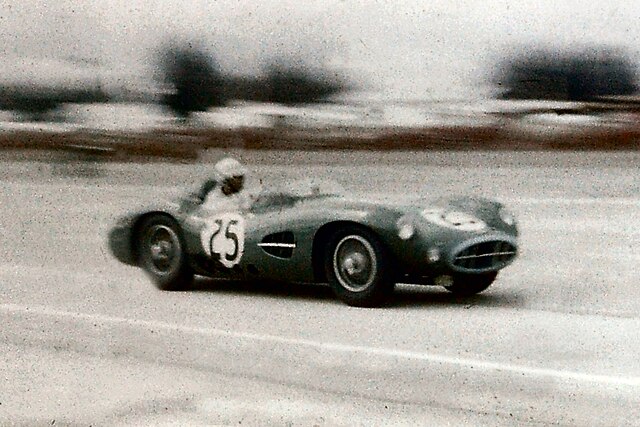
It was just a relief. He says it almost came too late. If that doesn’t tell you everything you need to know about John Wyer, then he says, we were past any great emotion by the time they won Le Mans. So when he says him and David Brown flew home immediately afterward, he wasn’t kidding. He actually did. In another section of the book, he brings this up again with a little more detail. He was talking about how determined David Brown was on winning Le Mans. And he talks about this exact same time after the race. So he says,
“As we took off, we looked down at the circuit and David’s remark to me was, thank God we need never go back to that bloody place again. As far as he was concerned, that ambition had been achieved and one did not go back. We did in fact go back in 62 and 63, but he was never really interested.” – John Wyer
You can just feel the relief and the exhaustion in these quotes.
I brought this up earlier. I went to the race this year. I was at Le Mans and there’s this tiny little airport right next to the track. It’s the Le Mans airport. It’s right behind the main grandstand area. And during the race, it seemed like there were a dozen helicopters flying around filming the race and they were all taking off and landing at this little airstrip next to the track.
So it was really cool to see that little airstrip because when I read the end of this book, where John Wyer, says, what I just read, he said, we left immediately after the race and flew back to England. And then he goes, as we took off, we looked down at the circuit.
David Brown and John Wyer Reflect
And that’s when David Brown, he said to John Wyer in the plane, he goes, he’s looking down at the circuit and he says, thank God we never have to go back to that bloody place again. So that was so cool because I saw that little airstrip they were taking off from.
It’s right next to the track and looking straight down, they would have been just a few hundred feet off the ground as they’re probably dead tired and they’re just looking down and just like, let’s get out of here. I can picture that scene in my head now after seeing the track and that little airport in person. John Wyer has a lot of nice things to say about his boss, David Brown, through the entire book.
You can see how much respect there was for DB and the leadership. He made the goal crystal clear. We’re going to win LeMans. And then he let John Wyer figure out how he was going to do it. But Wyer didn’t stop with just a quick tipping of his cap to his boss, David Brown. I thought this was really cool. He broke down how much it set him up for success later in his career. Wyer recognized how lucky he was to get to work for DB. Check this out. says,
“I learned my job because of the scope that David gave me and because along the way I made mistakes which were accepted as being part of the game. I really could not possibly have had anybody better to work for and had I listened to him more closely I might have avoided some of my errors. From 1954 onward David was always pressing me to delegate and to get better people working for me and although I did not realize it at the time I know now that he was really telling me that there was no way he could promote me until I had found my own successor.”
And this is great. So John Wyer, he continues on here in the book. He gives some really good nuggets of career advice if you want to take it. And most importantly, just finding a truly great person to work for and learn from. Probably the biggest lesson here, but I’m going to read a little more of this because there are some gems in this book. John Wyer says,
“From the point of view of winning races. The JW Automotive Golf Oil period was certainly the most successful of my career and this was because by that time I had learned the lessons that David Brown had tried very hard to teach me. You cannot do it all yourself. You must have good people and must let them do the job. There will be times when they will make mistakes but you have to accept this. David accepted it from me. I have no doubt that he could see the many mistakes I was making, but he accepted them, thinking that I would not make them twice. He was absolutely right, and I was wrong not to learn to delegate earlier than I did. I think we might have done better than we did had I taken more heed of David in that period. But my attitude in those days was, why should I let somebody else have all the fun of this job instead of doing it myself?”
So that’s John Wyer right there. Then he finishes, he says,
“As chairman of the board, chief executive, and patron of the racing team, it would be difficult, if not impossible, to find anybody better to work for than David Brown.”
So there you go. Straight from one of the greatest racing team managers and leaders of all time, John Wyer. Some excellent career advice right there if you’re looking for it. Like I said, most importantly, finding somebody to work for that you really respect like DB and then go after a goal with everything you’ve got.
Tribute to David Brown
He was smart enough to learn the tough lessons all along the way. Then he carried those lessons with him the rest of his career. And then not only that, he credits his mentor 20 years later, just like a pro. So this book was awesome for a lot of reasons. Number one, was John Wyer telling the story of the David Brown Aston Martins, race by race, straight from one of the all-time greats.
There’s another reason it was awesome. It was a surprise ending for me to hear that almost somber conclusion. That anticlimactic ending. I was not expecting that at all. John Wyer, David Brown taking off in the plane right after they win Le Mans. Looking down on the track. Like they’re almost disgusted. These two were so competitive.
These two were so competitive for a decade trying to win that race and they get it done. Like the book said in bold all caps. It just said, FINALLY. Here’s another reason the book was awesome. I found this thing at a bookstore in Cardiff, this coastal city in the UK. It was at an old bookstore and it was the first edition original copy. So I opened this book up for the first time.
And the smell from this book just hits you like a ton of bricks. It smells like it was sitting in the dungeon of an old English castle for the last 40 years. And it just might have been. There’s a little water damage on the corners of every page. So it has this great old book musty smell to it. More so than any other book I’ve found so far.
After doing a handful of these car creator stories, there’s a bunch of common themes I’m seeing over and over. Here’s a big one. The racing stories never really have a conclusion. It’s just always, what’s up next? Gordon Murray in my episode on the McLaren F1, he admitted his entire life he was just focused on the next goal. Whatever it was, that was his focus. The next goal.
Peter Sauber. Carl Benz, Enzo Ferrari, Rudolf Uhlenhaut. These guys were all focused on constant improvement. The next model car, the next race. So you have to check out my other episodes for the full stories. Maybe my favorite example of this, a guy who was absolutely shot out of a cannon. He was the grandson of Ferdinand Porsche. His name was Ferdinand Piech. He worked his way up in his grandfather’s company, Porsche.
And coworkers described his temperament like this. They said he was like an “approaching typhoon,” with a, “relentless impatience for change.” Can you imagine working for Ferdinand Piech? I read this book all about the Porsche 917, that monster race car that was designed specifically to win the 24 hours of Le Mans. Does that sound familiar?
This was the goal. in that book that I read by author Peter Morgan, he said, Piche was a, “born achiever who would not accept that there were limitations to anything in life.”
So that’s who you would want in charge of building the greatest race car of all time. The Porsche 917. This is a theme that comes up over and over in these racing stories. Relentless improvement, iteration and developing the next great car to rule the track.
Iconic Racing Stories
As soon as success is in hand, almost instantly there’s the desire to move on to the next goal, the next race.
So I’m telling you all this because here’s the last paragraph in the Aston Martin book. It’s the conclusion by John Wyer on the last page. He was talking about winning Le Mans in 1959 and flying home back to England two hours later with David Brown, like we’ve been talking about.
He says he didn’t miss out on the big celebration party afterward at the hotel because there wasn’t one. He said the rest of the team didn’t even celebrate the win. Everyone was in bed early that night. So he was taking a few guesses as to why nobody wanted to celebrate the big win. Here’s what he said,
“Perhaps there was another reason. I think we all knew that we were getting near the end of the road. We had done what we set out to do and it was time to think about something else. The future might be better or worse. It would certainly not be the same.”
– John Wyer, October, 1979.
That’s the last paragraph of the book and a similar sounding theme as my other car creator stories. We had done what we set out to do and it was time to think about something else is what he wrote in the book.
John Wyer would go on to race with Ford in the GT40s. That’s another iconic and epic story. These stories are almost never ending with these legendary racers. As fate would have it, over at Porsche, a decade later, we just talked about this guy, Ferdinand Piche. He’s building the Porsche but he’s having trouble on the track. He wanted to win Le Mans.
But he needed a great manager to put all the pieces together. So Piech, this force of nature behind the Porsche 917, he’s the one that managed like an approaching typhoon.
He needed the best.
He went out and got John Wyer.
There’s a famous old English poet. His name is Robert Browning. And I randomly stumbled on a quote from one of his poems while I was reading this book about the David Brown Aston Martins.
And by the end of this book, this quote by Robert Browning became a perfect way to summarize this episode, especially since he was an English poet and he was from the 1800s. This book on David Brown Aston Martin’s, it was written in 1980, but the thing smells like it might’ve been written by Robert Browning’s grandfather in the 1700s. But anyways, it’s a perfect quote for this story and really any great story.
There’s this desire for something more, a giant goal that seems almost impossible, and then going after it like a bat out of hell. Maybe you make it, or maybe you crash and burn. Here’s how Robert Browning said it back in 1855 in his famous poem, ‘Andrea del Sarto.’
“Ah, but a man’s reach should exceed his grasp, or what’s a heaven for?”