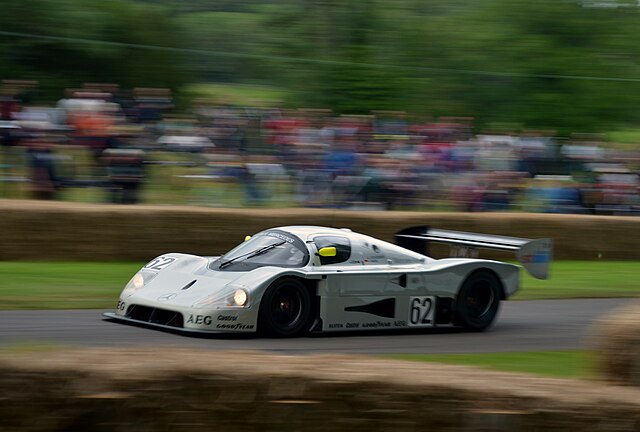
The Sauber-Mercedes C9
“There are those who keep out of mischief and there are the adventurers. We racing drivers are adventurers. The more difficult something is, the greater the attraction that comes from it.”
That’s Juan Manuel Fangio, five-time Formula One world champion. If you’ve listened to any of my other car creator stories, you know that Juan Manuel Fangio makes an appearance in just about every single one.
So here he is again, and by the end of this story, you’ll understand why I started with the Fangio quote. And we’ll talk about Fonjio later on. I had no idea how this would all work out, but this is a special episode on the amazing Saber Mercedes C9. We’ll dive into this incredible car creator story on the beast, this epic race car. But first check this out. This episode ties together every other car creator episode I’ve done so far.
They’re all related and it’s pretty amazing. And I definitely didn’t plan it out like this, but we’ll look at how these stories are all interrelated. And I can give you a hint. It’s all because of a certain racetrack that these episodes tie together. And I’m sure you probably could guess the name of that track. The track is called Le Mans. So this world famous racetrack in the middle of France doesn’t just pop up in a few of my car creator stories. This racetrack pretty much ties all of automotive history together over the last hundred years.
The more I learn about Le Mans, the more amazing it becomes. And what makes this story a lot of fun for me? I was able to go see the track last month for the very first time. I wanted to see this place with my own eyes and I finally was able to attend the 24 hours of Le Mans race last month in June. So it’s my first car creators episode I’m doing now after actually having attended a race there.
And I’ll get into my travels to the race. I’ll get into that in a bit. But we have some important business to attend to first. This car, this monster, and I’m sure you know what this car looks like already. This beast of a race car. It just looks different than anything else on the track when it ran back in the late 1980s. It’s just a menacing looking car, the profile of this car. But I finally figured out why this car jumped out at me every time I’d see a video or a photo of it over the years.
It didn’t look like anything else on the track because number one, it had very few sponsors on the car. Most race cars are completely covered in these sponsor brand names. But what it did have though was lots of silver. The car is all silver, the livery. And of course there’s a very good reason for all that silver paint. This is not a random color.
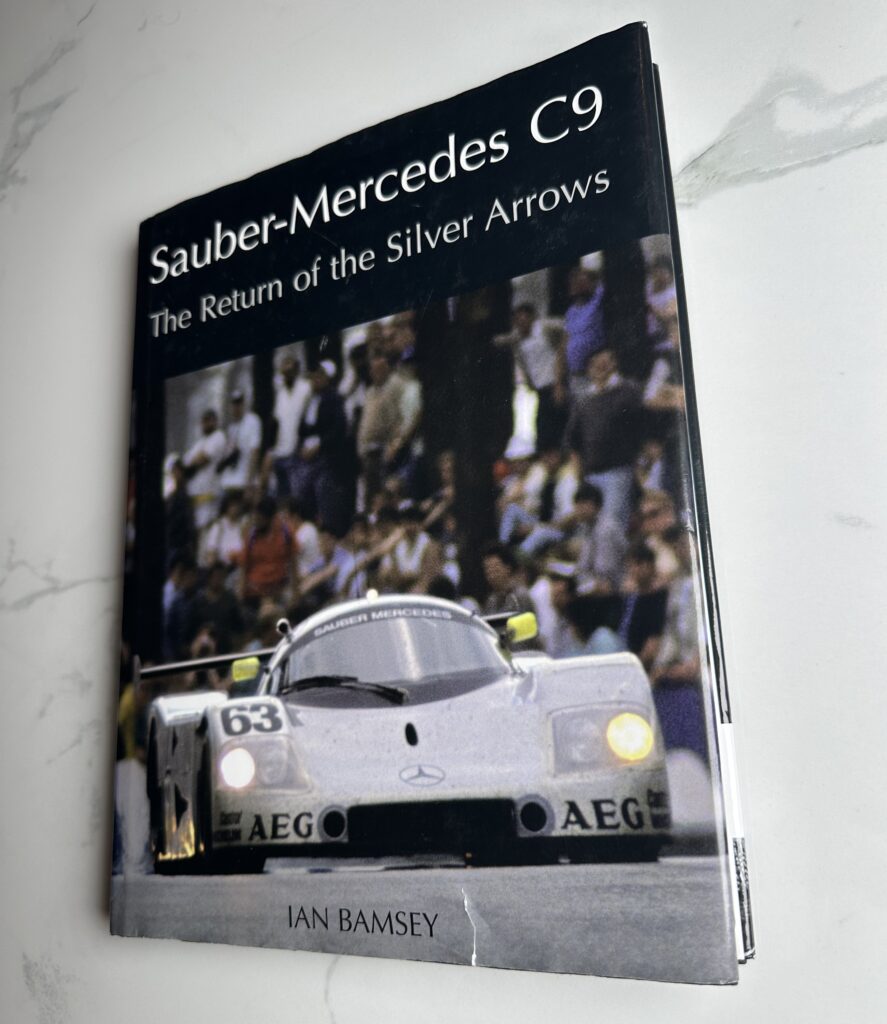
Silver was a tribute to the past glory of the Mercedes-Benz Silver Arrows. Benz was back on the track and they were bringing back the Silver Arrows with this car. The silver paint scheme that was so successful back in the 1930s and then again in the mid 1950s when Mercedes dominated the racetrack. So of course I can’t learn all about the sober Mercedes C9 without an awesome old book. Just like I usually like to find and the one I have here covers the entire subject down to every single last detail.
The book is titled, “Sauber Mercedes C9, The Return of the Silver Arrows,” by author Ian Bamsey. And this book was published in 2006 and Ian Bamsey spent several years with the teams and at the races and he covers this car in amazing detail. Every single aspect of the C9, he goes into all the technical details of almost every piece of this car.
I had to read the book a couple times just to absorb some of these technical details. Let’s talk about the name of the car, the Sauber Mercedes C9. The car was a joint venture between Mercedes-Benz and Peter Sauber, who stumbled into a small team within Mercedes-Benz while he was searching for a wind tunnel that he could use for testing his cars. Peter Sauber was introduced to this team at Mercedes and they had this very informal and it was almost a secretive partnership that took many years to develop.
But how did Sauber pull off a partnership with Mercedes-Benz? From a small town outside of Zurich, Switzerland, Peter Sauber began his career as an electrician. Then he tried his hand as a car salesman, but he quickly decided he wanted to do much more than just sell the cars. He wanted to build his own race cars. So in 1970, he started to build his own car in the basement of his parents’ house.
Over the next 10 years, Peter Sauber slowly built up his skills and he developed several prototypes, starting with the Saber C1, and then all the way up to the C6, with the C as a tribute to his wife, Christine. And by the way, that’s the exact same thing Horatio Pagani did with his first prototype, and he called it the Zonda C12 after his wife, Christina, and then the 12 being for the V12 engine that he put in it.
Anyway, so all the way up to 1982, Peter Sauber is entering races and he’s building prototypes. So over 10 years of dedication and struggle, he builds the Sauber C6. And this is what I mentioned earlier. He’s looking for a wind tunnel so he could test his car out from his small town, Hinwell in Switzerland. This is just outside of Zurich. So it’s not that far from Stuttgart, Germany, home of both Porsche and Mercedes.
But at the time Mercedes wasn’t involved in racing, but Porsche was dominating the seventies and the eighties. So Sauber wants to use a wind tunnel at the university of Stuttgart. The professor there, he says, no, but I can introduce you to a few people over at Mercedes. And even though Mercedes doesn’t have a race team at the time, Sauber finds this group of engineers inside Mercedes and they were working on road cars, but they were also really passionate about racing. so later on, looking back, they all said they were just a group of dreamers who were really into racing and they spent a lot of their time debating the group C regulations that just came out.
So they hit it off with Peter Sauber and they help him by using some of their equipment to test his cars out. And this goes on for several years and it’s an informal agreement. This team of “dreamers,” inside of Mercedes is just helping Saber and as things get more serious and more involved with testing Sauber’s cars, it really evolves into more of a covert operation. That’s how I’ve seen it described because Mercedes is not officially involved in racing at all.
Since all the way back in 1955, they withdrew from racing completely. So this collaboration, can’t be an official partnership. Not yet. But that’s going to all change. Just a few years later, by 1985, Sauber has a new car, the Sauber C8, and it’s powered by a Mercedes engine for the first time.
It’s a V8 twin turbo Mercedes engine inside the Sauber C8, but they have to keep it a secret. And they say the engine isn’t from Mercedes. At the time they said it was from a guy in Switzerland, an engine tuner named Hanny Mader. Later on, they admitted and they called it a smoke screen because no one at Mercedes could admit that they were involved in racing in any way. And they were also managing the risk here too, just like a giant automaker would.
They didn’t know how the Sauber C8 would perform on the track yet, so Mercedes wisely wanted to just keep their distance. They couldn’t risk getting involved in a car and an engine that they really didn’t completely control. But it didn’t take long for Mercedes to see that they wanted to get more involved in this Sauber C8 race car. With the Mercedes engine inside the C8, the car wins a race at the Nurburgring and with some Mercedes-Benz top brass attending that race,
It’s now going to make it much easier for the team to sell this investment or this involvement to the Mercedes management so they could continue this unofficial partnership with Sauber. Now, what do they want to do next? It’s really what happens in every racing story ever told. They want to make a better, faster car, of course. It’s all about the next model with these racers. The iteration, this small racing team, I’m sure they’re excited, but they know they can do better.
They now have a little more support from Mercedes and more resources at their fingertips. So what happens? They start to make plans for the Sauber C9. Now Mercedes decides to make it official. They’re back in racing in early 1988. They officially announced Team Sauber Mercedes is formed. They know they have a great car and they win the opening race in Spain. But it’s not that easy. Nothing is easy, especially in racing.
They head to the 24 Hours of Le Mans and during qualifying the cars barreling down and they have a high speed tire blowout. The car flips in the air and lands back on its wheels. It’s still running, but it’s over. They have to withdraw from the race. They’re not sure about the Michelin tires and they can’t take the chance of another blowout. So the team is done at Le Mans in 1988.
They’re finished before they could even start the race. It’s a disaster for Team Sauber Mercedes. Remember Mercedes-Benz did not just announce their return to racing to go off to Le Mans and have this incident that could have badly hurt or even killed one of their drivers with this tire blowout. So this was bad and Team Sauber needed to take drastic measures. What’s often overlooked is how close the entire project came to failure.
The team’s withdrawal from the 1988 Le Mans 24 Hours is a known fact, but the reasons ran deeper than just a single tire failure on this car. It was an accumulation of issues that created a crisis of confidence. One of the drivers had already announced he wouldn’t drive at Le Mans. He said that the straight was too dangerous. Another driver, Mauro Baldi, he needed, “heavy persuasion,” to even participate.
The tire blowout was the last straw for a team already on the edge. This failure forced a critical reorganization. Engineer Dave Price was brought in to manage race operations and that freed up designer Leo Rast to focus on development. But it didn’t take long and they got a new plan put in place. So the C9 was born straight from this near disaster. With two cars up and running, they won four out of the last six races in the 1988 season.
So here’s the big moment. There’s big time momentum building for team Sauber Mercedes. They get through a gut wrenching disappointment with that tire blowout at Le Mans in 1988. They recover, they build up the team, they fine tune the car and close out the season with four victories. And now the big moment. The moment that would define this entire era for team Sauber Mercedes, the iconic C9 car. And really this would define the entire era of the late 1980s racing.
This was it, heading right into the 1989 racing season. And the big moment was not testing the car on the track. It was with a guy named Werner Niefer, the chairman of Daimler Benz board. I have to read this from an interview I found in Motorsport Magazine. Here’s what happened. It says,
Max Wellty, Sauber’s long time team manager takes up the story. “We were all drunk. Pretty drunk actually. Niefer had these big hands and he banged his big fist down on the table and said that we were going to race silver cars. The beer glasses literally sprang up in the air. It was all done by him, Mr. Neifer. It was his decision and his decision alone.”
That was from an article in Motorsport Magazine. And it was an article written by Gary Watkins that I found. And that was the moment that brought on the silver cars. There it is.
This is the exact time when the Sauber Mercedes C9 went to its silver paint. It was Werner Niefer who made the call. He slammed his fist down on the table. Beer glasses bouncing up in the air. You can just picture it right now. With that one single swift blow, the silver arrows were back. And that was a huge statement to make.
To have those cars in all silver after the amazing history of Mercedes on the track, the victories, the defeats, the tragedies, and all those years away from racing, bringing the Silver Arrow livery back for the 1989 season was a master stroke by Werner Niefer. But Mercedes is not just going to bring back the Silver Arrows, making one of the biggest statements in racing history and then just hope for the best. They know what they have with this sober team and the C9 car, but they came back to win, not to blow out tires in qualifying runs.
So what do they do? They drop a new engine into this C9 car. Maybe the most important little detail in this story. For the 1989 season, they now have a new four valve M119 engine. Not only cranking out 925 horsepower, but incredibly reliable because the rev limit is only 7,000 RPM. And another big advantage of this engine, it has higher torque at lower speeds relative to the competition.
But with this new engine, what is almost never mentioned is that when it was first tested, it actually made the car slower. Designer Leo Ress revealed that while the new engine was more powerful, the four valve DOHC heads added weight high up, raising the car’s center of gravity. Ress said it like this. He said, “We were a bit surprised and then we saw that we were slower in the corners.”
So Mercedes had to undertake a big development program just to counteract this effect and get the cars balanced back. So the C9’s ultimate weapon was not a simple plug and play upgrade or a fix. It was the result of intense and iterative engineering to solve a big fundamental problem. So now finally everything’s lining up perfectly. There’s a new engine, all silver cars, the historic Mercedes paint job, and the dialed in Sauber racing team.
They tasted a little success in 1988, but now it’s on. And in 1989, these Sauber Mercedes C9 cars crushed the competition. Check this out. The Silver Arrows returned and won seven of eight races in the World Sports Car Championship season. And then almost like its very own championship, the biggest race of them all, the 24 Hours of Le Mans, the Sauber Mercedes C9 cars finished first, second, and fifth place.
The first victory at Le Mans for Mercedes since 1952. So this epic car creator story, it’s got everything. It would be hard to make up a racing story this good once you step back and look at how this all played out. One detail I can’t leave out, the Sauber Mercedes C9 not only won at Le Mans, it actually redefined the track. Literally redefined the shape of the track.
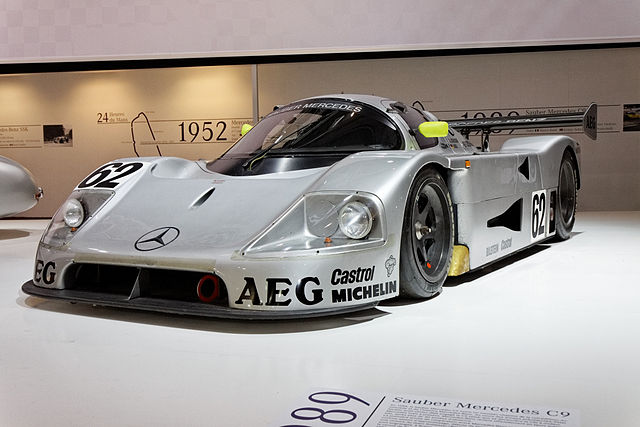
This car is the reason there are two chicanes on the Muslane straight. During qualifying, this car hit a top speed of 248 miles per hour down the Mulsanne straight. And race organizers decided they needed to break up this long straightaway because speeds were getting way too crazy. So the next year they added two chicanes to slow the speeds. So this was the car that ruined it for everyone else. And the Musslane straight would never be the same.
And this is amazing. Here’s one more detail and maybe the most surprising and little known fact about this team’s legendary 1989 Le Mans victory. It was never part of the plan for that year. Peter Saber said it himself. The team approached the race as a quote, practice run for a full scale assault in 1990. Saber said it like this. said, “Everyone was well aware of that and no one put any pressure on us to make it first past the post.” And then he keeps going, he says, the race was supposed to be part of our preparations for the future, not a race to victory. That they dominated and secured a first and second place finish was an unexpected and ahead of schedule triumph that makes the achievement even more remarkable.
So it’s an awesome story. I would strongly recommend you check out this book I have here by author Ian Bamsey. This book goes into every single detail of the story and it gets into the nuts and bolts like you wouldn’t believe. All the technical details, every single step of the way for the Sobber team. It’s pretty amazing that author Bamsey spent years documenting every issue, all the troubleshooting, all the iterations. So this book is like a work of art in itself.
I really tried to understand what I was reading, but some of these concepts like the aerodynamics of the underwing, I was really into it, but I had to go through it about 10 times. And I’m not sure I really understand it completely yet, but I’m going to keep trying. So, and this is crazy, Bamsey in the book, he doesn’t just break down the Sauber engines, but he actually compares the Sauber engines with every other competing manufacturer’s engines and how they stack up against each other from year to year.
So this book is just packed with details. I was saying earlier about how this story about the Sauber Mercedes C9 ties into my other car creator stories I’ve done so far. I had no idea when I started doing these stories how they would all tie together. And the common theme here so far, it’s been this race, the 24 hours of Le Mans.
So check this out. I just did an episode on the most valuable car in the world. The 1955 Mercedes Benz 300 SLR Uhlenhaut Coupe. The car sold a few years ago for over $150 million. There’s only two examples of this car ever built. You’ll have to check out the full episode on this amazing beast of a car. But one of the things I’m learning over and over, with my collection car episodes I’ve been doing, is that if you want to learn about the most amazing cars ever created, you’ll find that almost all roads lead to Le Mans.
This race that’s been going on for over a hundred years, it’s much more than just a race. You could say that the 24 Hours of Le Mans race is at the heart of motorsports and the proving ground for automotive innovation all the way back to nearly the very beginning of auto racing.
Anyway, I was telling you about this Mercedes-Uhlenhaut Coupe episode I just did, and it’s crazy, but again, the story of that car is tied to Le Mans forever because of the horrific crash that happened during the race in 1955. Mercedes was involved in a terrible crash where cars actually went into the crowd and killed more than 80 spectators. And this awful crash changed racing forever.
Mercedes decided to withdraw from racing the following year and they didn’t return until this story we’re talking about here with the Sauber Mercedes in 1989. Those two Uhlenhaut coupe cars that I was talking about, the 300 SLR Mercedes race cars were built for racing back in mid 1955. They were completed just before this horrific crash at Le Mans.
And they were actually registered for a race that would be scheduled later on that year. But after this terrible crash, that race was canceled. And then Mercedes decides to exit racing. Well, those two cars were now just sitting around in the parking lot at Mercedes and the legendary engineer, Rudolf Uhlenhaut, he decides to drive them around town as his personal cars. And that’s how they got their name, the Uhlenhaut Coupe. He was actually driving race cars around town.
And they look like passenger cars because they built these coupe panels over the top, but these were actually race cars that they were designing to run and they never ran. So that’s just one example of how all these episodes on how all these stories are linked together through racing. And it’s not all joyful stories. Some of it’s tragedy, heartbreak, failure. And then there’s the victory and success sprinkled in there too. I have an episode on Gordon Murray, and the amazing story of the McLaren F1.
The unthinkable goal that Gordon Murray had to create the world’s best road car that as he said it would set new standards. Well, as it turns out, Gordon Murray did exactly what he set out to do and he created the McLaren F1, one of the most unbelievable cars ever made.
So check out that full story on how he pulled off this dream of his. But of course, as it turns out, the McLaren F1 road car was so good, such an amazing machine in every sense that they decided to build a track version of it for guess what? You can probably guess they built the track version so it could race at Le Mans. And you can guess what happened, I’m sure. The McLaren F1 goes out and takes first place at the 24 hour of Le Mans in 1995. Gordon Murray set out from the start to create the ultimate road car, not a track racer. But then he goes out and he wins Le Mans anyway. It’s an unbelievable story.
Another story I did a while back, the Porsche 917, an absolute monster of a car. And this car caught my attention years ago when I was watching an interview with Horatio Pagani. And he mentioned this was his favorite car of all time.
I had to pause the video and replay it. I was so surprised that he didn’t name off one of his Pagani models. It was the Porsche 917. And that was a surprise for me. But Horacio went on in the interview and he talked about how he owns over a hundred scale models of the Porsche 917. And then he goes on and he said, sometimes he’ll just pour his tea in the morning and he’ll grab one of his scale models and he’ll just stare at the Porsche 917.
So I figured, okay, I’m doing this story. I have to find out the full story behind this car. And you won’t believe it, but the Porsche 917 was built for the sole purpose of winning the 24 hour of Le Mans. And people refer to the 917 as possibly the greatest racing car in the history of motor racing. So you have to check out my full episode on the Porsche 917. Can’t go through the entire story right now as much as I want to.
It’s John Wyer, the Porsche founder’s grandson, Ferdinand Piech, and an entire team of drivers and engineers. They’re trying to solve the riddle of the Porsche 917. Like I said in the episode, iteration was the key to the 917.
It doesn’t stop there. All my other car creator episodes tie back to this story and directly to Le Mans.
Like my episode on Enzo Ferrari starting his own racing stable, the Scuderia Ferrari. Ferrari won Le Mans in 1949 for the very first time, on their very first try. It was after World War II shut down the race for 10 years, and now with the race back on, Enzo winning Le Mans launched his Scuderia Ferrari name into the headlines.
So I didn’t realize this when I started doing these stories, but the car creators episodes are turning out to be so much more fun than I even could have imagined. They’re all packed with relentless passion, vision and perseverance, pushing boundaries, creating what doesn’t yet exist and staring down constant danger and financial ruin at every twist and turn. Now think back to the beginning of this episode. read a quote from Juan Manuel Fangio.
One of the greatest race car drivers of all time, Fangio drove for Mercedes. He also drove for Ferrari. But one of his biggest contributions, at least in my mind, was the recommendation he gave a young Horacio Pagani to help him get a job at Lamborghini, which set Horacio off on a path to greatness. And yes, I’ve done an episode on Horacio Pagani, so you’ll have to listen to that full story. It’s amazing.
But not only did Fangio help Horacio get a job at Lamborghini, later on he would help him get an engine for his car creation, the Zonda. He would help him get an engine for his car creation that he was working on, that he was building on the side, what would become the Pagani Zonda. Well, Fangio helps Horatio get a Mercedes AMG V12 engine into that car. Much like we just saw here with Peter Sauber getting that brand new Mercedes turbo V8 engine, in his car that would go on to win first and second at Le Mans.
So Fangio is a legend and his name pops up in these stories as often as anyone’s. And I’m looking forward to doing an entire episode on Juan Manuel Fangio. So this quote at the beginning of the episode, I really love that quote. It’s just a common theme that I’m seeing with these car creator stories. It’s the perfect quote. Here it is again. I’ll read it. He said, “There are those who keep out of mischief and there are the adventurers We racing drivers are adventurers. The more difficult something is, the greater the attraction that comes from it.”
So I mentioned at the start of the episode that doing this story was so much fun because I was able to go to Le Mans and see the race for the first time. And it was just a few weeks ago, walking around looking at the displays before the race. And there it was. The Sauber Mercedes C9 was right there.
They had a car, the number 61 car was sitting right there. And it was really cool to see this thing up close. So I’d highly recommend if you’re anywhere near Le Mans, you need to go check out that race. And from the looks of it, most of the country has already taken my advice. There was about 300,000 people there and it was incredible to see it.
From where I was coming from, it was not an easy place to access. This village in the middle of France, it was planes, trains and Ubers and a lot of walking and hiking. But what an adventure. It was kind of like my own little endurance race, trying to get to this track and then back home again. But it was worth it. It was so much fun to see that race.
And one of the big surprises for me, I was actually able to watch the race, the start of the race from one of the suites right above pit row, every racing team has a suite directly above their pit. And as I was waiting for the race to start, they do this warm up lap and the cars will go around the track and then come through the starting line at full speed. As soon as that clock starts to tick from 24 hours, they’re coming through at full speed. And that was one of the coolest things I’ve ever seen. These cars came through the grandstand area and the roar of these cars was unbelievable.
That was definitely an unexpected roar that I’d never heard before. And it’s a roar that I’ll never forget. So just like Fangio was saying, “There’s those who keep out of mischief, and then there’s those who are the adventurers.” And my trip to Le Mans was quite the adventure. Not exactly like racing 248 miles per hour down the Mulsanne Straight, I’m no race car driver, but in my own little way, I can definitely relate to that last line in the Fangio quote, “Some people just can’t keep from the mischief. The more difficult something is, the greater the attraction that comes from it.”