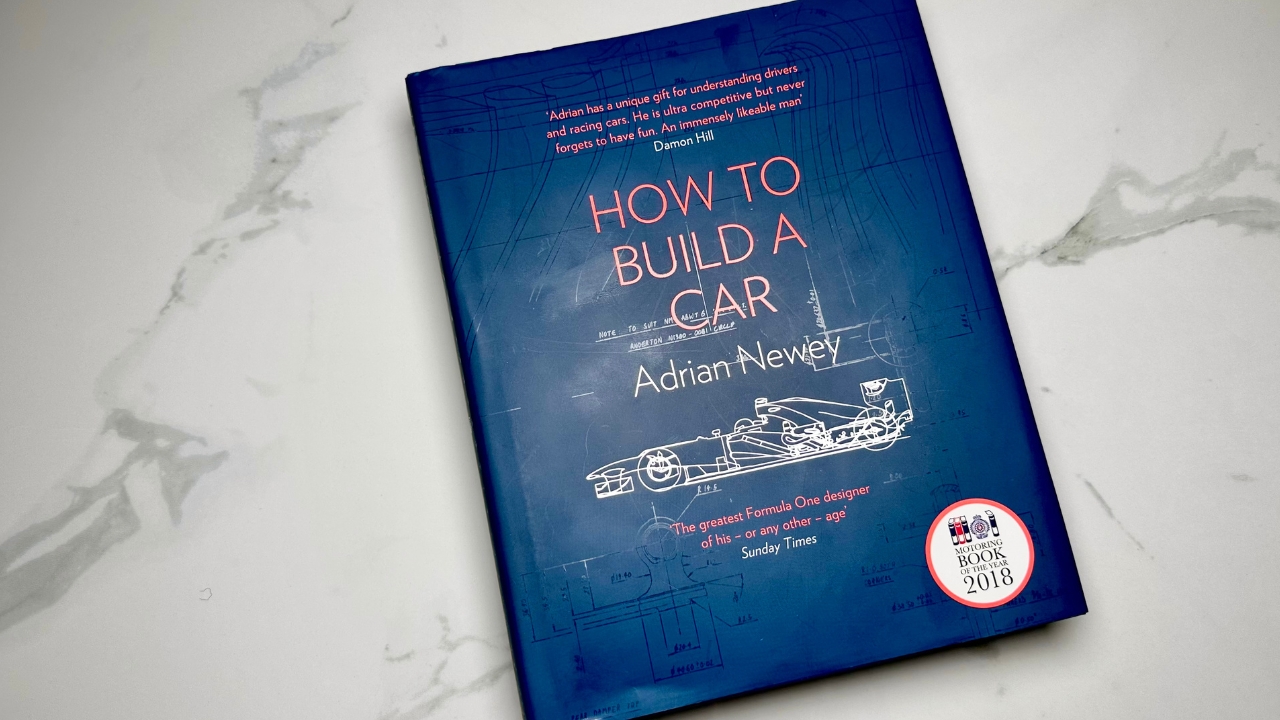
Adrian Newey
Adrian Newey (How to Build a Car)
Episode #35
01.06.2026
“No doubt it was thanks to that extra income that my father was able to indulge his interest in cars. Not just driving them, although he did an awful lot of that, but tinkering, modifying, and maintaining them. It was where his true interests lay. Despite specializing in life sciences for his career, his heart lay in physical science. He read math books like other dads read John le Carre. He had a huge passion for engineering and he liked nothing better than a challenge. How can I do this differently? How can I do this better?”
Adrian Newey
“Each year in Formula One we pour over the regulations for the next year, and part of my job, perhaps even the part I relish most, involves working out what the regulations actually say, as opposed to what their intent is, and whether this subtle difference allows any new avenues. I’m basically saying, how can I use these regulations to try something that hasn’t been done before?”
And so that was the greatest Formula One car designer of all time, Adrian Newey. That was him right there talking about his father and what he learned from watching him as a kid.
The Greatest Formula One Car Designer of All Time
I just finished reading Newey’s amazing book he published in 2017, ‘How to Build a Car.’ I’ve been staring at this book on my shelf for months now and I finally got to read it. It’s a car creator’s life story from start to finish, page after page and car after car. From the master himself.
That opening excerpt that I just read, Newey looked up to his dad who was constantly tinkering with cars and trying to make things better. Like I just read, his dad led by example.
“How can I make this different?”
“How can I improve this?”
Well, Newey’s watching his Dad like a hawk as a little kid, and he mimics these actions from the very beginning. Adrian carried these same traits of his Dad’s all the way through his life. And so this was the gift. Young Adrian knew, he knew almost from the very start he was in love with cars and motorsports.
Passion for Racing at a Young Age
He says in the book, age six, he knew his future was in car racing. And then by age 12, he knew designing cars would be his goal in life.
“It all began with Dad. When I stand at my drawing board inspired by a love of cars and constant ongoing desire to improve them. Not just their speed and performance, but ultimately the way in which they move through the world, the impact they have, aesthetic, environmental, sporting enjoyment. It all comes back to him, his workshop and his eccentric love of tinkering with all things mechanical, that and mom’s love of art and painting.”
And so there’s Newey again from the book. At his home, a couple hours north of London, England, his dad worked as a veterinarian, but his passion was cars. How Adrian says it,
His Dad’s true passion was in the physical science. Adrian’s dad also had shares in the old family business, Newey Brothers. It was this manufacturing company that went back generations in the family. So he says, because of this extra income, his dad was able to tinker with cars. So they weren’t, “frightfully rich,” he says, but not at all poor either. And it was a great environment for Adrian watching his dad. He’s reading Autosport magazine every week, which was the Bible for cars back then. And he’s totally hooked on motorsport when he was just six years old.
He doesn’t just read about cars, but he starts drawing cars. What he called his “first language” was on the drawing board. It’s something he carries with him his entire career. Throughout this book, he’s drawing and sketching ideas out on paper with his pencil. He carried this habit through his entire life.
Pencil to Paper
They didn’t design cars with computers when he was coming up and knew he never converted over to CAD. He stayed with the pencil and paper the whole way, which is awesome because I just did my episode on the Lamborghini Countach and the designer of that Countach, Marcello Gandini.
In that story, he also preached the artist sketching his designs out on paper with a pencil. Newey said one of his favorite things about the drawing board over CAD is that you can sketch at scale right in front of you without being limited by the size of the monitor with the computer aided drawings. And then he can quickly change the paper with an eraser. He said he used almost as many erasers as pencil led when he was working.
Battling Through School
So Newey’s upbringing at home sounds like a dream come true, but then he has to go to school. He attends a local covenant school. The teachers there discover that Newey’s left-handed. The school told him being left-handed was a sign of the devil. So the nuns in class, they make him sit on his left hand, trying to train him to use his right hand only.
And he says, “It didn’t work. I’m still left-handed.”
But worse than that, he moves on to prep school and he couldn’t write. He was left-handed, but he was never able to use his left hand. So he never learned how to write. So they place him in the lower tier class.
He calls it the “lower set.” And what do the kids in the lower set do? And they mess around and cause trouble. And now Newey’s paired up with the troublemakers. There’s a time in science class when the teacher asks Newey about friction, if it’s good or bad. And Newey says, it’s good. Otherwise we’d all fall over. And the kids laugh and the teacher scolds Adrian thinking he was just being some kind of wise-ass. The teacher explains to the class that friction’s obviously a bad thing. And Newey’s kind of thinking to himself, yeah, that doesn’t really sound right to me.
And then it’s funny because there’s these times when you’re young that just stick with you. And it could be something small, but it makes an impression that lasts your entire life. This is one of those times right here. Adrian looks back and he realizes he’s just thinking about things differently than the teacher, who’s supposed to be an authority figure and know what he’s talking about. This is how he says it in the book right here. He says, quote, right then I knew I had a different way of looking at the world.
“Thinking about it now, I’m aware that I’m also possessed of an enormous drive to succeed. And maybe that comes from wanting to prove I’m not always wrong. That friction can be a good thing.”
So it’s stuck with him. You can see he’s referencing it all these years later. Newey makes his way through school realizing that he’s driven and he’s not going to take some bumbling teacher’s word for everything. If it doesn’t make sense to him. After school, he’s not just reading car magazines and sketching out designs. He starts building his own model cars in his father’s garage.
He builds this model kit, his favorite car at the time, was the Lotus 49. It was this F1 race car kit. Great thing about the Lotus model car that Adrian builds in the garage, all the parts are labeled. So as he’s putting this thing together, he’s learning all the pieces. Here’s the lower wishbone or here’s the rear upright. Everything’s labeled. Newey says this is when he really began to combine the artistic left side of his brain with the more practical right side where everything needed to fit with a purpose.
The Engineer’s Mind
He called it the design engineer’s mind, where you think, wouldn’t it be interesting to try this? Nui says this is where it came from, the combination of practical solutions along with imagination. It all started right there in his dad’s workshop.
Pretty soon Nui was building his own cars, sketching his own designs, cutting sheet metal. He said this is where he started to make them “flesh.” He didn’t have any neighborhood friends. So he said he called himself, “A preteen hermit sequestered in a shed, beavering away on my designs.”
Then his dad would take him to the track and this is where it all comes together. Not the sight of the cars as much, but the sounds of the V12 engines. He said he was overwhelmed by the sights, but mainly the sounds of the racetrack. And I gotta tell you right here, I’ll jump in and say, almost every car creator story that I do now, I have to mention this. This comes up because I went to Le Mans this past year and the roar of those cars coming through the grandstand area at full speed to start that race.
That blew my mind. An unforgettable roar. So I can just picture Adrian Newey as a kid. Already a car nut. Then walking around the track and hearing the roar of those cars. That sound never goes away, man. It’s the first time you hear that roar. It just sticks with you. So just like watching the start of that Le Mans race last year, right above pit row. So there’s my little mention of my Le Mans trip. I don’t mind bringing it up because it was so much fun.
Anyway, we know that Newey wasn’t a great student, but he’s already locked into his passion, which is racing and cars and building model cars. He’s running with the troublemakers at school and he ends up getting expelled from high school after a prank that didn’t go so well.
It was a little incident that had to do with cranking up the speakers during a concert so loud that it shattered the stained glass windows. A classmate of his at the time, Jeremy Clarkson, you might recognize that name, he was another car enthusiast. He was also expelled from this school for a different incident.
These two car nuts were the only two students expelled from Repton School during this time. And I believe both their photos are hanging in that school hall at the moment because they went on to such successful careers. But his parents are able to get him back into another school. And then he almost failed his final exams at his new school because he’s got other things going on. Of course, cars and now Italian motorcycles.
And he also adds in a few other interests at the time, which he said were girls, music, and booze. And so he’s got a lot of interest going on at this time and in his life, as some of us may remember, but luckily he gets some really good advice here. He’s told if you’re serious about designing race cars, you need a degree. That’s the requirement. If you don’t go to college, that’s it. You’ll be out of luck. And this is where it snapped him back into action. He said he started to take school seriously, because he knew he had to get through it to get a job in motorsports. But it wasn’t easy for him at all.
Adrian Newey on Focus
Here’s what he says in the book. He says, “One thing I learned from almost flunking those exams was that distraction is the enemy of performance. I thought I was revising in the lead up, but in fact, I was listening to music while reading notes. I learned the words to ELO songs, not my material.”
That’s a very mature thing to realize at the time. He’s thinking he’s studying while jamming out to records and then he’s realizing, no, this is not gonna work. This is not how it’s done. He snaps himself into shape because he knows the schoolwork has got to get done otherwise no career.
So he gets busy and here’s a big turning point very early on. This is fascinating because at the time the path to getting into motorsports was mechanical engineering but Newey decides to go to the University of Southampton where they have a wind tunnel.
He wants to go there because at the time the racing team, Brabham Racing, was using that wind tunnel. So he’s hoping maybe he’ll bump into that racing team at the wind tunnel.
Here’s the big decision. He decides to study aeronautics and astronomics rather than mechanical engineering because he wants to get into racing, not just work on production line road cars.
The Study of Aeronautics
And he explains this, “But I didn’t want a career in the automotive industry. I wanted a career in racing. My thinking was that the aeronautics course would teach me about aerodynamics and about the design of lightweight structures, about materials and control theory. I decided that because of that parallel technology with aircraft, and because of the lure of the wind tunnel, I’d aim for Southampton.”
And we’re going to find out why that was such a great decision. It sets his career on a totally different course. School’s still a struggle and he’s always feeling a few steps behind everyone else. He almost quits college right here because he couldn’t keep up. But again, Newy got some timely advice from a tutor who told him, if you quit, you’ll be a draftsman and that’s it. Not that there’s anything wrong with that, but if you want to design cars, you that degree.
So this tutor says, what I suggest you do is, “get your head down and keep battling.” So Adrian turns that into his mantra. He, as he’s grinding through his schoolwork, he tells himself, “get your head down, keep battling.” Newey admits math would always be his Achilles heel, but he got through it. He knew he had to do it to move on to the next step of his goal.
So Newy does what it takes. He puts his head down and he keeps battling through it. His artistic mind along with his degree and already years of drawing and building his own model cars. He’s ready to go get a job in motorsports. And it’s perfect timing. This is from the book. He says, “Fate, luck and chance were also playing their part. I started at Southampton in 1977 and graduated in 1980. Those three years just happened to be a time of seismic change in Formula One. Which is where it starts to get really interesting.”
Newey lays all this out in the book in detail, the evolution of Formula One up to this time that he graduates college, the seismic change that he’s talking about. And it’s awesome because the way he describes all this, I love the way Newey is able to distill aerodynamics and engineering down to the very essence – is what I finally realized. And I know this because I was able to understand a lot of what he was saying in this book.
A true master at his craft can do that in the simplest terms, refining concepts that are extremely complicated. It’s the bulk of this book. Adrian Newey simplifies the engineering concepts of Formula One racing and he boils it down to simple terms so you don’t have to be an astrophysicist or a licensed engineer to consume this book and understand it. It was awesome. So let me give you one example.
Here’s what Newey says,
“To make a racing car accelerate and achieve a higher top speed, you need more power, less weight and less aerodynamic drag. And if that sounds like a simple set of goals, it probably would be, if not for the troublesome mechanics of cornering. This is where downforce comes in. Downforce is what we call the pressure that pushes the car downwards, effectively suckering it to the track. And because the generation of downforce is something that happens as a result of the aerodynamic shaping of the car, you can increase grip without it involving a significant increase in weight. In other words, you get to have your cake and eat it. More grip without a loss of acceleration.”
Simplifying Racing Concepts
And so the entire book is like this. He’s just laying down aerodynamic gems one after the other.
Newey explains the goal of the car designer. He says, first, you want the tires evenly on the ground through cornering, acceleration, and braking. Second, you need a lightweight car. Third, you don’t want drag. And fourth, as much downforce as you can get, and still balanced while cornering. Those are the four things.
Now remember, there’s a seismic change happening in 1980 just as Newey graduates college, and a lot of that had to do with downforce. In the late 60s, engineers were realizing these aerodynamic properties weren’t just for flying, but for driving as well. During the 1970s, racing started to incorporate downforce, but it just wasn’t understood very well yet. Newey says,
“With the introduction of a very large rear wing by Jim Hall at Chaparral in 1967, cars started generating significant downforce for the first time, having literally looked to the skies for inspiration – to aircraft.”
So they realized that the same thing that lifts the wing of an airplane, just flipped that upside down and it’s going to push the race car down and keep the tires on the track at high speeds for better grip.
So through the 1970s, car designers are playing around with spoilers, but then Newey says in 1977, it was a big year right here because it’s when Lotus developed the underwing, creating this upside down airplane wing, but underneath the car. And then to lock in this downforce so it didn’t leak out the sides of the car, Lotus developed “sliding skirts” along the bottom sides of the car. Newey says this is what you’d call a disruptive technology, a total game changer, and it moved aerodynamics to the forefront of racing design.
Now he’s explaining all this because he graduated college after studying aerodynamics, trying to get a job in Formula One, the sport that now is realizing how important aerodynamics actually is. A lot of that had to do with Nui’s design hero, Colin Chapman, founder of Lotus. He had aeronautical training and he used it in his car designs. But the legend Colin Chapman, he just ran out of time.
He makes this huge breakthrough on the Formula One car, then he kind of gets sidetracked. He gets involved with John DeLorean, building that DeLorean car, and then he passes away from a heart attack not long after that. But Newey was a big Lotus fan because of Chapman.
Even with Newey’s education, he applies to every racing team, but nobody’s hiring. They want someone with experience. He says half the job applications that he sent were ignored. But the phone rings. It’s from Fittipaldi Automotive, and this guy Harvey calls, and tells Newey, come on over for an interview. And they were both into motorcycles. so Newey cruises over to his interview with his Ducati 900 SS.
Harvey had a Moto Guzzi. So Harvey says, let me take your Ducati out for a spin. He takes it out and then he comes back and he pulls his helmet off and he just, he says to Newey, “When can you start?”
So Newey’s off and running. He lands his first job and here’s what he says in the book.
Adrian Newey’s First Job in Racing
He says, “I began at Fittipaldi with the title of Junior Aerodynamicist. But because they didn’t have any other aerodynamicists, I was Senior Aerodynamicist as well.”
So he’s in, he’s off and running, he’s got his foot in the door. But then he would leave pretty quickly. He followed a coworker from Fittipaldi. This guy, Peter McIntosh, leaves and goes to March Racing and Newey he goes with him. Now he’s a race engineer there. Plus he gets to do some designing as a draftsman.
So this is great right here. Another example, through this entire book, there’s this distillation again, racing principles broken down and simplified. Here’s another example. He says,
“In its simplest form, the essence of motor racing is to link together as quickly as possible the sequence of corners that form all racing tracks. However, all drivers have subtly different styles and all racing cars have different inherent characteristics. Changing the setup is a process that involves customizing the car to the individual driver and finding the best relationship between the car and the style of the driver. This involves tweaking the setup parameters.”
I love how Simple he says that, racing’s just linking together as quickly as possible the sequence of corners that form the track. I’ve never thought of it like that, but Newey says it simply.
Now he’s showing what he can do on the drawing board as an engineer. The team’s having success and he’s quickly promoted to chief designer. And then he says, I was the grand old age of 25. And now he spends a lot of time working on Indy cars for March, which bring him to the United States on long airplane flights. Here’s another thing that pops up in the book too. Newey talks about these long flights. It’s a lot of traveling from the UK to the U S and then back again, but he doesn’t waste any time.
On the plane was a place where he got a lot of work done. He said, “Even so, I did a lot of work on flights. Being on a plane has the distinct advantage of freeing you from distraction and pressure. I look back at my ideas now and I can pinpoint which ones I did over the Atlantic.”
Adrian Newey, Always Designing
And then Newey mentions this several times in the book, the time he spent flying, it was distraction free. Check this out.
“The whole time I was still flying back and forth to the States. One of the great things about flying, as I mentioned before, it’s that for eight hours you have nothing else to do. So if you feel as though you’re doodling or being inefficient with your time, it doesn’t matter. I found that liberating. I had lots of ideas for the 881 on those plane trips. How to package the front suspension, for example, because having adopted the new shape, it wasn’t easy to get all the suspension inside this relatively small monocoat. That was sketched out on the plane.”
So you can see here, Newey does not waste time. He knew what he wanted to do with his life since he was six years old. If he’s sitting on a plane for eight hours, there’s going to be a car designed during that time.
It’s so funny. I just caught myself a few days ago thinking about how I don’t have enough time to do this and that. And I caught myself complaining, but I know the facts. I really don’t need more time. I just need to stop wasting the time that I have.
And here’s a great reminder right from Newey. He says eight hour flight on a boring airplane without your perfect office setup? It’s not stopping Adrian Newey. He’s sketching out the front suspension – while some kid is probably kicking the back of his seat. It doesn’t matter. He’s locked in.
So he also talks about the importance of pencil and paper through the whole book. Here he goes again, the advantages of sketching everything out on paper. He says, “When it came to developing the aerodynamics, I tended to draw all the aerodynamic parts at the scale of the model, which at that point was one third so that my paper drawings could be easily cut out to form templates for the model makers.”
And then later on he even talks about the pencils and paper that he used for his sketches. He says, “I used a 0.7 millimeter HB propelling pencil for freehand sketching on A4 paper and a 0.3 millimeter 4H pencil for technical drawing on the board onto transparent film. Roughly 25% of my time at the board is spent on general layout drawings, trying to find solutions for mechanical and aerodynamic conflicts. The rest is spent purely on aerodynamic shapes. The former, done early in the process, is probably what I enjoy the most. Whereas the aerodynamic work tends to be more evolutionary.”
And there you go, you get a little insight into his thinking and how he likes to work. Pencil and paper right there.
And he’s shooting up in his career like a rocket. By 1988, they finished the season in fifth place, which is a great achievement for this small racing team. So he said he was the hot new kid on the block with the media and he’s doing interviews and he’s appearing in magazines.
But then the next year, not so much. They struggle on the track. He’s going through a divorce. He’s working all the time. And then the icing on the cake, the media that was building him up just the year before, they were turning on him and writing what he said were some pretty hurtful things. And this right here is when he figured out it’s probably best just to keep a low profile with the media. He never forgot that lesson. If you didn’t want negative coverage in the media, then no coverage at all is probably the best way to go.
Leyton House
So he’s with Leyton House Racing and it’s going through some ownership changes here and Newey figured out he should be moving on. He says, “ I was therefore free either to accept a lesser role within the team and carry on ‘fiddling in the wind tunnel,’ as they said, or just to leave. Effectively, I was sacked.”
So I checked into this a little bit more and I found this quote from an old interview in The Guardian about Nui’s departure. And he said in that interview, he said,
“I was fired, but I’d already made up my mind I was going. Because once a team gets run by an accountant, it’s time to move. Your self-confidence does suffer, but Williams had approached me.”
And this is no setback for Newey. He’s too talented. Patrick Head at Williams Racing quickly snaps him up and he makes him chief designer in 1990.
So two important things he talks about here in the book. He notices the intense competition between the drivers who are on the same team. That sounds familiar. My episode I did on the David Brown Aston Martin’s. Same thing.
John Wyer, the team manager, he talked about this with Aston Martin. He said it was very surprising at first when he started managing racing teams. He said he was very naive thinking all the drivers would be, like he said, “jolly good teammates,” just dedicated to the team effort. Wyer said that’s not at all how it went. And the drivers were so competitive with each other, but he realized the only way he could have stopped it was to have a team of robots. He said, if you want a good drivers, there’s going to be a rivalry. So figure out how to deal with it.
And that was John Wyer, one of the greatest racing team managers of all time, talking about this dynamic within the racing team of Aston Martin back in the 50s. Adrian Newey talks about the exact same thing here in the 1990s.
He says, “It’s worth noting at this point that if the competition in Formula One is fierce, nowhere is it fiercer than between two teammates.”
And listen to this, drivers on the Williams racing team, they would get creative.
The drivers would leak out misinformation during their debriefs. The drivers would have fake debriefs with their engineers when the other drivers were listening in. Then they’d hold a second debrief in private later on with all the real information. And so it’s crazy to imagine the entire career trying to design the fastest cars in Formula One and win races against other teams. Maybe the most competitive sport in the world. To go along with it, you have the most competitive drivers going at each other within the same team.
Think about your company wherever you work. You think your coworkers are slick and playing games at your company and gossiping too much? Imagine designing F1 race cars and trying to get along with everyone. Newey’s right in the middle of that intense pressure cooker his entire career.
Committed to Racing
Another theme in the racing stories, the dedication it takes to win races. It’s the travel, the long days and nights. Ultra competitive teams. John Wyer talked about this too in the Aston Martin episode that I did. He said, “By definition, motor racing is an extremely competitive sport, one of the most difficult and dangerous activities in the world. And it calls for very exceptional people.”
Newey is one of those people, but it’s going to take a toll on other areas of your life. At one point, he says one of his ex-wives told him he was the most selfish person she knew.
And Newey tries to explain it a little bit better right here.
“It’s true that you can become so immersed in what you’re trying to achieve as a competitor that you risk tunnel vision, becoming thoughtless as a result and failing to consider the little things that make the people in your life happy and family life smoother. Even so, I prefer to think of myself as ‘absorbed’ rather than selfish. After all, I’m not thinking about myself, I’m thinking about product.”
He’s locked in.
He’s thinking about putting the best car on the track for his team, the product. And to do this, takes 500% commitment and tunnel vision. And there’s going to be some sacrifices in other areas of your life, unfortunately. But with all the resources at his disposal at Williams, the Newey designed cars win the Constructor’s title in 1992 and again in 93.
The next year Williams gets a new driver, the youngest three time world champion ever with Constructor’s titles in 89, 90 and 91. One of the all-time legends joins Williams Racing. Ayrton Senna. Newey talks about how special Senna was. Just being around him, you knew you were with somebody special. Here’s what Newey says about Senna.
Williams Racing and Aryton
“He had a boyish enthusiasm, a desire to learn. It was definitely one of the qualities that made him so great. Then of course there was his driving. As a driver he seemed to be able to make the car do things others simply couldn’t.”
Big chapter in the book right here, heavy, heavy stuff. We get into the days leading up to the tragic crash that killed Senna. Completely shocked the entire world, stunned the racing community, and of course Senna was driving the car designed by Adrian Newey, the Williams FW16, when he was killed in the crash at the San Marino Grand Prix in Italy.
All the details leading up to that race, all the factors are in this book and it’s really wild to get the first-hand account from Newey, who was right there during this tragic crash. If you’re a racing fan, have to read this entire book. There’s just so much going on leading up to this Grand Prix race. The crash and all the events that followed. There’s an entire episode I could easily do here on all the events that played out.
The crash happened on lap seven. Senna’s car goes into the wall and there’s no information. The team’s on the radio is trying to find out what happened. Nobody knows. Here’s what Newey says about that time waiting.
“But we didn’t know. The only information we had came from what we saw on the screen lining the pit wall. Our driver on a stretcher. No movement. No information.”
And then Newey goes on here. He says, “Another thing I remember, something burnt into my brain, is the noise from the spectators. The horns, klaxons, and tambourines. All this excited frenzy and noise that carried on despite the terrible tragedy unfolding at Tamburello. The sound, a trademark of Italian Grand Prix, still to this day sends shivers down my spine.”
“We don’t know Damon,” I told him, as the cars were reformed on the grid. From over our heads came the sound of a helicopter. We just don’t know. The race began again and we were forced to refocus. The helicopter took Artin to the hospital. Schumacher won. Damon finished sixth.”
“The news came through at the airport. Aryton was dead.”
So this was devastating. Aryton Senna was a global superstar, not just a racing hero. Here’s what Newey says in the book.
“What I felt as I drank my beers and lay awake in bed that night was an overwhelming sense of loss and much more than that, waste. Even back then you knew Artin was destined for great, even greater things. People had speculated that he might be president of Brazil one day. Was it all worth it? Just to watch a bunch of cars racing around a track on a Sunday afternoon? Even now, 20 something years later, I struggle to talk about it without my voice wavering.”
That’s Newey about Senna and the crash, and the Williams racing team now has to go to work and try to figure out what the hell happened.
And it takes years. Newey and his team now have to watch the race footage of the crash over and over. I can’t imagine what this was like. The courts in Italy try to prosecute the Williams race team, including Newey for the death of Aryton Senna and after one trial and then two re-trials.
Newey’s cleared in the courts, but this plays out over several years. It’s a huge process.
There’s a section in the book about the risk of racing. And in all my racing stories, I said this a while back. These are not stories that always end in victory, standing on a podium in first place with big smiles. I think that’s why I love doing these stories so much. Because on the surface, you think learning about racing history, it might end with celebrations and champagne spraying all over with big smiles after every story.
But to go through entire books, basically the entire life, at the best of the best in racing. It really hit me during my Aston Martin story that I just did. John Wyer spent a decade trying to win the 24-Hour Le Mans, the goal that David Brown set out for the team. They finally win it in 1959 after 10 years of trying.
And I get to the end of that awesome book by John Wyer, and I was just kind of stunned because he goes, “The victory at Le Mans was anticlimactic. It came almost too late.”
He gets into the airplane with David Brown immediately after winning Le Mans. They take off right next to the track from that little airstrip. They’re looking down on the track, just almost shaking their heads in disgust. And David Brown looks down and he says, “Thank God we never have to go back to that bloody place again.”
And so that’s just reality. The physically and mentally draining efforts that you go through year after year after year of failure, heartache, working around the clock, trying to figure out how to go faster, and then thinking you almost have it figured out, and then the transmission blows out.
It’s just relentless struggle. On a good day, it’s relentless struggle. In the bad days, there’s tragedy. Friends and teammates are killed in a split second.
But everybody knows this deal going into it. It’s all about pushing the boundaries of speed and design and power. Relentless improvement, never being satisfied with the result. It’s not a part-time gig. You’re either all in or nothing.
Relentless Struggle
Even after victory, you have to improve to stay on top. It’s relentless striving. Aryton Senna had already won the title three years in a row, the first one to ever do it. And he’s back out there pushing the limits, going for another win. So Newey has some great writing about the risk of auto racing.
He says, “You question yourself. If you don’t, you’re a fool. The first thing you ask yourself is, do I want to be involved in something where somebody can be killed as a result of a decision that I have made? If your answer is yes to that one. The second is, do I accept that one of the design team for which I’m responsible may make a mistake in the design of the car and the result of that mistake is that somebody may be killed? Prior to Imola, stupid as this may sound, I had never asked myself those questions.”
And he goes on a little more, he says, “If you want to continue in motor racing, you have to square that with yourself. You have to be prepared to offer an affirmative to both of those questions because try as you might. You can never, ever guarantee that a mistake will not be made. Designing a racing car means pushing the boundaries of design. If you don’t, it won’t be competitive. Then there’s the decision-making during the race. If a car is carrying damage for some reason, you have to make the decision. Do I tell the driver to retire the car or let him continue? If you call it too conservatively, you’ll simply retire the car for no good reason. If you’ve been too bullish, the driver could have an accident with unknown consequences. It’s never an easy judgment.”
And then he says something else here about Senna. He says,
“People ask me if I feel guilty about Aryton. I do. I was one of the senior officers in the team that designed a car in which a great man was killed.”
So like I said, it’s a heavy, heavy part of this book and really well written. And you got to read this entire book. Eventually, Newey moves on to McLaren with Ron Dennis at the helm, one of the most successful teams in Formula One history. And now he’s got more control as the technical director. He gets to work right away on improving the existing car.
McLaren Racing
And they win titles in both ‘98 and 1999. The first title for McLaren since Aryton Senna won with them in 1991. So there’s success at McLaren, but he’s got to deal with Ron Dennis, who at one point, he wants Newy to agree to a long-term deal to take over when Dennis retires. But he won’t tell Newey how long that might take.
Ron Dennis wants an open-ended commitment. Newy wants to know how long he’d have to wait. Newy says, I’m not going to wait around indefinitely for your retirement.
And of course, Ron Dennis doesn’t like to take no for an answer. So Newey’s contract comes up and Dennis makes him a deal that would be a pay cut. And Newey says, I’m not signing that. What are you crazy? Of course, Dennis doesn’t appreciate that very much either.
And Newey goes on and he eventually strikes up a deal with Jaguar. In 2001, he signs a contract with Jaguar. And as you could guess, Ron Dennis, he doesn’t take no for an answer. He counter- offers with a deal to keep Newey at McLaren for a few more years.
So there’s a lot of gamesmanship going on in this super competitive world. Like you could imagine with Newey and all these different racing teams, he’s in big demand and you can’t blame him for trying to get what he’s worth.
Not just money, but control to run the teams the way he thought was best. That was a big part of it. Newey is with McLaren for a few more years, but maybe the biggest theme in all my racing stories. If I could summarize all my car creator stories in three words, this is what it would be.
“What’s up next.”
So way back over a year ago, I did an episode on Gordon Murray and the McLaren F1, that insane road car that Gordon Murray built. I have this crazy book all about the McLaren F1. It’s called ‘Driving Ambition.’ This entire book mentions Gordon Murray constantly talking about the next challenge.
“What’s up next?”
And then every car creators story after that. Same thing. “What’s the next challenge?” You have John Wyer with Aston Martin. He goes to Ford, then Porsche.
Peter Sauber with the Sauber C9, Rudolf Ullenhout, his 300 SLR, Enzo Ferrari, Horacio Pagani. Go all the way back to Carl Benz who spends half his life perfecting an engine. And then what’s next? He spends the rest of his life attaching his engine to a horseless carriage and creates the first mass-produced automobile to sell to the public.
It’s just this relentless search for the next thing. It’s the same pattern with Newey. From the age of six he starts tracing cars from photos. And then he starts to add his own details to these drawings, improving them just a little bit, then building his own model cars and then designing cars for Formula One teams.
He marches right through this industry his entire career, looking for the next step. Sure, there’s setback, heartbreak and tragedy. And there’s plenty of success too. It’s this familiar pattern that I’ve seen now over and over with these great car creator stories. “What’s up next?” The second that checkered flag starts waving, they’re all thinking the same thing.
“What’s the next challenge?”
Well, Newey finds his next challenge and maybe it’s the biggest and toughest of his entire career. Making it very attractive for someone like Adrian Newey.
He’s off to Red Bull.
And this didn’t happen overnight. It was a process. Over a couple years of a process. All the details are in this book. It was so cool to read about how the Red Bull founder, Dietrich Madeschitz, he wines and dines Newey. The final pitch included a trip up into the Austrian Alps.
Red Bull Racing
Newey called it a surreal weekend with jet rides and helicopter rides. And anyway, Dietrich closes the deal. Newey gives Ron Dennis the news that he’s off to Red Bull and there’s some back and forth on how they’re going to announce it, how they’re going to play this out. And the timing of the press release. Finally, Newey is just fed up by that point. He goes, “Sorry, Ron, I’m afraid it’s going to be announced and I’m not sure I can stop it. Red Bull wishes to announce it. That’s that.”
That’s what he told Ron in the book. And now Newey says,
“What I didn’t expect at the time was to be led back to my desk and ushered out of the building right there on the spot.”
They threw him out of the McLaren office right there. He said it was a pretty sad ending to his years at McLaren, but that’s the business. It’s hardcore. And some of us have been through situations that are similar where you tell the big boss man you’re leaving and they take that opportunity to make one more last power play on your way out the door. Some of us can relate to that in our own little way right there.
But anyway, Ron Dennis at McLaren, he took this pretty hard as you can imagine. Newy says that the McLaren car that he had worked on, it would go on to win the award for car of the year, that year. So at the end of the season bash, they’re all in London. They’re at this award ceremony. Newey’s already with the Red Bull crew at this point, all sitting at the table together. But now Ron Dennis goes up on stage to accept the award for the McLaren for this car that Newey designed.
And now Newey’s wondering, sitting there and he’s wondering if Dennis is going to mention him as he accepts the award. And this is from the book. I think it’s pretty funny.
He says, “He certainly mentioned me. He told the room how I had left McLaren to join Red Bull because I wanted a quiet, low pressure job working for a team that would never succeed. Yes, and how I was doing it all for the money.”
And that’s crazy. So Newey just let this go, of course, but he didn’t forget it.
He adds this right here. He says, “Sitting beside me, Christian was indignant on my behalf.”
So his Red Bull team, Christian Horner, “But I found myself feeling a little more philosophical. I thought, well, at least I know I’ve made the right decision.”
I love that story. That’s exactly how you handle that too. Just like a pro, Newey doesn’t even flinch. He’s sitting there at the table and he just takes it and he files that away for later.
In 2005, Red Bull was not the powerhouse race team that we all know today. They were just getting up and running. So Ford got tired of dumping money into the Jaguar racing team that they owned.
The Racing Team That Was Just a Joke on Pit Lane
So Ford sells the entire Jaguar team to Red Bull. People assumed that they would try to make a splash for a few years and then they just fizzle out. Newey says the established racing teams thought of Red Bull as, “a bit of a joke.” That was the quote he used, “a bit of a joke.”
So they’re rebuilding this old Jaguar program almost from the bottom up and it’s a huge challenge. And Newey noticed he had to do some house cleaning at the Red Bull design office, which was the old Jaguar crew. He’s meeting the design team and they’re still referring to themselves as Jaguar. Even though it’s clearly now Team Red Bull, Newey’s thinking he’s like, okay, we need to fix this culture here. This is going to be a problem. And he makes a few much needed staffing changes.
He said after they got rid of a few senior people from the old Jaguar crew, there was an overnight change in the atmosphere. Now Newey and his new Red Bull team, they need some things. First, they need a simulator. And Dietrich quickly approves this new simulator. And then they build out a new research facility. So literally from the ground up, they’re building this thing up.
Now they need a new engine supplier. They’d been using Ferrari engines but then these were the downgraded spec’d engines. There’s no way Ferrari was going to build them the same equal spec engine that they were using in the Ferrari cars. So they had a downgraded spec engine and that was a big problem. So they go to Renault and they agree to supply engines that are the same spec as the rest of the cars.
There’s something else that got Newey’s attention. There’s a big rule change coming up for the 2005 season. And this is something he talks about through the entire book, every time there’s a rule change, he would dissect it and start working on ways around the new regulations. No different here. It’s one of the things he enjoyed most to find that edge and to see something that nobody else could see.
Building From the Ground Up
He goes, “However, I realized while poring over the rules that there was a loophole allowing us to do something similar to what we’ve done on the 1998 McLaren, which was to distort the chassis into a V-shaped cross section. Again, the rules said that the depth of the chassis had to be a certain prescribed figure, which varied along the length. But it was only a depth, it didn’t say how it had to be rectangular.”
So he goes into all the detail here, but that’s just to give you an example. That’s how his mind works. Every regulation had to be analyzed upside down, forward and backward. He’s constantly combing through the rule book, trying to figure out a different approach. He’s trying to find the edge that nobody else sees.
So Red Bull wins. They end up winning a lot.
Newey and the Red Bull team, they put their heads down and they keep battling. If that sounds familiar, that’s just how it’s done in racing. Whether it’s studying for those final exams in the math class that you have to pass, or whether it’s combing through regulations and rules trying to find an edge. Adrian Newey kept battling.
And here’s what he says about his Red Bull years.
He says, “But to take such a big gamble on a little fizzy drinks company owned team, the Joke of pit lane, and help steer it to a constructor’s victory was very, very sweet success indeed.”
And then he keeps going on a little bit more. He says, “Red Bull was in many ways a means of giving something back to the motor racing after motor racing had given so much to me. We’d introduced a team that was new, that was different, that could get results. My work there offered fulfillment in a sport I had adored since childhood, a sport I’d loved, not always for what it was, but for what it had the potential to be. The total synchronicity of man and machine, the perfect combination of style, efficiency and speed.”
During all this time now, Newey starts racing his own cars on the track. He buys a Ford GT40 and he enters races with it. He said it made him better at his job to go through the racing process as a driver and see what the drivers see. That pressure to perform behind the wheel. But he has a few scares. Newey crashes his GT40 at Le Mans, and he was really lucky he wasn’t seriously injured. Then as they’re rebuilding the GT40, he buys a Jaguar E-type.
And he goes to Goodwood and after two laps in the practice session, he crashes that car as well. Here’s what he says.
“I have no idea what went wrong with that one. Just remember waking up in the ambulance convinced I was still at LeMans and saying to the nurse, “I’m feeling car sick. Can you let me out, please stop the ambulance?” I was probably a bit aggressive. Apparently it’s quite normal in concussion cases. She said, “no, we can’t stop the ambulance. How old are you?” I replied, “28” and then slipped back into unconsciousness.”
So he has some close calls on the track. He drives in the 24 Hours Le Mans race. He completes it. Newey enters motorcycle races all over the world. And then something that brings everything full circle. He buys a Lotus 49. Here’s how he described that car.
The Circle of Life
“I bought a Lotus Gold Leaf 49, my childhood dream car. The first car I’d ever built as a 1-12 scale model. I stripped and rebuilt it myself with the help and guidance of the classic team Lotus. It was a kind of circle of life thing. Going from building the model from a kit to the real thing nearly 50 years later, driving for the first time at the Lotus Test Track in Norfolk in a car that I had spent all the time I could grab over the last years rebuilding was a special moment. I then made the rather bold decision, never having raced a single seater car, to enter it for the high profile 2016 Monaco historic.”
And so then Newey, says this right here, he says, “If my good wood drive was my best, then this was my most enjoyable, to be racing in ex-Graham Hill Lotus 49 around Monaco is as good as a fulfilled childhood dream ever gets.”
So now here’s something that surprised me at the end of this book. Newey starts to talk about designing a road car. And I gotta admit this, I didn’t know about the road car that Adrian Newey designed.
Red Bull Technologies teams up with Aston Martin. He talks about what he wants in a road car. This is from a blank sheet of paper. He says he asks himself before designing anything you have to know, “What am I trying to achieve here?”
Building Valkyrie
So he says, okay, number one, “Beauty.” Beauty by any means. Someone told me that recently, and Adrian Newey agrees with that statement.
He says, “If you never drive it, there’s gotta be a joy from just staring at the thing. And then if, and when you get into drive the thing, it’s gotta give you a tingle of excitement before you even get in it.”
But he goes on, he says, “slightly intimidating,” but a chance at taming the thing and mastering it at some point. And then of course the sounds just got a rip.
Small and responsive. Fast as hell. Lightweight. More power than you could ever dream of. Downforce. So you gotta have beautifully engineered aerodynamics. Of course it’s gonna have downforce. Here’s Newey’s summary of what he wanted in a road car. Here’s what he said,
“So I wanted it to be a car of two characters. One, when stuck in traffic in Oxford Street provides a reasonably comfortable environment. But if you wanted to take it to the track and drive it at a pace that would beat most categories of racing car, it would be capable of doing that too. Once you start to lay down the goals, you can start to think, okay, how do I achieve that?”
So of course, Newey does achieve that. Over about three years, by 2021, they had their car. Newey from Red Bull and Aston Martin, they get together for this project. They called it originally code name AMRB001, which would become – the freaking Valkyrie.
I did not know that Adrian Newey was behind the Aston Martin Valkyrie. Maybe I’m the last one to find out. And I apologize. This is something I should have known, but that’s insane. I’m glad that I finally learned about that. Better late than never. I was on the grid walk before the 24 hour Le Mans, of course, like I was saying, and I was taking pictures of that Valkyrie hypercar before the race started. And I didn’t even know Adrian Newey was in on that project. So that was really cool to hear about that.
It’s amazing how much there is to learn about these legends, even when you think you have a good idea of what’s going on. I’m just humbled over and over.
Newey summarizes his career and he says it better than I could. So here’s from the man himself at the end of this awesome book.
He says, “After all, I’d like to think that I’ve shown some aptitude in motor racing. Cars for which I’ve been responsible have won 10 constructors titles and 154 races. And in that time, I’ve been lucky enough to move among brilliant and inspirational drivers, visionary money men, movie legends, even a beetle. I weathered tragedy and savored victory, navigated the choppy waters of a sport that first entranced me as a car-obsessed child and subsequently accompanied me into adulthood when I discovered a talent for turning my mad ideas into reality and was fortunate enough to find paid work doing it.”
How Could I Do This Better?
So that was the last page of Adrian Newey’s book. And then I got chills when I read the very end, because in the beginning of the book, Newey describes his dad’s mindset. Remember back while his dad’s out tinkering in the garage. Remember I read this earlier. I started the episode with it. Newey said about his dad, he said, “He reads math books like other dads read John Lucre. He had a huge passion for engineering and he liked nothing better than a challenge. How could I do this differently? How could I do this better?”
So that’s in the beginning of the book. And I started my episode off with that passage right there.
Now we get to the last page in the book, the last paragraph. Newey says,
“35 years later, I can look back on an eventful, fruitful career, once spent designing cars and asking myself the same series of simple questions.”
“How can we increase performance?”
“How can we improve efficiency?”
“How can we do this differently?”
“How can I do this better?”