
The Lamborghini Countach
The Lamborghini Countach (Creating Emotion)
Episode #32
11.21.2025
“Gandini insisted that his start and end point on the drawing board was beauty, which meant breaking the golden rule of industrial design that form follows function. Gandini liked to say, form follows emotion and not other things.”
And that’s a profile that I found on the chief designer of the Lamborghini Countach, Marcelo Gandini, one of the most prolific and respected car designers of all time.
The Lamborghini Countach
This profile I found on Gandini was incredible, and we’re going to take a closer look at the designer’s words of wisdom in a minute. Gandini just said, “form doesn’t follow function. Form follows emotion and not other things.” This is a common theme I’m seeing over and over with my car creator stories. The greatest creations follow emotion.
My episode on Horacio Pagani, he said, “Our goal is to keep investing on everything that invokes emotion, which is art. Pursuit of art is part of our DNA.” I love that quote from Horacio.
Inspired by the Countach
There’s another vehicle that I was thinking about as I was reading the story of the Countach that also shows emotion and defiance and nonconformity. That other vehicle I was thinking about was so outrageous and vulgar. The chief designer threw a steel ball through the driver’s side window when he unveiled his creation in 2019.
If you want to know what it looks like to place engineering and design emotion far above any commercial and boardroom logic, then you’d build the Tesla Cybertruck. And that crazy Tesla Cybertruck was inspired by the Lamborghini Countach.
Unveiling the Tesla Cybertruck
Think back to that Cybertruck unveiling. The chief designer at Tesla, he smashed the window with a steel ball in one of the most brilliant marketing moves I’ve ever seen. (Although he says it was not a marketing move.)
Franz von Holzhausen, creator of the futuristic cyberpunk brutalist beast. Here’s how Franz said it. The chief designer at Tesla. He said this in an interview a few years ago,
“I think my all time favorite car is the 62 250 GTO. I mean, it’s quintessential. It’s an insane car. But I’m also a big fan of this wedge era. So the early Countach’s and that whole kind of flat low sports car. Those were always posters on my wall.”
– Franz von Holzhausen
So there it is, the interview that was asking Franz what inspired the design of the Cybertruck. And he said one of the big inspirations was the Lamborghini Countach. It’s a perfect way to start this story. I read a great book all about the Countach. I’ll get into that in a second, but the story of the Countach was the need to transform and create emotion.
Creating Emotion
Just like we see in all my other car creators stories, it’s a constant theme. The next car, how to improve it, how to take the game to a new level. It’s almost like whatever amazing car they’re driving or racing at the time, their minds are always on the next car, the one that’s in development. They’re not even thinking about the car they’re driving anymore. They’re thinking about the one they’re going to build next and what they can do to create that feeling, a reaction to go beyond anything that’s ever been built.
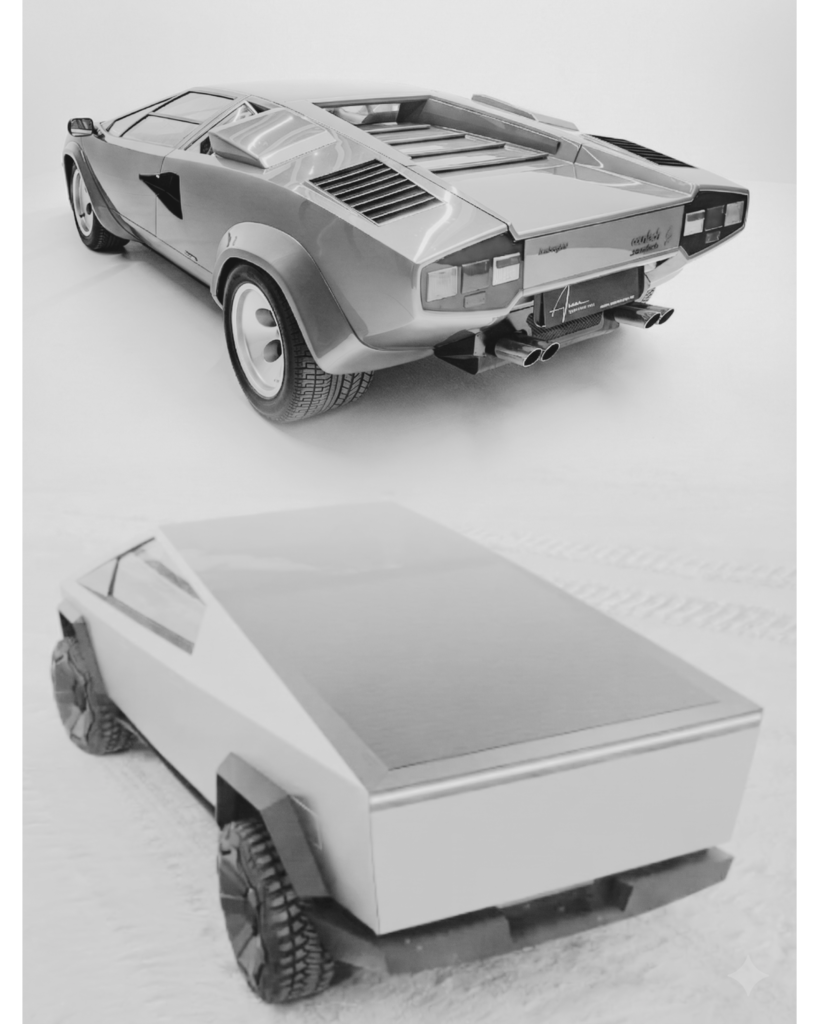
That’s why I love that the Tesla Cybertruck was inspired by the Countach. Because the designers at Lamborghini were not talking to customers and focus groups. They were not reading the auto journals for what their next car should be after that iconic Mira model. They were asking themselves, what do I want to see in the ultimate car built for the road?
Shocking the World
It’s the same thing that Tesla did with the Cybertruck. There’s this conventional boring design for a pickup truck. Franz talks about this in his interviews. He’ll make this shape in the air with his finger, when he talks about this, that pickup truck profile that every automaker follows. But Tesla created the truck they wanted to – without compromise.
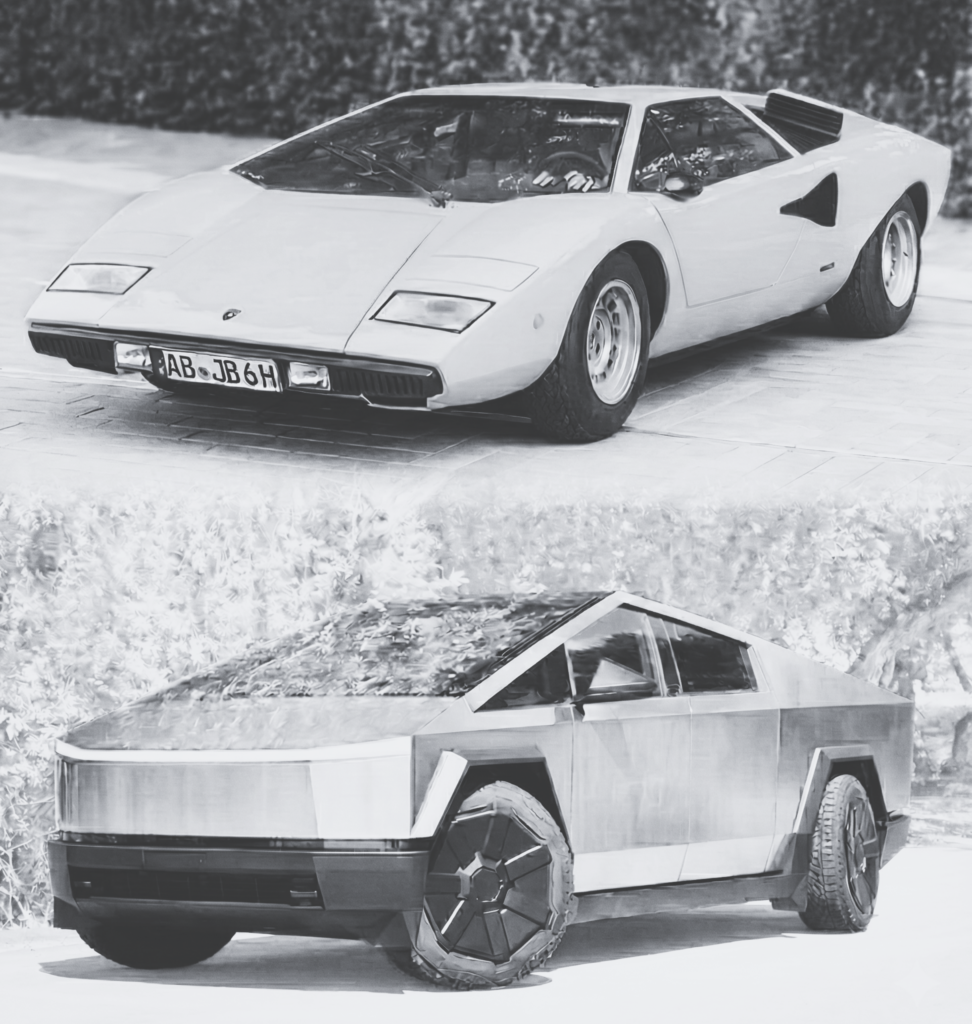
Lamborghini did the same thing with the Countach. It was radical, jaw dropping. To some, it was offensive, but totally unique and like nothing anyone’s ever seen. It created a gasp the first time you saw it. This was not an incremental improvement. Countach and Cybertruck both, these were dramatic leaps.
It was risky, but they wanted emotion.
“The philosophy behind the Countach was not based on modern marketing principles. Its design was not derived from detailed and inexpensive research into what the target customer wanted from such a car. There were no customer clinics in which people could compare the new Lamborghini directly with its rivals. Instead, with appealing Italian arrogance, it was the creation of a small group of single-minded men of enormous talent who asked themselves, rather than anyone else, the question, what is it that I want from a high-performance car?”
So that’s from the, book that I have here that I just read. It was the creation of a small group of single-minded men of enormous talent.
So the book I found, it was published back in 1990. It’s by author Peter Draun called ‘Lamborghini Countach, The Complete Story.’
The Complete Story of the Countach
And the reason I have to read an entire book for my car creator stories, because we can talk about philosophy and emotions all day long. But with these stories, once you have the design, there’s a brutal reality that you’re going to have to face.
The physical reality of building a totally outrageous, high performing sports car that people will actually buy to create the most wanted vehicle in the world, like they say in the book, to appreciate the blood, sweat and tears that go into actually engineering and manufacturing these cars.
It’s not for the faint of heart. If you want emotion, you’re gonna go against the grain and you’re gonna be paddling upstream. There’s so much to it. You’ll have to go through an entire book to figure out how the hell they pulled this off.
“Countach!”
Now think back when Tesla unveiled that Cybertruck in 2019. I can tell you the first thought that I had when I saw that truck roll out on stage. It’s the exact same thing that Nuccio Bertone said when he saw the first design for the Lambertini Countach back in 1971.
What I remember thinking about the Cybertruck was, “What the hell? Look at that thing.” Well, it turns out, Nuccio Bertone, of course, he didn’t say that same phrase because he spoke Italian. In Italian slang, what he said was, “Countach,” which actually means loosely translated in English. It means, “Are you freaking kidding me? What the hell is that?” That’s my loose translation of the word Countach.
The Tesla Cybertruck was just a concept when it rolled on stage back in 2019. They had a lot of work to do to make the beast a reality. So after my initial shock of seeing the thing, it was almost four years later that the production actually started.
Is This a Joke?
At the time, a lot of people thought it was a joke. Like I remember some people thinking it was just a prank. Like there was no way Tesla was seriously going to build that Cybertruck to drive around on roads like that. As I’m learning all about the Countach this week, and I realized it was one of the inspirations for the Cybertruck design. I started to see a lot more similarities beyond just the wedge-shaped panels.
This Is Not a Joke!
So as the Cybertruck prototype was in development, I had a really unique experience. I had sort of an insider’s view on the Cybertruck. I was involved in some things at the Tesla Gigafactory in Austin during the construction of that giant building over about four years.
During construction, they had a prototype of the Cybertruck inside that half built out Tesla gigafactory and I saw this thing getting put together inside the factory before it was ready for production.
There were only a couple of them, but as I would pass through, I could see it with my own eyes. It’s right there. They weren’t just messing around. This was no joke. Tesla was actually going to build the Cybertruck.
Gandini Proposes the Countach
Let’s go back to 1971 car designer Marcelo Gandini shows Nuccio Bertone the original design drawings and sketches, and then he says that famous word, “Countach,” and they start a four year process to get a Countach prototype engineered into what would become the first production model, the LP400. Just like Tesla, like I said, it was about four years from the unveiling of the Cybertruck to that first production model.
Back to Lamborghini – this was the hard part. Prototypes are easy, compared to manufacturing and delivering dozens of orders of high-performance supercars to customers who are just begging you to take their money.
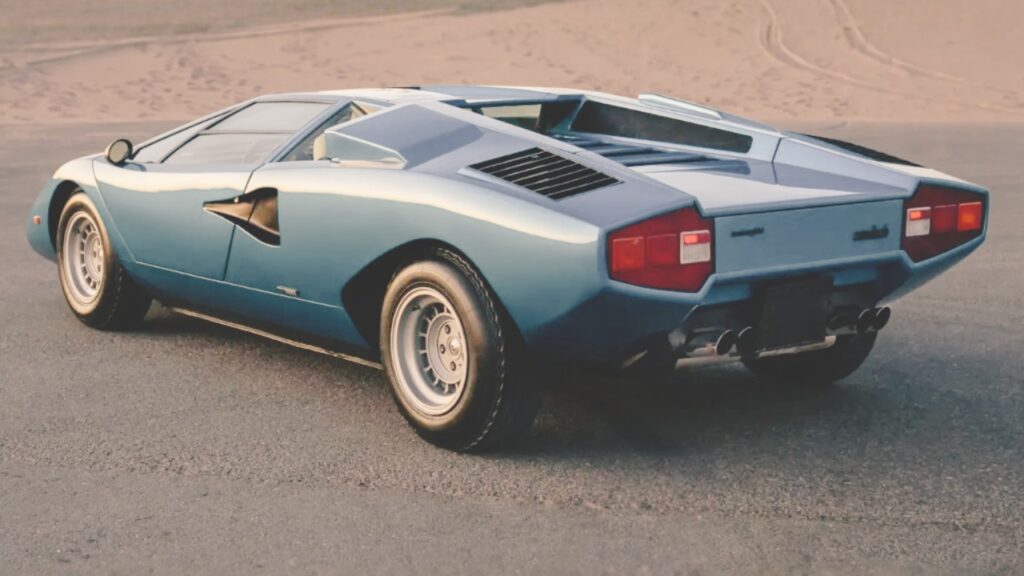
It was a long way to go before that car would go from concept to production. At least now they had a name for the car, because once Gandini and the team pitched the idea of the name Countach to Ferruccio Lamborghini, he approved and the word fit the car perfectly from that day forward.
Let’s look at this book by Peter Drahn and the very first sentence of the introduction. It just says, “Most people find the Lamborghini Countach an absurdity.” That sounds a lot like the Cybertruck when it came out.
Lamborghini Countach, It Doesn’t Matter What You ‘Think’
Some people called it absurd and ridiculous, and some people just absolutely loved it. That was the Countach when it was unveiled back in 1971. It was polarizing, futuristic, confusing, totally awesome, horrific. It was up to you. Call it whatever you want, just know that it didn’t really matter what you think. That was the attitude with this car.
The quote I read earlier from the book, it was a small group of single-minded, enormously talented engineers who created what they wanted. They didn’t give a damn what anyone else had to say. That was their message, but it worked. One of the most iconic cars of all time, inspiring other great creators like Franz von Holthausen, who hung Countach posters up on the wall when he was a kid.
So how could something so insane at the time become so iconic? Well, love it or hate it, you’ll remember the first time that you saw one. But once I learned the full story, eventually it all started to make a lot more sense. And the book says, quote, it could be argued that Lamborghini invented the modern supercar with the Countach’s predecessor, the Miura, but it was the Countach which took the concept to its logical extreme.
Absurd Power
And so that was author Peter Dron trying to explain how crazy this car was when it came out. So he lays it out all in the book. He says, even to car enthusiasts, this thing is still an absurdity. He goes, he says, nobody needs 500 horsepower in a road car, which is pretty hilarious because now we have almost a 1000 horsepower supercars all over now, which is completely absurd. But back then 500 horsepower was crazy.
And goes on and he says, this car had issues. There’s no storage space. It’s almost impossible to get in and out of the thing. There’s the crazy scissor doors that open straight up like a paper cutter. And once you squeeze into the driver’s seat, you can barely see out the tiny little back window. So you can’t go in reverse unless you pop open the driver door and sit up on the side of the car and hang out the side and look backward while trying to reverse.
Imperfections
Okay, so Dron is just getting started. He goes on with the Countach quirks. He says there’s several methods to starting the engine depending on a cold or a warm start. So you gotta run through an entire checklist first just to start the engine. Then it’s a full-blown leg workout pushing the clutch in and out. Everything’s really tight and stiff so it’s a chore to shift and change gears which makes driving this car at low speeds a physical workout.
Dron says quote, “The Countach does not like being chugged around in rush hour, nor will its occupants.” So then, and if it rains with those giant thick tires, you’re totally screwed. He says there’s a serious danger of aquaplaning if it rains. Then there’s the maintenance costs. The book says the servicing bills are, “simply horrifying.” The insurance companies will just laugh in your face when you call them to get a quote for coverage.
Didn’t matter, this was all part of the package. It wasn’t supposed to be perfect. It was not going to be everything to everyone. Most people think they’re logical and know how things should be. Well, most people are also boring and don’t know what the hell they’re talking about. Listen to this quote,
“Yet the paradox is that it is these very qualities which contribute to the Countach’s success. Its logic is its lack of logic. If you have so much money that money is no object and you want a wild toy, this argument runs, then you might as well get yourself the wildest toy in the world.”
And of course, that’s from the book. And a brand new Countach was selling for about $50,000 back in the seventies. And that’s a lot of money back then. In 1975, the average price for a new car was about $4,900. So we’re talking about 10 times the average price of a new car. That was the Countach. It’s logic – was its lack of logic.
And if you didn’t get it, like if you weren’t down with the styling and the vibe of the Countach back in the day, then we probably couldn’t hang out back then. This was a car with a certain attitude and you didn’t have to get on board with it. Maybe it just wasn’t your thing. You could learn a lot about somebody if they didn’t approve of this wild new Lamborghini Countach.
Visit to the Lamborghini Factory
So a couple years before he published his book, Peter Dron traveled to Santa Agata, in Italy. He’s doing prep work for his book and he visits the Lamborghini factory. He’d never driven a Countach, so he’s headed for his first visit to the company and even he still had some doubts going in.
But he gets there and he’s amazed to find this factory. It’s packed full of craftsmen trying to keep this company afloat. Once he drives the Countach for the first time, he’s totally blown away. Super responsive, powerful brakes, accurate steering. So, Dron’s realizing how well the car is engineered.
And then he goes, he just says this, “But that engine words cannot describe the sound that Lamborghini is a 5.2 liter V12 makes as it approaches 8,000 RPM in fifth gear. is simply staggering.”
The Need for Power
And that’s exactly what they wanted from the very beginning. Power. They wanted a powerful engine. They didn’t design the car for comfort. They didn’t want air conditioning. They didn’t want a radio or power windows.
Here’s how the book says it, “Thus the Countach was right from the beginning. What could be termed a purest car. In other words, it was a racing car for road use. It was the definitive modern supercar.”
Standing Apart from the Competition
Another key at the time, the Countach was going in a very different direction than the competition. The Mira had been out for about five or six years already and Lamborghini was getting a reputation as a cutting edge company. This wasn’t a startup with the first big product launch.
The Mira was already an epic car for several years. The success of the Mira meant they had to go to the extreme. Even further, Ferrari was moving away from exciting designs at the time in favor of practicality. So this was a chance for Lamborghini to make a huge statement.
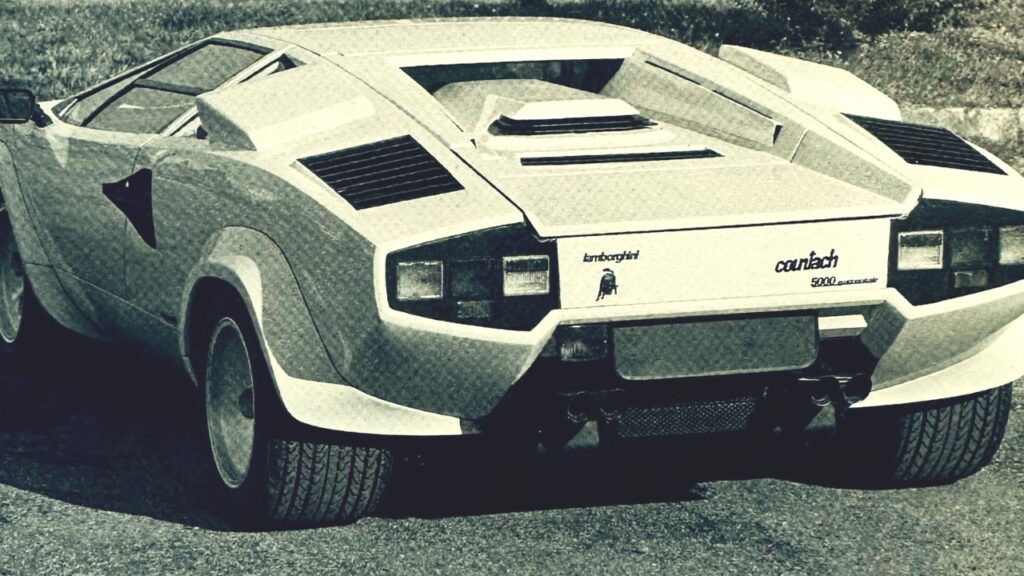
The book says it was, all about raw excitement tempered only by engineering of the finest quality. I love this. Listen to this one way drawn describes it in the book.
He says it really depends on your own definition of practicality. The car wasn’t designed to be uncomfortable on purpose or hard to climb into or impractical. They didn’t try to do that. It was just that maybe it was your definition of practical that was off. The book explains a better way to think about any comparisons to Ferrari at the time. It was just a different set of priorities.
Ferruccio Lamborghini Bows Out
Crucial to the Countach’s story is the founder, Ferruccio Lamborghini, he was on his way out of the company just as they proposed the Countach. So there were some critics who thought maybe Ferruccio was creating this monstrosity, taking this huge risk because he was leaving, like he wouldn’t need to deal with it. So why not just throw this Hail Mary?
But that was not the case. The book said sure, maybe it was his last defiant gesture, but not because he wouldn’t be around to deal with the blowback or the failure.
Such an extreme design it was actually the Miura that was the bigger gamble, because he went all in on that car when he was in a pretty solid financial position. He didn’t need to do anything like that. He was already a successful businessman, but he took a huge swing with the Miura and he hit a grand slam with that car.
The Countach was just the logical next step from the Mira Faster and more dramatic. This was the path that they were on. Their own path and they had to keep the wealthiest customers interested in the brand.
Lamborghini Countach, Power to the Max
And here’s why Dron reminds us in the book, the power of the Countach. He says, “the car is most in its element with the engine wound to the rev limit in the two upper gears.” He says it’s the car that comes into its own at speeds that are illegal. Under a hundred miles per hour, and you’re more aware of the heaviness of the clutch and the steering and the brakes. And he says, “But at speeds over a hundred, it feels precise and loosens up.”
Absurd Concentration on Speed
So I found another good quote from the book by auto journalist Paul Frere. He adds this, says,
“The only excuse for the virtually non-existent rear view and completely non-existent rear three quarter visibility is that it is fast enough to make the possibility of anyone coming up behind very unlikely. That is, if you are competent enough to drive it as it should be driven. As far as practicality is concerned, a lot could be written. But this almost absurd concentration on speed is probably why people buy a Countach.”
He says almost absurd concentration on speed. That’s the focus.
Are you understanding the Countach yet? We’re getting there!
All right. Another reason I like to go through an entire book to get the full story because there’s engineering challenges to fit a 5.2 liter V12 engine inside a wedge-shaped design that’s only 42 inches high off the ground.
Countach Engineering
They come up with some brilliant ways to position the gearbox in front of the engine and they have to figure out how to move air through this car with the least amount of air intakes. Designer Marcelo Gandini, he did not want air vents all over this thing. But the technical engineering problems are only the beginning.
Lamborghini’s trying to build the Countach, and there’s a global oil crisis going on. Italy doubles the tax on gas for cars to try to ration. They enact new lower speed limits and then they ban driving on Sundays. All driving is banned to try to conserve fuel. And this economic storm was no joke. It was actually what tipped Ferruccio Lamborghini into selling the company right at this exact same time. So it was nasty out there.
Economic Storms for the Countach
Ferruccio had other businesses that famous tractor company that made him wealthy that enabled him to start this luxury supercar business all of this economic turmoil caused trouble in the farming sector and there was a big order that was canceled in Ferruccio’s tractor company right here at this time. That was one of the big blows that forced him to sell off 51 % of his car company right at this time here.
But somehow back at the shop work on the Countach continued on.
The Shock of the Lamborghini Countach
So like I was saying earlier, it’s one thing to roll out a prototype onto a stage and shock people with a cool looking design, but to deliver, to manufacture, that’s the real struggle.
They showed the car for the first time at the 1971 Geneva Auto Show and they had orders for the car pour in immediately. They knew they just created emotion that they were looking for with that prototype. The book says they got so many orders from that first auto show they had to start production as soon as possible.
So the crucial part, the quote that I read earlier, single minded men of enormous talent. Who were these guys? Paolo Stanzani, he was the chief engineer and then Marcelo Gandini, he was the chief designer. What Gandini wanted was only essential functions, which meant a minimum number of air intakes and then the entire body needed to be as flush to the overall shape as possible.
Marcello Gandini, the Legend Designer
They didn’t just get lucky with this design. One of the all-time great car designers, Marcelo Gandini, who was leading the project. That group of single-minded men of enormous talent, it would take all of them to figure this thing out. The doors opening straight up and forward. This was something that was never done before in a production car.
Mercedes had the gullwing doors 20 years earlier that flipped straight up and out. But the paper cutter doors were never attempted on a production car up to this point. They rotated from a hinge in the front and twisted straight up, and that became one of the most iconic features.
And in the book, not everybody loved the design of the Countach. But here’s what it says, “But you certainly cannot ignore it. No car designer before or since has made such a dramatic visual statement.”
So between Gandini, Stanzanni, the chief engineer, and then Bob Wallace, the chief test driver, it took three years in the factory to come out with a Countach ready for production.
Don’t forget they’re doing this in the middle of a global oil crisis with their boss Ferruccio Lamborghini selling off the company because of this total economic cluster going on all around.
But they did it.
1974 Geneva Auto Show, they rolled out the LP400 Countach, which would become the first production model. Over the next 25 years, Lamborghini made several variations of the original LP400 model. It was the LP400S, the LP500S, then the 5000QV, and then after that, the Countach anniversary model.
The Polarizing Reactions of the Countach
And all those models have slightly different profiles and details, which is pretty cool because it was already a totally outrageous original design. And then with each iteration of the Countach, you get more polarizing opinions.
It’s like a never ending debate trying to figure out these designs and angles and what to make of them. Each time the design changes – and I love this quote in the book – because I’ve taken a closer look at all these different models as I’m reading this book and they all look so unique from different angles. And even depending on how the lighting is hitting the car, it’s just amazing how much it changes the look. And then even the exterior color changes that visual look so much.
So listen to this quote from the book. It describes this perfectly. It says, “From every angle, the Countach is an interesting piece of sculpture in which form is narrowly beaten into second place by function.”
So this was really cool in the book. The author includes a bunch of reviews from auto magazines that were written about the Countach back in the day. As the journalists were trying to decide how to write about this car.
Check this out. The author, Peter Dron, he says, he’s tested at least a hundred cars per year and had to keep notes on each one so he didn’t get them all confused. But he says with the Countach, “If you cannot recall all the details of your drive in a Countach, then you’ve probably forgotten your own name.”
Journalists Review the Countach
He said he’s still astonished by the sight of the car. And this is already in the 80s. He’s writing this and he adds that he says it has an animal quality absent from most modern rivals. During his test drive of the Countach, Dron said that at low speeds it’s miserable. But then he goes,
“However, get it onto a suitable stretch of road and your opinions can change very rapidly. Apart from all the other qualities of the car, the engine is simply wonderful with a unique blend of refinement and aggression.”
Here’s another great review by Mel Nichols from Car Magazine. One of the more creative writers in the car scene back in the seventies. They gave him a test drive in the Countach. Here’s how he described it.
“The straight was running out and we were rushing at the bend. Stanislao Sterzel’s foot stayed flat to the floor and the V12 behind our heads almost between our heads went on snarling. The tachometer needle went on climbing: six-six six-seven six-eight. Even at those revs, in fifth, and thus with the speed already well in excess of 170mph, we were still being pressed back hard into our seats. Prisoners of that incredible power plant. Such tarnished savagery, such thrust. Would it ever stop? Was it running away with us, sweeping us beyond control, as surely as though we were in the clutches of a riptide?”
Wow! That was Mel Nichols. He loved that test drive. As you can see, he was impressed with the power.
Countach Did Not Compromise
That’s why I love that quote that I read at the beginning. The creators of the Countach, didn’t do expensive research to see what anyone else wanted. It was no compromise. A pure sensory experience above all else. Again, they were going for emotion. And then maybe some comfort and convenience if there’s anything left over. That’s what they wanted in a car and they found out there were other enthusiasts who wanted the same thing. Even decades later, journalists said the Countach,
“Exists outside the constraints of convention, fashion, some may add taste.”
They didn’t care. Lamborghini was going in their own direction here. Here’s another great review from back in 1983 from Car and Driver, Patrick Bidard, the editor. Here’s what he wrote.
“This is a bad boy’s car and everybody knows it. Just being seen at the wheel of such a thing is prima facie evidence that you’re a regular traveler beyond the borders of good judgment, good sense and good taste.”
This is this guy, Bedard. He was skeptical of the high speeds that Lamborghini was claiming for the Countach. But then he ends his review with this. Check it out.
“It is not what the Countach can do for you that counts, but what it does to others. This car was made for shattering sensibilities. It performs equally well in heavy-duty neighborhood work or on fleeting targets of opportunity. If driving it requires earplugs and the strength of two legs on the clutch, well, nobody ever said being a bad boy was all fun.”
That’s awesome.
Countach Carries the Lamborghini Brand
The Countach carried Lamborghini through the crisis of the 70s. The brand was pretty much synonymous with the Countach all the way up until the Diablo came out in the 1990s.
Not only that, but they bent this entire industry toward this extreme design idea. Ferrari had to come up with something shocking that led them to the GTO and the F40. They had to respond. Here’s one more review and one more attempt to describe the impact of the Countach. This was from the book by an anonymous writer and they said,
“Its mission is not and never has been to present a responsible face to the world, nor is its mission to fine hone the cutting edge of automotive technology. This is not transportation in any normal sense.”
I love it. These reviews go on and on in the book. The epic story of the Countach is the tension between the pure vision of its creators and the impractical and legendary reality it created. It’s a physical symbol of courage and dedication and uncompromising charisma.
Marcello Gandini, the Great Designer
Which leads us back to the designer, Marcello Gandini. Possibly the greatest car designer of all time. I stumbled on a profile of Gandini just as he passed away in 2024 at the age of 85. The opening quote that I read to start the episode was from this profile in ‘The Times.’
Just like we asked Franz von Holtzhausen what inspires him to create show-stopping designs like the Cybertruck. You can see the visions come out in the vehicles.
Franz said it when he was a kid, he had posters hanging of the Lamborghini Countach. He loved that wedge shape. And then things start to make sense. This creator’s story starts to come together once you learn all about the inspiration.
Following the Dream
When Gandini was a kid growing up in Italy, he had a different experience than Franz. He grew up with a strict father who wanted him to become a classical pianist. Gandini’s father was an orchestra conductor and this was the dream he had for his son, and it was all mapped out from an early age.
This was the plan.
Well, young Marcelo Gandini had a different idea. During his first year of high school, Marcelo was given money to buy a book on Latin. He didn’t buy that book on Latin. He instead, he bought a book called, ‘Endothermic Engines,’ authored by the designer of the Fiat 500. Marcelo said he analyzed every line of that book and he quickly knew it by heart. The world of classical piano was not for him.
He said it like this, “All this classical culture, such rigid and conservative context immediately triggered in me an unconditioned passion for engines, mechanics and technology, whether it be design, racing or innovations.”
So Marcello Gandini was hooked. This was going to be his future, but he had an immediate big problem on his hands. His strict father was crushed that he wouldn’t follow his rules.
So we forced him to leave home when he was 18 years old. He booted him out. It didn’t stop Gandini. He continued his drawings and he followed his passion. He slept at a friend’s house for a while. And then he eventually got a job at the auto design shop, Nuccio Bertone.
They hired him because they noticed this “iconoclastic zeal,” is what they said.
And then his career took off. By the age of 27, he became the chief designer at Bertone. As soon as he becomes chief designer, they ask him to design a new car for the automaker, Lamborghini.
But there’s a catch.
They need something fast. As in, they don’t have much time.
The Geneva Motor Show is only three months away. So from the first sketch to the official unveiling at the Geneva Motor Show three months later, Marcello Gandini designed the Lamborghini Mira.
This is not normal! I say this in a lot of these episodes. My last episode was on the baseball legend, Willie Mays, and I said that a few times in that story. This is not normal behavior to create the Mira at age 27 in just a few months. And by the way, at the same time he’s designing the Mira with that insane schedule, he was also working on a design for Jaguar and a design for the Porsche 911 roadster at the same time.
Gandini, The Legend is Born
Well, Marcello Gandini is just getting started because after the Miura was the Countach about five years later.
And everything that we’ve been talking about in this Countach story, that’s Marcello Gandini, one of the greatest car creators of all time.
So he worked into his old age and as that computer aided design became the standard, he struggled to keep up a bit because he was such a big believer in sketching and drawing ideas down on paper in the early stages. In his seventies, he gave some great advice to the young car designers. I love this thought, it said,
“Don’t stop writing, drawing, calculating, creating sketches on paper. The pencil is an extraordinary means of connection between the brain, ideas, and reality. Starting a project from a sheet of paper and a pencil means there is an idea. If there is no original idea, no technological wonder can create it for you.”
Marcelo Gandini was known as a modest and courtly figure. He was graceful instead of flamboyant. That’s exactly how they described him in this profile. Then it says this, when he turned 80 years old, it said in a rare moment of hubris, he said of the Countach,
“Nothing better has been done since.”
That’s awesome.
Now check this out. The profile includes this incredible little nugget. When Lamborghini rolled the very last Countach off the production line back in 1990, after almost 2000 were created, they offered the very last model off the line to Gandini as a gift, but he declined.
They asked him why he declined the very last Countach. He said, “I didn’t want to have to polish it all the time.”
This guy’s a legend. A few episodes ago, I did a story on Victor David Brenner, the creator of the Lincoln cent, the penny over 427 billion Lincoln cents were produced by the U S Mint, and that made it the most reproduced work of art in world history.
And I called Brenner a legend. And then I just made up a new definition for the word “legend,” because that word might be the most overused and abused word ever.
But legend applies to Marcelo Gandini, just like Brenner. So instead of a legend or a better way to say legend anyway, I’ll just say it like this, that “Gandini’s work remains.” That’s all you need to know.
Gandini said his greatest pleasure was proving his father wrong. And here’s how he described it.
“He wanted me to become a pianist. It wasn’t until he got on board the Lamborghini Mira that he realized that I knew how to play other notes.”