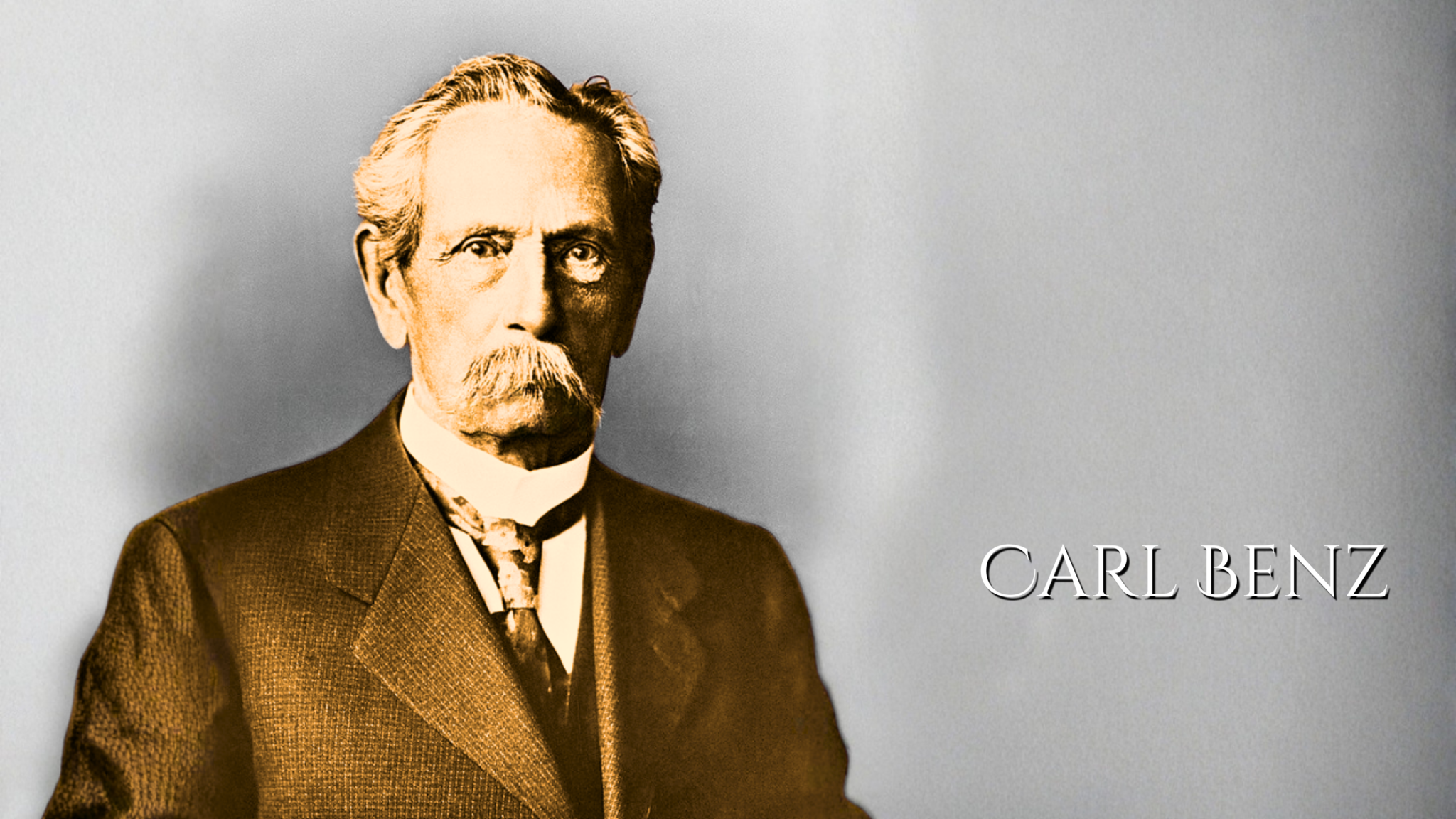
Carl Benz
Carl Benz, Father of the Automobile
Episode #40
04.15.26
“But despite all this, I must answer the question. What feelings might have gripped old Dr. Benz as he drove his once self-designed vehicle at the head of all those who, in diligent competition, had become his successors and competitors in pursuing his ideas? With a note of melancholy, believe me, inventing is infinitely more beautiful than having invented. Oh! How I wish I could start all over again.”
– Memoirs of Carl Benz
That’s the last page of this unbelievable book that I just finished reading, The Memoirs of Carl Benz, published in 1925, written on his 80th birthday.
This is by far my favorite example of a rare and powerful combination. Out of all the stories that I’ve read, it’s extreme stubbornness and an optimistic spirit. I could read this book over and over because the writing is incredible.
The Legend, Carl Benz
Carl Benz, as he just turned 80 years old, he’s looking back at his amazing life. This was the first and only book he ever wrote. It’s crazy because I can almost hear his voice as I read the book. Even though I have no idea what he actually sounded like, I’ve never heard him talk. But the powerful inventor’s spirit of Carl Benz comes right through this entire book.
Stubborn and determined, tough as nails, focused on his ultimate goal.
But with a positive outlook, a youthful joy, his entire life, meeting every setback with energy and creativity to find the next step decade after decade, enduring the mockery from the crowd that you can tell it was still painful as he wrote his book and thought back on his amazing life.
Memoirs of an 80-Year-Old Inventor
He writes with this deep emotion and incredible authority. At one point he just says, “A thousand others would have given up in despair, and abandoned the project unfinished.”
And at the same time, he’s thankful and he’s humble. And now that it’s all over Carl Benz, he could have easily just said, I told you, how do you like me now? But he doesn’t say that at all. He didn’t forget about all the critics, but he’s way too wise and he’s way too overjoyed thinking about his crazy and unbelievable journey.
So usually I like to start out these episodes with a big moment that just jumped right out at me. That big turning point in the story.
I’m not doing that with Carl Benz. I went right to the end. I couldn’t make you wait until the end of this episode for that unbelievable quote. It tells you everything you need to know about this guy and his incredible spirit. The quote that I read to start this episode, it’s the last paragraph in the book. And they just had this big 80th birthday celebration to honor Carl Benz.
He says, “Certainly I appreciate being among the fortunate few who were able to witness the victory and triumph of their inventive idea on this culturally transformative scale.”
“Inventing is Infinitely More Beautiful than, Having Invented”
And then now he wants to answer this question right here. And it’s probably something that somebody asked him at this party when they honored all of his accomplishments. They had this big parade, all the heads of state and business leaders attended.
And Benz was at the front leading the way. He was leading this parade as they honored his life on his 80th birthday. And what I just read at the beginning, he said, “But despite all of this, I must answer the question with a note of melancholy.”
And so this is the question they were asking him. Like, “How does it feel? What’s it like to be honored like this on this great day? We’re all here. Give us your thoughts.”
So I’ll just read it again. This is what he says. He said,
“Believe me, inventing is infinitely more beautiful than having invented. Oh! How I wish I could start all over again.”
You really don’t even have to listen any further. This captures everything right here after reading this book, all the struggle and failure and the fun that he was having his entire life.
He just says, I wish I could just start all over again. Freaking legend right there. Carl Benz.
So now I’m going to talk about the rest of the story, of course, but it was such a treat to read this book. And you need to remember that if you don’t listen any further, that phrase hit me hard, personally, thinking about what it means to live a good life. Full of energy and passion.
As an 80 year old guy, Carl Benz, he just says, how I wish I could start all over again. That’s awesome. So let’s continue on in this story, but we got to go back. We got to back up about 40 years. And it’s a big moment. I said, I’d to start with the big turning point in these stories. Well, here’s one of them. Of about 50 turning points in this story!
Carl Benz and the Final Stage of Invention
Car’s at what he calls the third and final stage of invention. He knows what he just created is amazing, but he’s the only one who knows it. At this point, he says,
“Now that I thought I was at the top, at the height of inventor’s luck, I realized I was at rock bottom. At the very bottom, and had to knock like a beggar at the door of humanity and its culture. A great gray worry now stood before me, compared to which all previous inventor’s worries were nothing but petty schoolboy anxieties. Now it was a matter of taking up the fight against the smiles and laughter of the mocking crowd. It was a matter of asserting myself and my invention. Despite all the denial and rejection, the brooding inventor had to become the cultural conqueror, the struggle with problems, the struggle for the future of the enterprise. That was the third and final stage of invention, that perilous stage over which many a great inventor, after overcoming the first and second stages, had collapsed in despair. Collapsed because humanity offered the unappointed benefactor a pittance instead of a reward. But I had no need to fear that pittance. My coveted stationary two-stroke engines would see to that. But I experienced firsthand at every turn that overcoming this third stage of invention required the utmost perseverance and tenacity and a remarkable strength of character.”
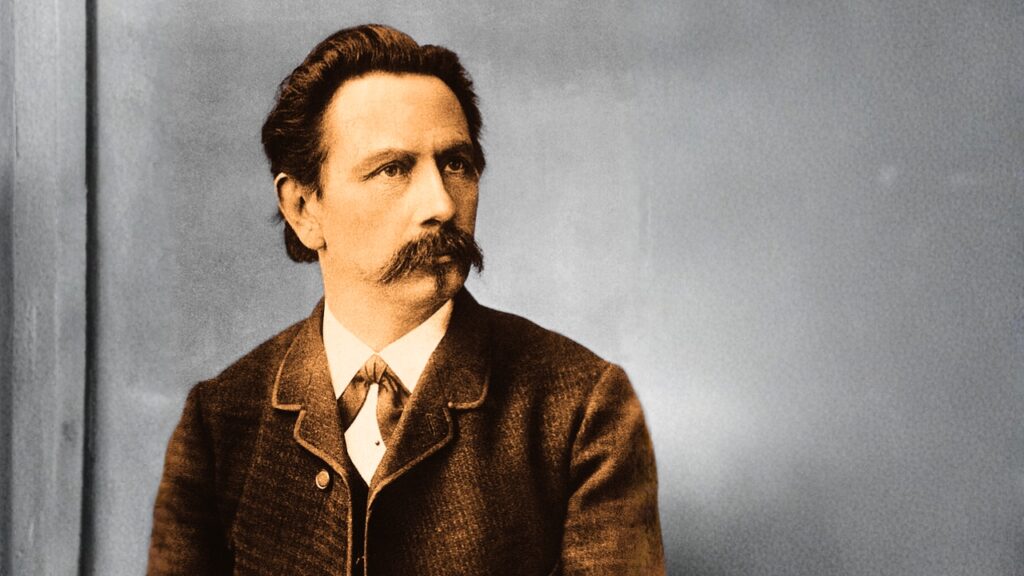
Alright, so I hope you’re getting the idea now. Who Carl Benz is. It shouldn’t take you long to figure out. Something might be going on with this guy right here.
I had to translate this book from German to English first before I could read it. I couldn’t find an English copy.
So I just did an episode on Bertha Benz, Carl’s wife, and I used these memoirs for that episode, because I discovered Bertha didn’t write anything down during her life. And like I said in that episode, she was too busy working to write anything down. So Carl did that for her and documented their amazing life together in his memoirs.
Carl never quits. Just when he thought he was at the very top, at the height of inventor’s luck, he realized he was at rock bottom once again. But he won’t back down.
The Rejection of the Public
He was finding out that creating the first motor wagon and testing it, getting it to run smoothly, that was only the very beginning. The first and second stages, like he calls it, those were almost easy compared to the third and final stage. A remarkable strength of character is needed. Like he said, he needed people to accept his invention and find it useful and then buy it. It’s gonna be the biggest challenge of all.
So Carl, in that quote I read, he’s now finding out how stubborn people are gonna be. They just flat out rejected his invention for so long. And this pattern of amazing ups and downs, struggle, despair, failure, but then the way Benz responds every time with optimism and grit, the inventor’s mindset, that there’s always a creative solution to any problem. He just has to work harder until he sees it. So where did Carl Benz get this strength and tenacity?
He goes back to his ancestors who were mostly blacksmiths. He says his ancestors were lined up in a long line, all with aprons tied around their necks and hammers in hand. He said in his book, “They let the song of technology ring out brightly and loudly from the anvil of his workshop into the silence of the village peace.”
So I’m not sure if you just caught that, but Ben’s just said his blacksmith ancestors let the song of technology ring out, from the anvil.
He goes on, says,
“My ancestors who all lived within me in some brain cell, in some drop of blood or in some heart fiber, apparently all want to sing along and shout for joy from within me.”
Okay, I hope you can see now this writing and this might be the most powerful part of the book right here. We get to his father. Carl’s father was different. Instead of becoming a blacksmith, his dad went to work on the new railway line that has just opened up. It’s another new form of technology. It was the locomotive.
Carl Benz and his Ancestors
He says “The iron track led into a new world of wonders.” His father worked on one of the very first trains to run through Germany, but then he says he never knew his dad. He never got to meet him. His dad passed away when Carl was two years old.
“Men came and carried my father away to the place from which no one ever returns. To the cemetery. They carried him away and with him, our happiness. Death had taken the beaming leader by the hand on the plane and never let him go. A victim of his profession, he died as it were in the tunnels.”
So Carl’s dad went out to help a derailed train and trying to get it back on the tracks, he caught pneumonia and he passed away after a few days in the hospital.
Carl Loses His Father
“What my dead father left me as an inheritance was almost nothing but the shining example of the ethical imperative. “Let man be noble, helpful, and good.” And so at the age of two, I became fatherless, but I still had a mother. She was the best mother in the world.”
Carl’s mother is completely focused on raising her son now and giving him as much opportunities possible. She gave him what he calls lenses, so he could take photographs. It’s like, it’s one of the first cameras. And this is how he made his first pennies in life. He says, as a photographer and a watchmaker.
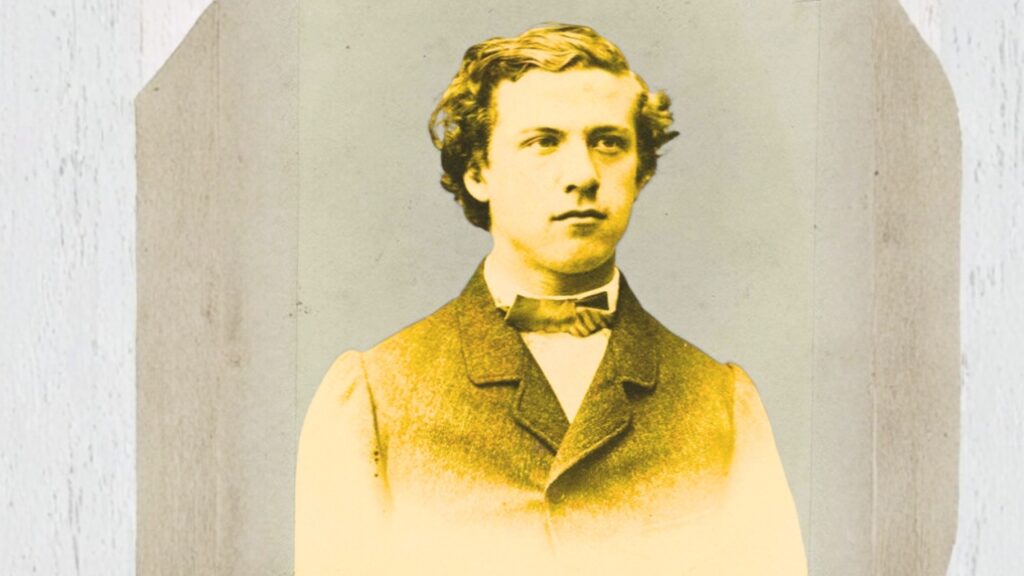
“My ultimate goal was an acquired book knowledge, but rather self-taught, experiential knowledge. Even today, I see the greatest educational value of the natural sciences in the practical struggle with problems.”
So Carl earns money now for the first time by taking photos for people. And then he also learns the art of watchmaking and how to repair watches. He says, “As a photographer, I earned my first pennies in life. As a photographer and as a watchmaker, whatever watch was tired and ill, I helped it get back on its feet safely.”
And this is cool because what his dad left for Carl turns out to be something that he’s going to take with him his entire life. The love of watches and timekeeping.
A Love of Timekeeping
He says, “Five pocket watches left behind. That’s an inheritance that holds more appeal for an inquisitive young tinkerer than an entire manor.”
Carl learns how interlocking gears of a watch speak to each other. He loves watches and keeping time. In his entire life, he’d keep a clock in every room of his house, and then he’d go to the train station every few weeks to get the official time to make sure all the clocks in his house had the exact correct time.
You can see now even with the loss of his father when he’s only two, his mother’s setting him up early in life with the love of learning, fixing watches, taking pictures, making money. And now his next stroke of luck is the school that he attends. It’s the Karlsruhe Polytechnic School. And at this school, he runs into one of his heroes, professor named Rettenbacher. They learned hands on at this school and Karl knows it’s not just about book smarts. You got to have both.
The Great Mentor
He knew this and then his professor Retenbacher was this inspiration who just lit the fuse of all of his students. Listen to how Carl explains his teacher.
“Familiarity with Homer and Cicero did not prevent the engineering student Benz from looking up with reverence to the simple man of manual labor and skill. More respect for the work of hands, for craftsmanship has always been my motto. And so the two, Master and his apprentice, soon became the best of friends. The new teacher understood nothing of dietics or heuristics, but he knew how to ignite the blazing fire of professional enthusiasm in his pupil, so that flames of passion burst forth from every window of his soul. Therefore, we find him in the workshop, even outside of prescribed class time, tinkering and creating for many hours. And the stalwart Master could never tire of giving suggestions and impulses for the new designs and creations.”
So that’s Rettenbacher right there. That is professor. He’s giving his students “blazing fire of professional enthusiasm!”
So now he’s still in school and he’s totally inspired by this professor. And he starts to dream of building a self-propelled vehicle. He says,
“Boldly, I had set myself the highest goal. It was to be a vehicle like my father’s without horses, but also without rails. A self-driving road vehicle.”
Now Carl’s gonna start to take this idea very seriously. To free the locomotive from its constraints. That’s what he says. But he’s patient. Carl knows it’s gonna be a long road to do this. He’s got to be patient.
And I think this is a really funny part of this book right here. Check this out. He says,
“I told myself quite rightly in order to meet all the demands of the future. To create outstanding value, one must start at the very bottom with the basics.”
Start at the Bottom, With the Basics!
And so I think that’s really funny because as we get into this story, remember he basically has nothing right now other than this passion and energy. He says to create outstanding value, you have to start at the bottom with the basics. Well, that’s exactly where he’s starting. He’s already at the very bottom. And this is what I love in this book, this optimistic spirit.
You can see him thinking back and he’s writing his memoirs at age 80. He’s thinking back and remembering his attitude at the time was just like, well, I’m at the very bottom right now. I’m learning the basics, but that’s perfect because to create outstanding value and meet all the demands of the future, I should start out at the very bottom. And this is the spirit of Carl Benz his entire life. Whatever he has or doesn’t have, he’s gonna spin it around and make it into a positive. This is the pattern, I love it.
So he wants to get this locomotive off the tracks and onto the road. He says, “It shouldn’t be bound to the rigid track, but it should dominate the entire space. Left, right, up and down.”
His guiding principle at the time was let the tracks go. So Carl goes to pencil and paper first. The basics.
Pencil to Paper
And this is another trend that I love, especially in these car creator stories that I’ve been doing. Adrian Newey, the famous F1 car designer. Pencil to paper. That’s what he was all about. Marcelo Gandini, the famous car designer from my Lamborghini Countach episode that I did. Pencil to paper. That’s all he talked about. That’s how he worked. Gordon Murray had an entire notebook from when he was in college and he printed this notebook, into this unbelievable book that I have on the McLaren F1. Drawing and sketching is how Gordon Murray came up with that McLaren F1.
Well, back up over a hundred years before all those legends, and Carl Benz was doing the exact same thing. Pencil to paper. He was sketching out the very first Benz motor wagon on paper. He says, “With every meticulous detail, a first draft, a first drawing emerged.”
And then check this out. Here’s what I was saying. This optimistic spirit over and over. He knew he had to start with the very basics because that’s all he had at the time and nothing else. He says,
“My vehicle has always remained just a paper model as I lacked pretty much everything for its practical implementation, money, time and opportunity.”
But he’s got a sketch. He’s drawing and that’s a start. You know, he was a big fan of the bicycle early on when he was younger. It was the bicycle that was the newest invention at the time and thought to be a little crazy and dangerous too. But with Carl, the invention of the bicycle was just more confirmation of this idea to travel without a horse. That’s the idea he’s now completely obsessed with. He says the idea of traveling without a horse, “Now gripped me with the full force of my inquisitive instincts and gave me no peace day or night.”
But he sees a few problems with the bicycle. First of all, the two wheels are not enough. He wants a carriage that’s comfortable with a bench for more than one person. Second, he didn’t want pedals. He wanted machine power to replace the human power.
“But how? That was the question that occupied me from then on,” he writes.
That’s a big question. Because prior to this, they only had the steam engine, which was too big. He needed something smaller to attach to a carriage, but also powerful.
So he needed something that didn’t exist yet.
The amazing life at Carl Benz was constant ups and downs, nonstop. His father passed away when he was two years old, but his mother pours every ounce of energy into raising him the best she could. He’s now on a life’s mission to create a machine-powered carriage, something that didn’t exist yet, but absolutely zero resources to get started. But luckily, with a great education from the Polytechnic School.
Meeting Bertha
The one thing that he can do is find a job. So he can start to learn all about engineering in the real world. And then he can also start to save some money because he knows he’s gonna need to start his own workshop as soon as possible. This optimistic spirit doesn’t prevent failures though. But with every failure, there’s luck waiting right around the corner for Benz. And here’s what I mean.
He takes a job at Bekenster Brothers, this bridge construction company. It would be the luckiest break of his life right here because at this company, he meets his future wife Bertha Ringer, soon to be Bertha Benz.
Now the full story on why this was the luckiest break of Carl’s life, you’ve got to check out my episode on Bertha Benz. Just a few episodes ago, I had to translate an entire 300 page book from German to learn about Bertha. And then these memoirs from Carl have plenty to say about Bertha and why she was so important.
So I can’t get into the full Bertha story right now, but this should give you an idea right here. Carl said about meeting Bertha, he said,
“To gain experience in bridge construction, I joined Bekenster Brothers Company in Pforzheim, but I learned more than just bridge building there. I encountered happiness there, young and beautiful. The happiness that would later become my life’s happiness, acting as a second driving force against the hem in my creative struggle and work. Repeatedly gave me new impetus to the resistance. Bertha Ringer was the name of the spirited child from Pforzheim who henceforth joined the circle of my ideas and interests, contributing her own ideas and advice.”
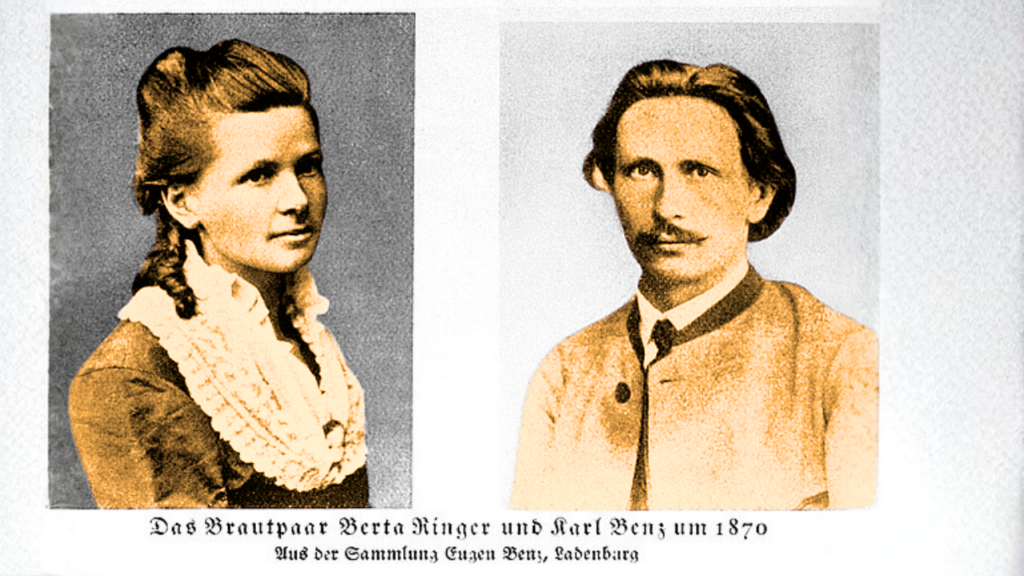
Okay, he just said Bertha, “gave him a second driving force against the hem in my creative struggle.” Again, you gotta check out my Bertha episode. Anyway, Benz continues on. These two are quickly married, Carl’s not messing around, he’s gonna marry Bertha. He knows he just struck gold with Bertha.
And here’s why I say that, because he wrote this, “I married in 1872. With him an idealist came to my side, someone who knew what he wanted, from the small and narrow to the great, the bright, the expansive. What until then had been a plan and a dream now had to take flight and soar into action. All belief and hope, all struggle and wrestling, but also all fulfillment and completion now became a passionate shared experience.”
Partners
Carl has a partner now, and this is the definition of synergy right here. I say that because I had an old boss way back in the day. This guy was amazing. And he talked about synergy all the time. And I was so young back then, I had no idea what he was trying to say.
But this is synergy right here. Carl and Bertha join together now. One plus one equals a thousand. And now I understand synergy, finally.
So now they’re completely locked in and they’re supporting each other on all these ideas and how to invent the future. The young couple save up for a workshop. But what to do next? Well, Carl’s not really sure, but he knows he’s going to figure something out.
Listen to this optimism. He writes, “This mechanical workshop marks the beginning and starting point of a remarkable industrial and cultural trajectory of upward development. Although I had no idea at the time of the course this trajectory would take, I sensed, trusting in the miraculous power of intuition, that it would be an upward one.”
Let me cut in right here for a second. This is why I love reading this book.
The writing is amazing, of course. Remember, this is the only book Carl Benz ever wrote. It’s his 80th birthday. He’s finally writing his life story. This was the first time he wrote anything, and he’s probably a better writer than 99 % of anyone alive. Anyway, it’s the positive spirit again. He wasn’t sure of the course at the time, but he sensed, trusting in the miraculous power of intuition that it would be an upward one. Are you kidding me?
Okay, he goes on. Check out his description. Carl knows how important it is to get off on his own, not as an employee anymore, but as a man in charge of his own destiny with his own workshop. Listen to this.
“Now I believed I had learned enough practically and theoretically to put myself in the lookout position, to determine the direction of travel myself, to put my own hand in the spokes of the wheel.”
So he’s got his own workshop. He’s got his hands on the wheel in the lookout position, but how to get started. He’s going to determine the direction of travel himself. Remember he keeps going on. says,
“The business started small and modest, but began to take root. Since I was after all a stranger in Mannheim on a business level, it was very difficult for me to gain a foothold.”
And it was difficult, but it was not impossible, for Carl Benz, that’s the attitude that he’s got. He uncovers the next step every single time because he says this,
The Benz Workshop and the Engine
“Suddenly there it was before us, the Pathfinder pointing auspiciously to the future. And this Pathfinder was the gas engine. I was convinced that the gas engine was destined to stand alongside the steam engine as a powerful competitor and to play the most significant role in powering machinery and vehicles.”
So this is a big deal right here because gas engines were new. Carl says gas engines were still in their infancy at the time and suffered from all sorts of teething problems. So there was a famous inventor from France, Lenoir, and he’d been working on a gas engine since 1860, but the thing could only run for about 10 minutes. Carl said that engine was such a guzzler of oil and lubricant, that it was jokingly called a “rotating lump of oil.”
It was just a slight variation of the steam engine. Benz thought he could improve it and he gets to work. This leads to one of the most famous scenes from my Bertha Benz episode right here. It was New Year’s Eve. Carl’s been struggling with his new version of the gas engine in the workshop and they have a big breakthrough.
Carl Benz on “Luck”
But first of all, before we move on anymore, Carl wants to talk about luck. I’ve already said, sometimes it seems like Carl gets lucky when things are looking pretty grim. Well, here’s Carl correcting me. He says, be careful how you describe this luck. He says, because you and me might have a different definition of luck. So right here, check this out, he goes,
“So I had no other choice but to try my luck, on my own and find a good solution myself. I turned to the two-stroke engine and got lucky. But luck didn’t come on a whim, nor was it the luck of inventive serendipity. Rather, was the luck of tenacious, tireless work, which in the systematic pursuit of a goal, finally sets the pendulum in motion. But to be able to work on the backs of experimentation, money is needed.”
So listen to that again.
If you want to know what Carl Benz thinks about luck, it’s called “tenacious tireless work.” I love it. Back to the engine though, they sink every single penny they have into this engine idea, but they can’t make it work out. But Bertha says, Hey, let’s go try it one more time. So they both go out to the workshop, New Year’s Eve, and they fire up this engine and the thing starts right up and it runs for a full hour. And they both just sit there and listen to this engine run.
It’s an emotional story as he’s writing all of this. It’s New Year’s Eve night. And I talked more about this in my Bertha Benz episode, but that’s a much needed boost for Carl and Bertha right now. A working engine that runs for a long time, an hour. And you can call it luck if you want, but it was just tenacious, tireless work. Don’t forget that. Which in the systematic pursuit of a goal finally sets the pendulum in motion. So if that’s luck to you, go ahead and you can call that luck.
But remember what else he said. Money is needed to be able to work on the backs of experimentation. You need money. You need investment. They put everything they had into the engine just to get it to run. They need more money. They need to keep going. They need partners to come in and invest. Listen to this quote from Carl. He’s talking about investment. He needs someone to come in and support him so he can continue his work. Here’s how he lays it out.
“Wherever something great has been achieved on the anvil of technology, hammer blows were necessary. Resistance had to be broken down, prevailing opinions hammered together so that the new form could emerge with indomitable creative power, despite all financial inhibitions and commercial obstacles.”
That’s what he went through, he needs someone to come in with him and partner. So luckily, people are noticing the talents that Benz has with this engine. And he attracts an investor who wants to get into the engine business with him, which is great because the business takes off and this company now grows from six employees to over 40. And it’s good news. But Carl knows he’s only halfway to the goal to create his engine powered wagon.
Benz and his Partners
But his business partner wants nothing to do with it. He wants to make money with the engines and that’s it. They told him, “no games, no fantasies.” They told Carl, “Don’t chase after phantoms.” Let’s make money with the engines. So Carl says,
“Thus the hopeful optimism, the sunny strong belief in the great inventor’s ideal stood in stark contrast to an impenetrable wall of business skepticism and financial pessimism.”
Carl has the talent and the skill to make money now with engines, but he can’t convince his partners to expand into the horseless wagon dream that he has. But do you really think that’s going to stop Carl Benz? There’s no way. He says,
“But when the others finished work and left, I in the manner of Frederick the Great, took out my beloved flute and played cheerful melodies of the future. Whatever thoughts, drafts and plans trembled quietly across the drawing board. One day they would unite in the loud, harmonious, technical overture of the motorized vehicle.”
He just said his plans trembled quietly across the drawing board. But one day they would unite in a loud, harmonious, technical overture of his vehicle in the manner of Frederick the Great. And I had to look this up, but Frederick the Great loved music as a kid. You might want to read this entire book, by the way. I had a feeling that Carl Benz was making a reference of some kind with Frederick the Great right there. And it turns out they both love music.
Anyway, Carl loses his partner now. Another big setback because the partners have all the money. Carl has the skill. He doesn’t want to stop and only build engines though. He wants to go all the way and design his own motor wagon. But these partners think Carl’s out of his freaking mind. So a new partner for Carl, but still, he says,
“Only after so much value had been created on the ground of solid, practical work that the further development of the business rested on a secure foundation. Were they willing to take the leap into the future and build bridges for the forward-moving company? I had no choice but to accept these conditions. But the fact that absolutely no one wanted to believe my aerial vision cut me to the core. I felt like a caged bird behind golden bars gazing upward with bound wings at its flying companions. But captivity wasn’t as bad as I had feared in my initial despair. With a renewed zeal, I now threw myself into working on the two-stroke engines that held the magic key to salvation.”
And this is another great section of the book. Carl Benz is trying to describe the difficulty that he had to overcome. This engine’s perfected, but now he needs to design and build the rest of the car.
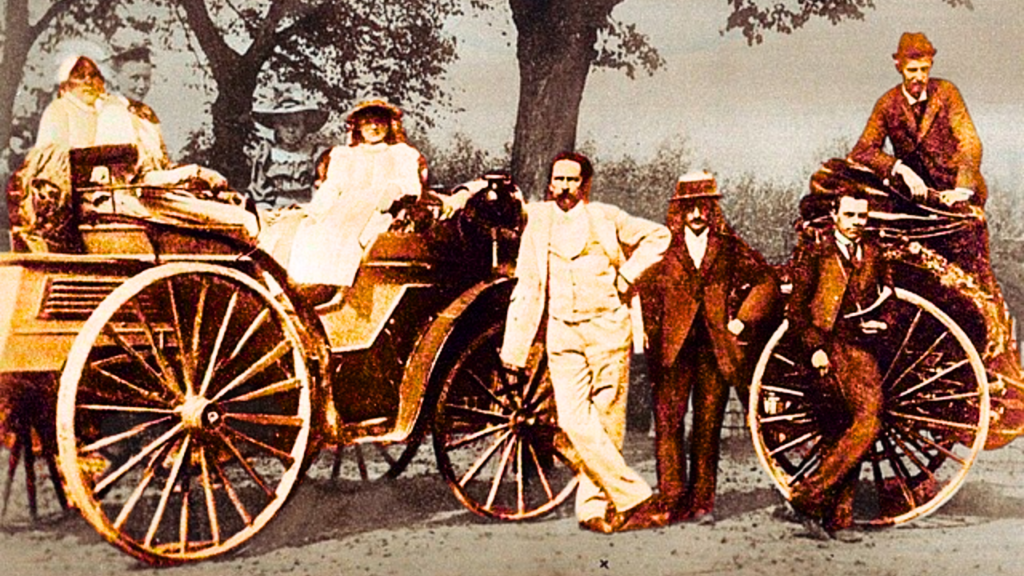
He said all the theoretical plans were now to be put into practice. He’s got the design complete on paper. He’s drawn out every gear and screw and chain and pulley that he needs. He says not a single part hadn’t been conceived and meticulously planned. But then in practice, he says many components behave quite differently than anticipated. He said from a purely mathematical standpoint.
He says some parts behave differently under practical stress than theory had predicted. Remember, he’s making all these parts by hand. Custom, he says,
“One difficulty after another arose, but none could paralyze my unwavering determination to overcome these obstacles. It was precisely in such adversities that the value of my years of hard work at the vise and lath became evident.”
So listen to this Carl, he likes to remind us that he was doing all this work with his own hands. He wasn’t just managing other workers and calling the shots. He was in there with his own two hands. Because he says this, he goes,
“The calluses on my hands became monuments to the practical worker. Only by working as both a hands-on worker and a technical researcher to overcome the difficulties that arose, was I able to eliminate all the quirks and foibles from the developing motor vehicle? In this situation, the practitioner often unconsciously bows to the theorist where the opposite would actually have been appropriate.”
He talks about this a lot in his book. It’s the practitioner, not the theorist who should lead the way. In my episode on Rudolf Uhlenhaut, this great Mercedes-Benz engineer, he would say that same thing. He was about a hundred years after Benz, he talked about “active personal involvement” as an engineer at Mercedes. That’s what he was into. He would test drive the cars on the track and then he would beat the lap times of all the famous drivers. Fangio and Sterling Moss were two of them.
Constant Problems and Challenges
Anyway, again, struggle to get his invention built right here. He says it was painful. He grappled. Problems arose. These are all his words. Here he goes.
“This example was repeated many times. However confidently and purposely the theorist believed he had guided the pen and calculations time and again practice had the final say. Here and there problems arose that could only be overcome with increasing experience. Gradually I began working with a certain experience factor from the outset, which was intended to complete the calculations and designed parts step by step in practice. Certainly a thousand others would have given up in despair and abandoned the project unfinished. Again and again I grappled with the seemingly insurmountable coefficient of experience in theory. Today few can truly understand the inventor’s pain that made bringing each individual part into being with the greatest effort.”
Okay.
He wants to make sure you understand that few can truly understand the inventor’s pain, he said. So how do you do it? Carl tells us exactly how he did it right here. One problem at a time. And only after one problem is solved can another problem be considered. He wrote,
“For me, however, the construction of the self-propelled motor vehicle consisted of solving a series of individual problems, each of which in turn encompassed a whole range of far reaching considerations. If one of these problems could not be solved, it was impossible to make the motor vehicle operational and roadworthy because the final overall result depended directly on the resolution of each individual problem.”
There’s no shortcuts. He wants you to understand. There is no easy way. A true inventor. Each problem has to be solved because the overall result depends on solving every single problem in order. He’s saying this is not easy.
Carl has to build the carriage and then the engine has to be lightweight and deliver greater power than anything ever built. So that’s the key that nobody before Benz had figured out. He said these were his guiding principles. An engine should be dwarfs in weight and giants in performance.
And then the fuel for these engine, they didn’t really know what to use yet. It wasn’t clear, but they discovered gasoline for the engine because of an accident that somebody had in their kitchen. Some people were using gasoline to clean off some gloves. But with the stove burning about 20 feet away, the gasoline fumes ignited and blew the entire kitchen apart. He said it brought death and destruction to several people. And then they learned the news of this highly combustible fuel. And they realized that gasoline would be the perfect fuel for an engine because of how explosive it was in this accident.
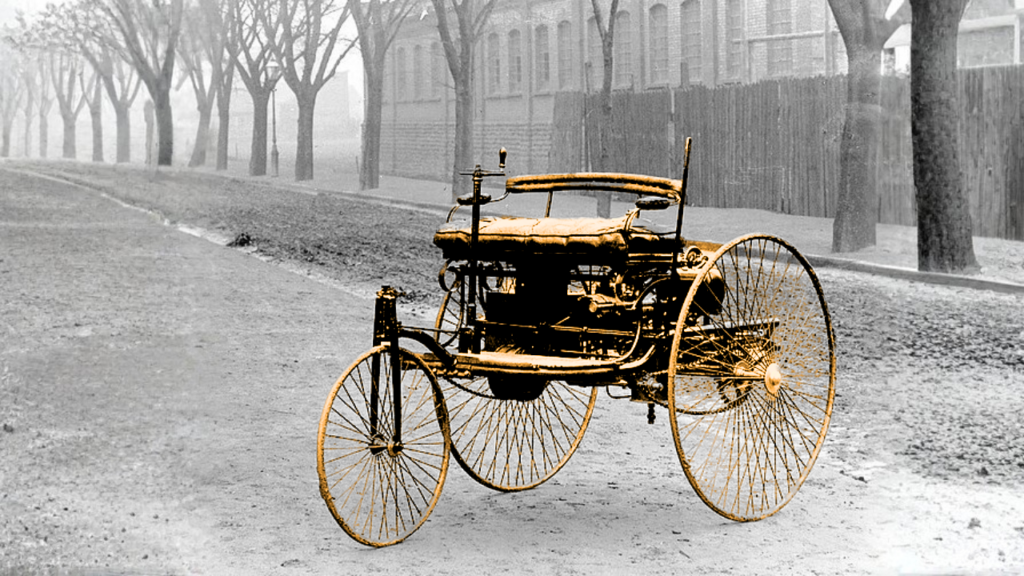
Now it’s spring at 1885 and the new motor wagon is sitting out in the yard complete, ready for the first drive. He says “It was lifted from the world of thought and placed into the world of reality. The latest child of technology stood one fine day in the factory yard.”
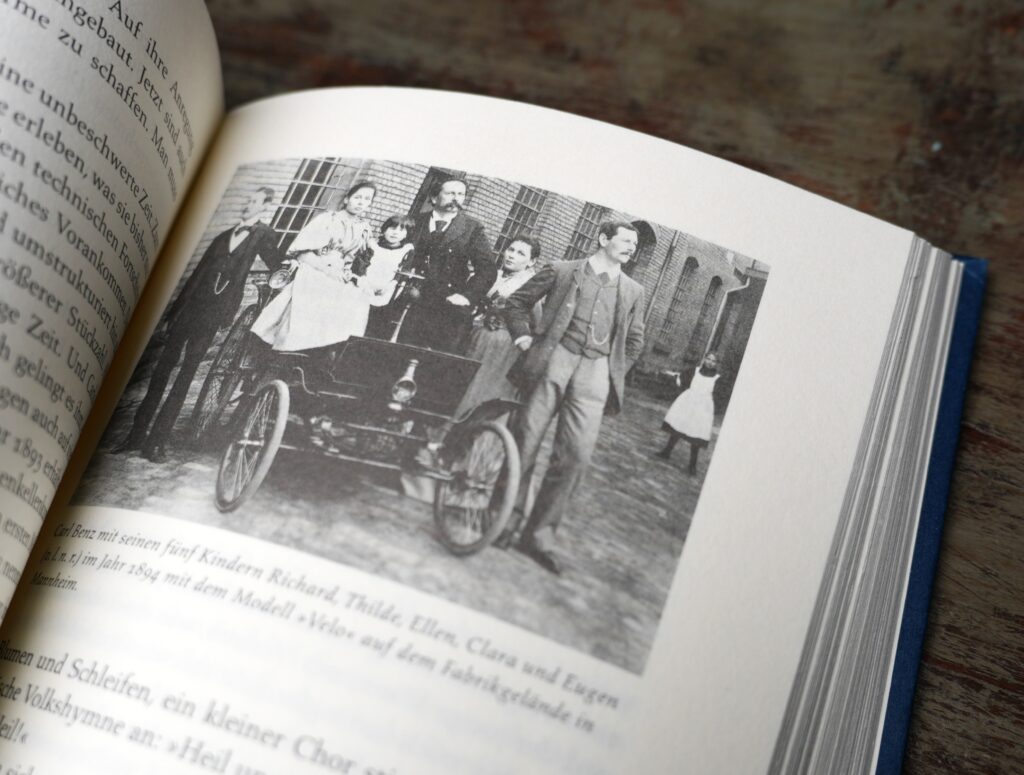
So Bertha’s out there and all the kids, they have five kids and they’re all out there in the yard looking at this new invention. It’s just sitting there and he says,
“All eyes shone with pride. Every child from the youngest to the oldest was filled with pride. And they fire up the new creation. It starts up and they drive it around the yard for the first time. Not long after that, they decide it’s ready to hit the public streets. They want to get it out onto the road. So the first Benz motor wagon is unleashed onto the streets and the people of the town are seeing this thing for the first time. He says,
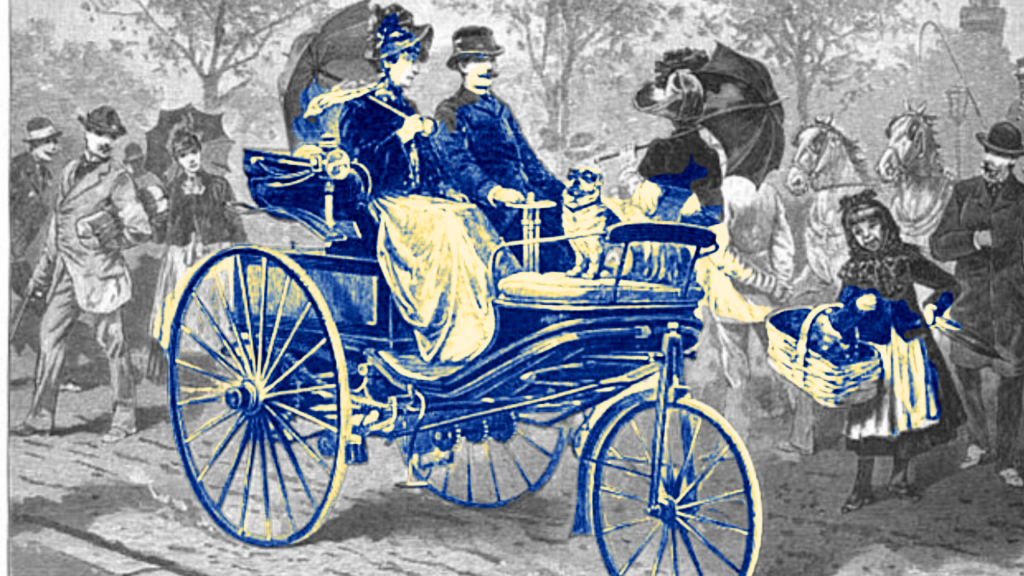
“A new greeting of a new era. A first horn call of that epoch when the engine begins its reign on land, then on water, and finally in the air. The world listens. People stop in the street, marveling and staring. What’s going on? A horseless carriage running and rolling like a miracle. The carriage chugs along the streets. Proud as a king, the driver steers. Proud as a king, he waves from his seat to the astonished onlookers. But suddenly disaster strikes. In the form of its first breakdown. The car slows down and now what? That’s right, it comes to a complete stop.”
The Motorwagen out in Public
So there we have it. Carl and his new invention out onto the streets driving around. He says he’s proud as a king. He’s up there waving, but then it breaks down. And this is maybe my favorite part of this book right here. It’s the life of an inventor, the struggle, the ups and downs.
He’s proud as a king. His family has pride in their eyes. The highs of his success, but then almost immediately failure. His invention breaks down in the street. And Carl wrote a lot about the public’s perception of this thing. And this is why I read that quote at the start of the episode. If you remember, Carl was talking about the third and final stage as an inventor. This is it right here. It’s a matter of taking up the fight against the mocking crowd, asserting myself in my invention.
Despite all the denial and rejection, the brooding inventor had to become the cultural conqueror. So when I read the opening quote, you might’ve been thinking, okay, what the hell is going on here? What are you talking about? Well, this is what I’m talking about right here. This is happening. Carl’s not ready for that public rejection that’s about to come his way. And his invention that he’s riding around in like a king waving, well, it just broke down in the street.
So this might be my favorite quote. This is how Carl Benz explains that third and final phase of invention and why it’s so difficult. He’s in the street with a broken down motor wagon. Here it is, he says,
“The driver dismounts, kneels down, tinkers and patches things up. People gather smiling and laughing. The amazement and admiration turn into pity, mockery and derision.
Just as it did the first time, every time the vehicle got stuck in the city or later out in the villages, a debate of the most devastating criticism erupted. “A toy that is nothing and will amount to nothing,” some said. “How can you sit in such an unreliable, pathetic, noisy machine when there are plenty of horses in the world and the most elegant carriages and cabs to boot?” Others said, “What a shame about this man.” The experts said,
“He’ll ruin himself and his business with this crazy idea.” And a good natured Berliner gave me the well-meaning advice. “If I had such a stinking contraption, I’d stay home.”
That was the public’s response to all the quiet struggle and tireless work of decades. To the mature solution to a deeply felt life’s work. A flat out rejection. But though everyone denied and rejected it, I remained steadfast. No one could steal my courageous belief in the future. There was only one person in the world who believed and hoped as bravely as I did. For it was my wife.”
That’s a crazy quote right there. The rejection that he dealt with, it fueled his fire. You know it did because the way that he’s talking about it when he’s 80 years old and you can feel the emotion still as he’s writing it after all that time, after all his great success, he still remembers that rejection out in the street. And of course he had Bertha right there beside him. Otherwise, I don’t think he makes it through. You’ll have to listen to my Bertha episode and I’m sure you’ll agree.
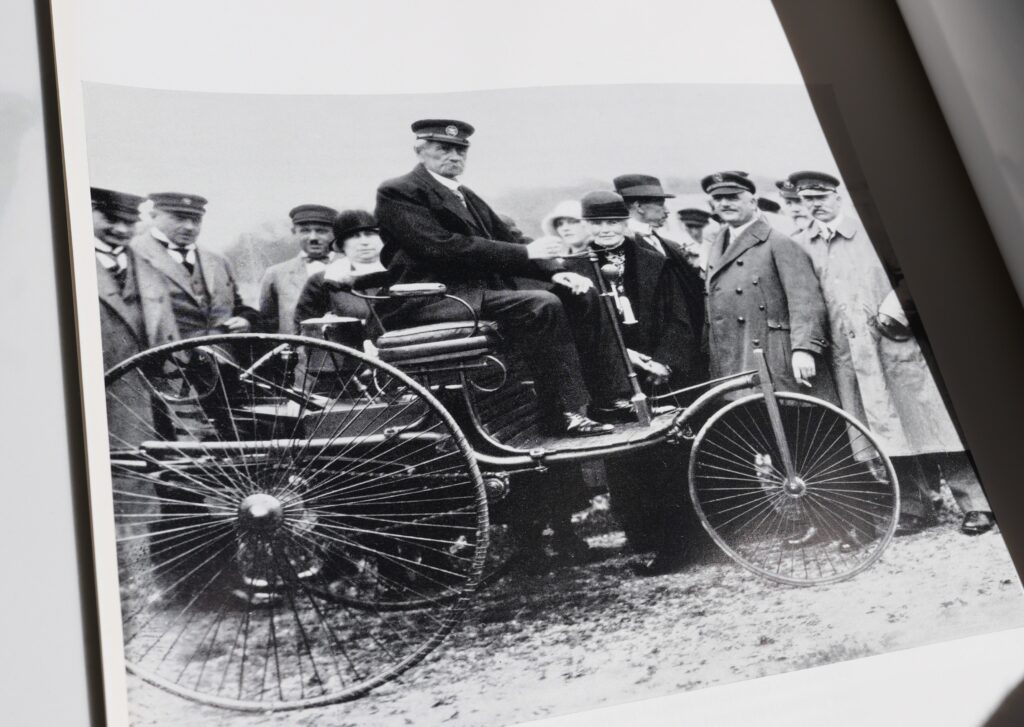
There’s no Carl Benz if it’s not for Bertha. Because this is just the start of huge frustration and hardship. Even with the working motor wagon, what he’d been dreaming about his entire life, he’s getting mocked by almost everyone who sees it. Because it doesn’t run perfectly right away. He needs to work out a bunch of issues. He says, “Wherever a treacherous fault was lurking, I didn’t rest until it was discovered and eradicated.”
He’s out there testing the thing in the streets and every issue he has. The cruelty, there’s just people just standing there waiting for him, trying to make him feel like a total jackass. That feeling never went away for Carl and he writes all about it. Luckily he had Bertha. This goes on for almost a year, but all of these issues are getting worked out. And so Carl files a patent, January 29th, 1886. Patent was called “A Vehicle with Gas Engine Operation,” and it was the very first patent of its kind.
The First Benz Patent
And this is important remember 1886 we’re going to talk about this in a minute this is the birth of the modern motor vehicle and they said it was to transport several persons that’s what it says in the patent and this was the first of his kind and it’s still not a perfectly smooth running vehicle yet though there’s plenty of issues to be fixed and remember carl still has an engine business that he’s got to keep running.
So all this work on the motor wagon needs to be done early in the morning or after hours. Even with a patent filed for this very first modern motor vehicle to transport several persons, Carl might be starting to feel like a king again. But we talked about this third stage of invention, its major struggle, it’s not over. It’s rejection that he’s feeling right now from almost everyone. And for the next two or three years, even the so-called experts.
They just don’t believe his motor wagon is any good. Of course, Carl says,
“Such expert opinions could not shackle my belief. Unyielding and tenacious, I sought to fight my original idea through all stages of its development to its goal.”
Now, another one of my favorite parts of this incredible story. And I talked about all of this in my birth of Ben’s episode, but we can’t leave this out of the Carl Benz story. It’s the famous very first long distance road trip.
First off, the only thing that makes sense to Carl is to get this car out on the streets. For one, so he can test it and make improvements to the motor wagon, but also so people can see how great this thing really is, so he can start to win over the public and catch their interest. Well, that’s the big problem for Benz. The police tell him he can’t drive this crazy contraption out in public. He gets a summons from the Mannheim district office. They said he was speeding.
And there’s a police report filed, so he’s got to fight all these rulings that they’re trying to limit his test driving. He’s going back and forth with the police and the courts. So let me lay this out. I go into detail in my Bertha episode, but let me lay this out real quick. The first long distance road trip was done by Bertha Benz. This is fact. It’s pasted everywhere around the internet. It’s listed on the Mercedes Benz website. It’s in the Mercedes Museum in Germany. This is what it says. Here’s the story.
The Great Bertha Benz Road Trip
Bertha took the vehicle one morning without Carl knowing about it. She stole it. That’s what they say. And Tess drove the motor wagon for some 70 miles without her husband knowing it and made this historic first road trip journey. Here’s what I’ve decided after reading all these books on Carl and Bertha over the last few weeks. This is just my theory, but Bertha made the road trip. That’s a hundred percent fact. She also took along her two sons. That’s a fact.
But what I think now is that there’s no way in hell Bertha and the two boys are going to steal this motor wagon for a 70 mile journey without Carl knowing about it. There’s no way. First of all, Carl’s going to hear the motor wagon start up out in the shed and he’s just going to walk out there and shut it off. Even if he’s in a deep sleep, Carl’s going to hear that thing fire up after about two seconds. It’s loud and it’s his life’s work.
Okay, so even if Bertha and the boys get down the road a little ways, it’s not that fast. Carl could just walk down the block and catch up with the thing and wrangle them all back into the garage. So there’s no way Bertha’s going to sneak it out without Carl knowing about it.
Here’s what’s obvious to me now, having read all about this part of the story. At this point, Carl’s been getting into some hot water with the police about his test drives, and they’re threatening him with official summons.
The problem is that Carl and Bertha need to show off this amazing invention, otherwise they’re going to go bankrupt. They need to show off this thing to other nearby towns. The only way to do it is to drive it around. And I think they decide together that Bertha should go on the road trip.
And then if she’s caught by the police, they can just say Carl had no idea what was going on. That Bertha took the motor wagon without him knowing about it. They were threatening Carl with jail, if he kept driving it out in the street.
So I think that’s the plan they came up with. That Bertha could just play dumb about this whole thing and hopefully just get a warning and she could keep Carl out of trouble by saying that she took it out without telling Carl about it.
That’s the story that makes sense to me after reading all these books. Because you can tell, Carl’s proud of the long road trip that Bertha and his two sons went on. And I love the idea that they keep this as a family secret their entire lives.
Because in his memoirs, as an 80 year old man, he maintains that Bertha and the boys went on the road trip without his knowledge. Nice try, Carl. I feel like I’m in on the secret now. And I can see these two, Carl and Bertha, these two soulmates, I can see them grinning at each other their entire lives when they’re asked about Bertha stealing this motor wagon for that historic road trip. Their little secret that protected Carl from any backlash back in the day.
It’s awesome. And who knows, maybe I’m wrong. Maybe Bertha did steal the motor wagon just out of the freaking blue. And she just goes on a joy ride. Maybe that’s true. Risking everything they worked their entire lives for without telling Carl about it. Maybe that’s how it went down. Okay. That’s the official story. That’s how it’s reported everywhere, but I’m not buying it for a second.
Anyway, now Carl and his motor wagon.
Out In Public
Now it’s getting out into the public and people just don’t know how to handle this invention. He says, I was already driving my car as far as the Odenwald Hills and across the Rhine to the heart mountains. Wherever I went, there was widespread astonishment and admiration. So people are starting to like this thing and sales start to come in for the new vehicle. The factory expands. They can barely keep up with the orders.
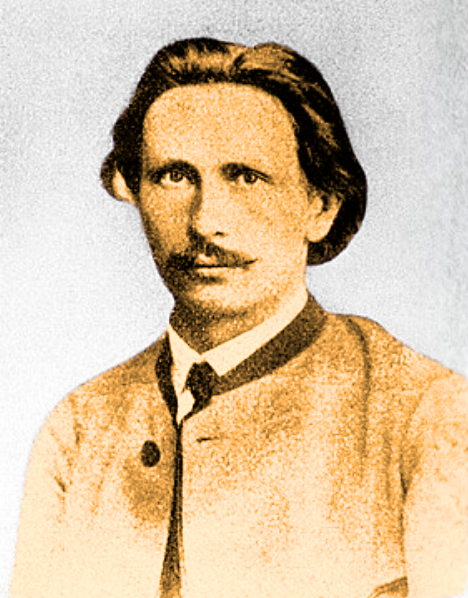
France, England, America, they’re all ordering the motor wagon. This is funny because it’s still kind of a slow grind to introduce this new invention to certain parts of Germany, the smaller towns especially. And Carl shares a few stories about the early days of the people that encountered this amazing invention. He says,
“From the treasure trove of my memories, I’ll just share a few experiences. One has to imagine how strange this unfamiliar vehicle must have seemed to animals and people during their earliest era of the automobile. The horses, who showed little affection or understanding for their new competitor, shied and wanted to bolt. When the car passed through unfamiliar villages, the children, shouting and screaming, the witch’s cart, the witch’s cart, jumped into the houses, slammed the front door, shut as quickly as they could, locked them, probably out of fear of evil spirits. A woman from the Black Forest repeatedly made the sign of the cross in rapid succession before me as if it were the embodiment of, God be with us. And another time a woman screamed in utter agitation, “a wagon has run away. A wagon has run away.” Even some unassuming Palatine farmers found the eerie devil’s cart downright terrifying. When I drove through remote areas of the Oldenwald, I observed more than once that a farmer out of fear of ghosts, abandoned his cart, jumped headlong into the field, and hid either there or in the neighboring forest until the devilish haunting was over.”
What a scene for Carl as he’s trying to show off his invention. These stories were from the treasure trove of his memories, like he just said.
Now think back to that patent that Carl filed, the official patent, January 29th, 1886, for a vehicle with gas engine operation.
Benz Setting the Record Straight on Henry Ford
I was loving this part of the book right here.
Carl Benz is gonna set the record straight right here. He needs to get a few things off his chest right now. It’s 1925. Carl Benz just turned 80 years old. It’s his first book he ever wrote. And here’s the deal. Three years before he wrote this book in 1922, another book was published that caught his attention and everyone’s attention. It was a book called ‘My Life and Work’ by Henry Ford.
There’s a few things that Carl Benz has to say about Ford’s book. And here’s the great inventor putting another great businessman, Henry Ford, in check. Here we go. 80 year old Carl Benz says,
“Recently the book Henry Ford, ‘My life and Work’ has been generating considerable buzz. The impact this book has had on the broadest segments of our population is tantamount to a generous and bold advertisement, specifically for the American Ford car. Let us take just two passages from the book and compare them.”
He’s going to quote Ford’s book right here. In Ford’s book, it says,
“In Ford cars, a cubic inch of piston area only has to bear 7.95 pounds. One reason why you never see a Ford fail, whether it is over sand and dirt, snow and mud, through water and over mountains, across fields and trackless plains.”
That was Henry Ford’s book that he just quoted. Carl says, “Any expert who has ever glanced inside a Ford car sent for repair cannot help but smile at this fact. But understands all the more easily why, just one page later, Ford considers it desirable to have stockpiles of spare parts for his never failing cars throughout the country.”
Now he quotes Ford’s book again. It says,
“The various parts should be so cheap that it would be cheaper to buy new ones than to have the old ones repaired. They should be stocked like nails and bolts in every hardware store.”
And that was in Ford’s book that he just quoted about how there should be spare parts of Ford cars everywhere. And Ben’s is just like, why all the spare parts? Do your cars not last? So Ben’s ends with this. He says,
“Tastes differ.”
“I do not consider a car that can only remain operational in the long term in conjunction with a network of spare parts assistance stations to be a desirable ideal for the automotive industry.”
Boom.
Benz drops the mic right there. He says, “taste differ.” Why do you have spare parts from coast to coast? Ford? Carl’s basically calling out Henry Ford and his cars, for needing a network of repair shops.
Now, Carl’s not finished with Ford. You might be thinking right here, damn, where is this coming from? Carl Benz just starts throwing haymakers in his memoirs, talking about how Ford cars need constant repairs and spare parts stocked in every hardware store because Ford cars just fall apart.
Well, there’s more.
And there’s a reason, and this is probably the reason, this is probably what got Carl a little riled up when he read this Henry Ford book that just came out.
And I have the book right here, ‘My Life and Work.’ So I looked all this up myself because I just wanted to see it for myself. And it’s all in there, just how he says. Henry Ford wrote in his book. It was the only time he acknowledged Carl Benz in his book. And this is how he acknowledged the great inventor. Let’s just listen to how Carl responds.
Here’s what he writes in his memoirs. He says,
“As is well known, the American Henry Ford, thanks to his exceptional organizational talent, exploited the automobile economically like no one else in the world. However interesting his explanations of labor differentiation, the Taylor system, the service principle, et cetera, are in his book, My Life and Work, he made an error in his account of the historical development of the automobile, which I wish to draw attention to so that it does not pass into the annals of history.”
Here we go. Carl Benz is not finished with Henry Ford. He’s going to bring down the hammer again. He writes this.
“Ford begins by stating that he built his first car in 1892, 93, and his second in 1896, and then continues verbatim.”
Now he’s quoting Ford’s book. It says, “Others in America and Europe had also begun to build automobiles. As early as 1895, I learned that a German Benz car was on display at Macy’s in New York. I went there specifically to see it, but there was nothing about it that particularly caught my eye.”
That’s in Henry Ford’s book. Oh boy. I looked it up. It is in there. It’s exactly like that in the book.
So Ben’s answers to that, he says,
“As for myself, I built my first car in 1884, 85, eight years before Ford took several American patents for the first designs of the automobile in 1888 and delivered the first cars to the United States and Mexico in early 1890s. Whether and to what extent the word “meanwhile” is appropriate from a historical standpoint, in this context, I would like to leave to the reader’s judgment.”
So Carl’s saying that Henry Ford just made a big error or he’s misleading the reader of his book. Ford said that he was building his cars in 1892 and then he added, “meanwhile, others in America and Europe also began to build automobiles.”
Then Ford said he saw a German Benz car on display at Macy’s in New York in 1895. But Ford wrote,
“He went there specifically to see it, but there was nothing about it that particularly caught my eye.” That was Henry Ford taking a shot at the Benz car on display in his book. But Ford wrote, he’s building cars at the same time others were, ‘meanwhile,’ in quotes, building theirs.
Carl Benz just says, hold up. I built my car in 1885 and filed the patent January 1886, eight years before Ford took those patents and started delivering his cars in the 1890s. But the misleading word is ‘meanwhile’ in the book. He says, I’ll let the reader decide if that’s misleading or not.
And it definitely is if you read it. This is pretty simple. Benz is right. You just have to look at the dates and there’s no dispute anymore. Everybody knows Benz was before Henry Ford.
Benz was 40 years old when he filed that first patent for his motor wagon after working his entire life to get the engine going. Henry Ford was 22 years old at that same time.
So Ford came after, and I love this 80 year old Benz responding to that new book that just came out. That Henry Ford book that had just come out three years before he wrote his memoirs.
Carl Benz Drops the Hammer on Henry Ford
But this is awesome right here. Carl Benz takes responsibility for all these misconceptions.
Basically, he says, Inever wrote anything down until now, because I was too busy inventing the entire damn automotive industry.
He goes, I do not, “However, hold such and similar legends against me, for I must bear a considerable shame of the blame myself. I left most of the numerous inquiries about ‘my life and work.’ (See what he did there) ‘My life and Work’ unanswered, because I did not want to repeat the same writing tasks over and over again.”
Again, he’s too busy working to write, but now he’s 80 years old. He’s realizing he needs to set the record straight, especially with this new Henry Ford book that just came out. And he does, he lays it down.
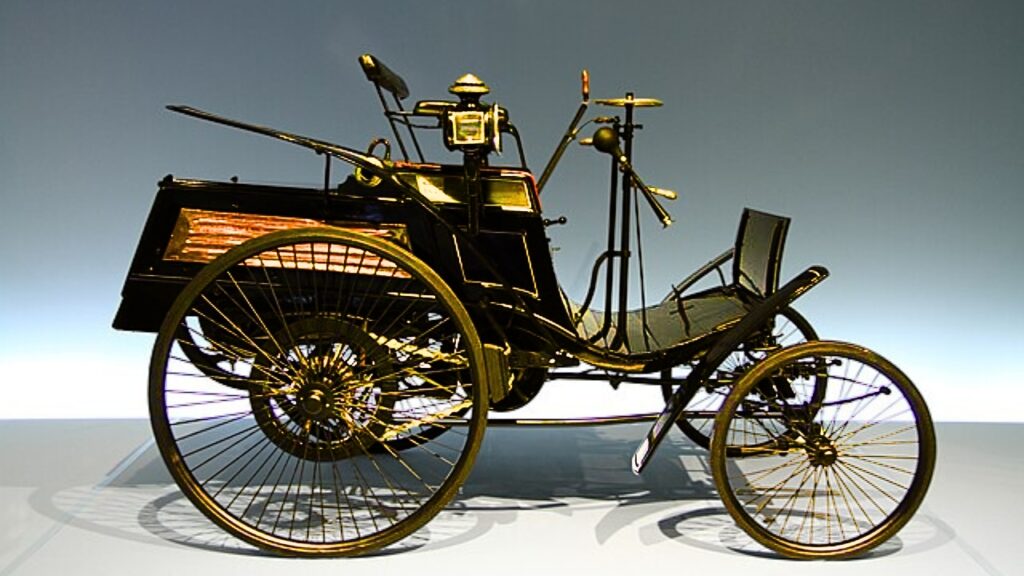
He’s this fierce competitive driven inventor. He’s not going to take all the credit though. He’s still a humble guy in through this entire book.
He goes on to talk about standing on the shoulders of giants and how everyone before him contributed to his invention.
And then here’s his big advice at the end of his book. I love this. Says,
“Become capable engineers for engineers, not philosophers and eloquent speakers are the pioneers of a better future.”
And so one thing I wasn’t expecting here at the end of his memoirs,
He talks about making this engine lighter and more powerful. That was the dream. That’s what put all of this in motion for him. Something that you can tell it. And this is something that just amazed him. You can tell as he’s writing this book, he says, the miracle of powered flight, airplanes. Listen to this quote on the last page of his book right here.
“Finally, an engine was developed in this way that was so light that humans could use it to reach an even higher level of development in terms of free movement. Listen above. Do you hear the powerful song of the light engine circling in the air high above your heads? That is the rushing wing beat of the latest age, that cultural epoch of the engine where humankind assumes dominion over space on and above the earth, far below triumphantly, it leaves behind all earthly burdens, casts off in innate shackles of space, an age-old dream of life. It has become an act and a fulfillment. Humans fly. That I was able to experience and witness the fulfillment of this ancient human dream is, for me, as an 80-year-old, a fading evening glow in my life’s sky, like the rising morning sun.”
You can see that Carl Benz is just beside himself at the fact that humans can fly. They just figured out powered flight about 15 years before he wrote these memoirs. And he’s still just amazed. He’s like, “Damn, they did it!”
Benz is Amazed at Powered Flight
He can’t believe it. The spirit of Carl Benz comes out as I read this book, and it was awesome. Like I said at the beginning of the episode, I’ve never heard Carl speak in any interview or any video. I don’t know what his voice sounds like. But as I read his book, can imagine I can hear his powerful voice like a Samuel Jackson type voice. This authority just comes through this writing.
As he got older, he was always in great shape. They talked about how he kept active and stayed healthy. He loved to ice skate and he wore skates that he built by hand. Of course, he built them when he was a kid. He wore them his entire life. He loved to dance and he loved to ride bicycles. Here’s what he noticed. He said,
“When I look back on all my sporting joys and passions, I find strangely enough that they all converge on one central point. And that central point is locomotion. But the joy of movement reached its zenith with the invention of the self-moving vehicle, the automobile.
This problem shone into my life like a sun.”