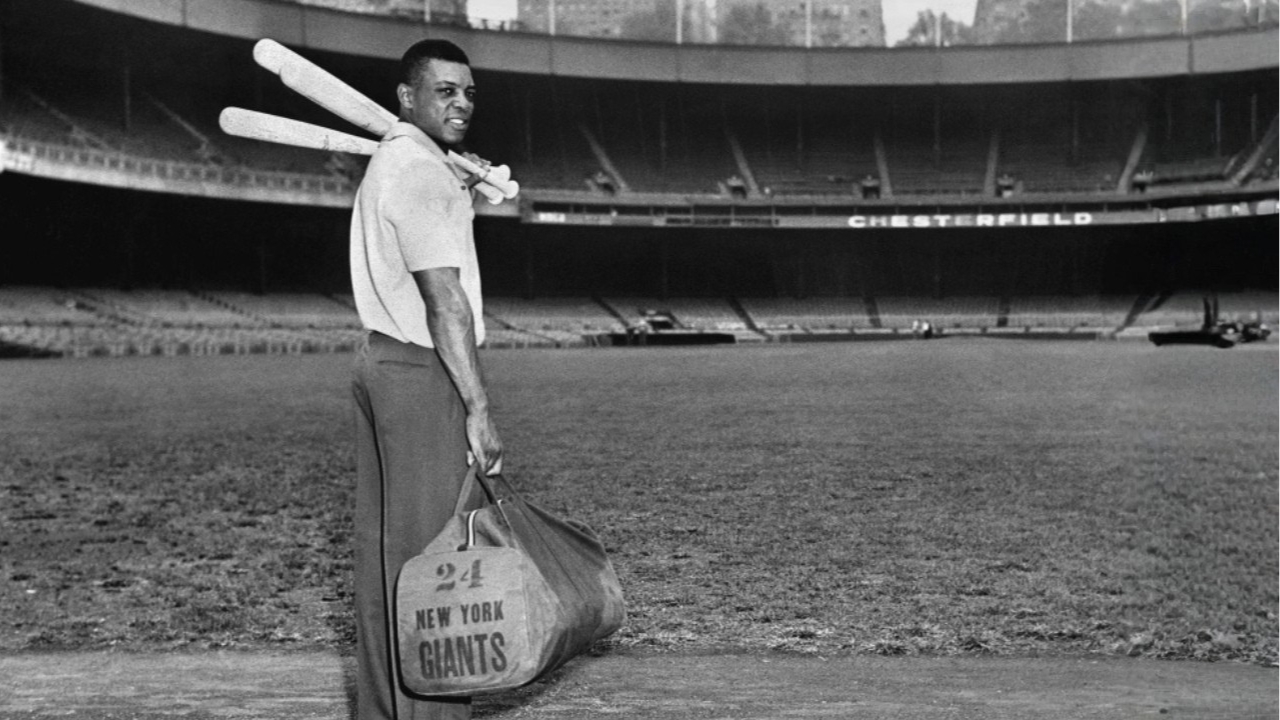
Willie Mays
Wille Mays
Episode #31
10.29.2025
I found a great line from a poet, not just any poet, they also called him the ‘Dean of American Sports Writing.’ He wrote this in June of 1954,
“With Mays contributing glittering heroics each day with his basket catches, his rubber arm, booming bat, and most important, his contagious, irrepressible zest.”
And that’s all I’m going to say about the poet for now. At the end of the episode, I can explain why the hairs on my arms stood up when I read that opening line.
Willie Mays the Legend
But what I usually like to do is start off these episodes with the big moment. So there’s only one way to kick off a story about Willie Mays. And obviously I’m going to start this thing off… at a movie theater in Sioux City, Iowa.
“Midway through the movie, the projector stopped, the lights came on and a man appeared on stage to make an announcement. If Willie Mays is in the audience, would he please report immediately to his manager at the hotel?
Willie Mays in the Minor Leagues
Mays’ first thought was that something had happened to his father or Aunt Sarah or maybe to somebody else at home. He rushed back to the hotel and headed straight for Heath’s room. Heath had sought out Mays after receiving a call from Durocher, who told him that Stoneham had granted him his wish. The Giants were calling up Mays.”
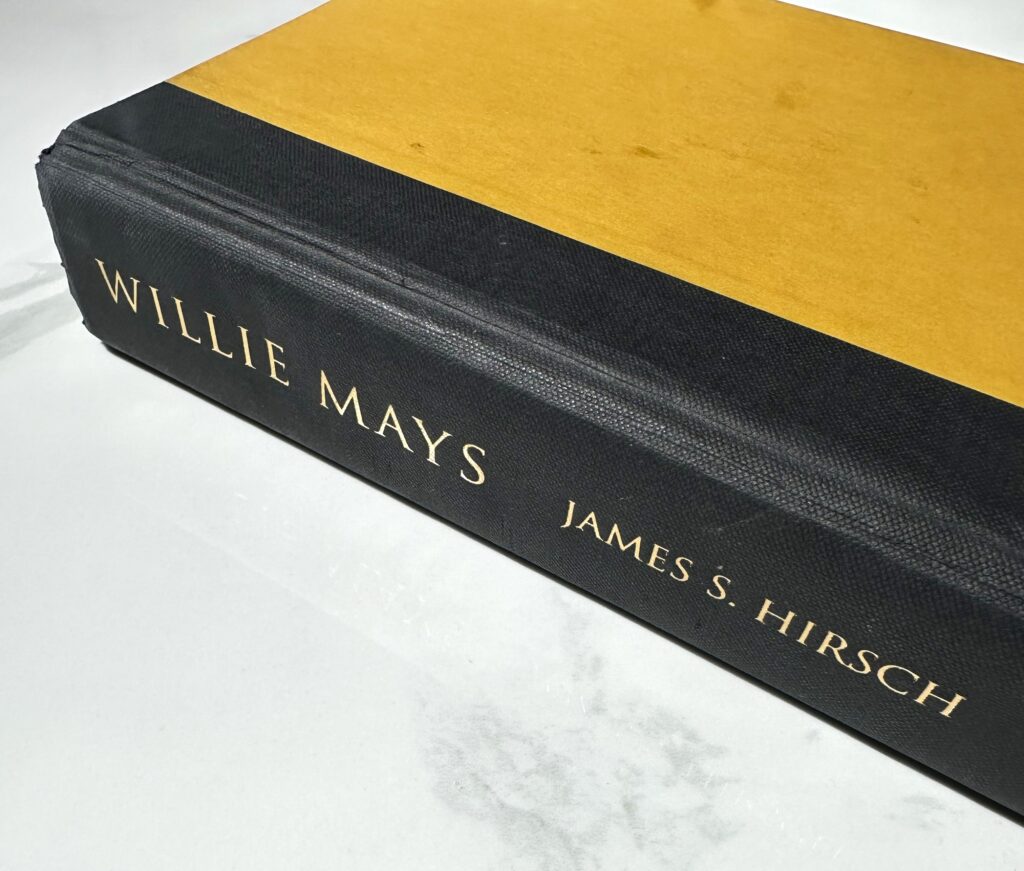
And so that’s a true story out of this book I just finished reading. It’s titled, ‘Willie Mays, The Life, The Legend,’ published in 2010 by author James Hirsch.
That’s a story I’d never heard before I read this book. That they stopped the movie halfway through, they turn the lights on, and a guy climbs up on stage looking for the minor league ballplayer, Willie Mays.
He’s in Sioux City, Iowa, and they’re trying to find him to let him know he’s headed to the big leagues. One of the many reasons I loved making these episodes, before I started doing this, I had this kind of dumb idea. For some crazy reason, I thought I already knew most of the good stories about these old baseball legends.
The Story of Willie Mays
But of course I’m finding out now there’s almost an unlimited amount of incredible stories buried inside these great old books. The most important idea I’m having as I do these creator stories, I’m just reminded how little I actually know and how much of the story I was missing. So it’s no different this week.
I read this book on Willie Mays and just like my last baseball legends episode on Walter Johnson, I flew through this book. It’s 621 pages. The Walter Johnson book was over 450 pages. But once I get started in these stories, I can’t put these books down.
Mays Gets Called Up
Anyways, we got to get back to the movie theater. They found Willie and his coach tells him he’s heading to the big league club in New York. They want him to report to the team right away. Willie’s minor league manager is so excited. He goes and he pulls him right out of the movie theater.
Most of these baseball legends I’ve done stories on so far, they don’t spend much time in the minor leagues, if any at all, but Willie Mays just graduated from high school.
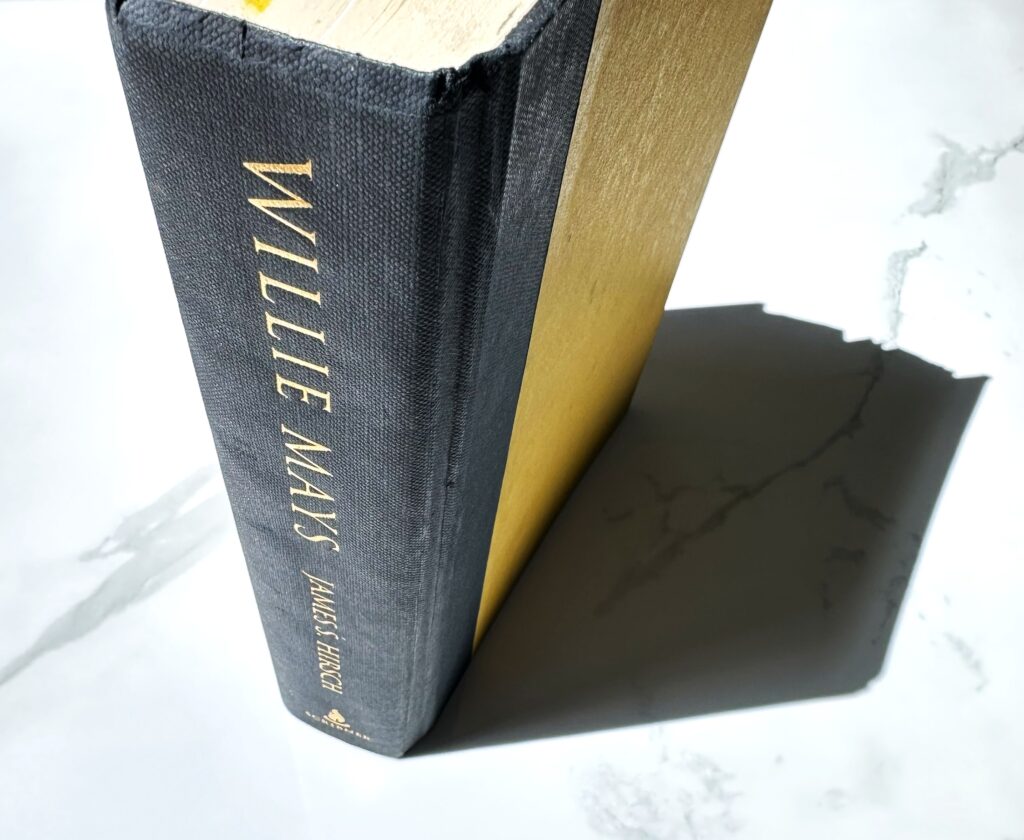
He signs a contract with the Giants to report to the minor league team in Minneapolis. The night he leaves to report to his team, he skips his senior prom. He has a buddy take his girlfriend to prom because he’s heading out of town to make it to his first game in Minneapolis.
When he looked back, this moment was one of the highlights of his entire life. Here’s how the book said it.
“Many years later, Mays said that his biggest thrill in baseball was signing his first contract with the Giants. But on the train out of Birmingham, he felt mostly fear and disbelief, tinged with amusement. The Giants were paying him good money for a chance to get to the big leagues. He would have played for free.”
It’s a common theme in the book. His dream is to play pro baseball. He would have played for free. That phrase is a big part of the story. His positive, humble attitude, his enthusiasm. He has this spark that connected with the fans and his teammates. He just wanted to play.
Once he reported to the minor leagues, he struggled at the plate early on. His quote in the book was, Willie said it himself, he went, “0 for Maryland,” is how he said it.
In his first few games, for 22 at the plate is how he started his minor league career. Luckily, his coach encourages him to just relax and it didn’t take long for Mays to get rolling at the plate. The Giants big league team was well aware of Mays this entire time. They’re watching him close.
Willie Mays and Leo Durocher
The manager of the pro team, this guy named Leo Durocher, and we’ll talk about him plenty later on, but Durocher wanted Mays on the big league team to start the season off.
But he was overruled by the team owner just because Mays was so young, he was only 18 years old. They wanted to give Mays a chance to develop a little more before they threw him directly into the big leagues.
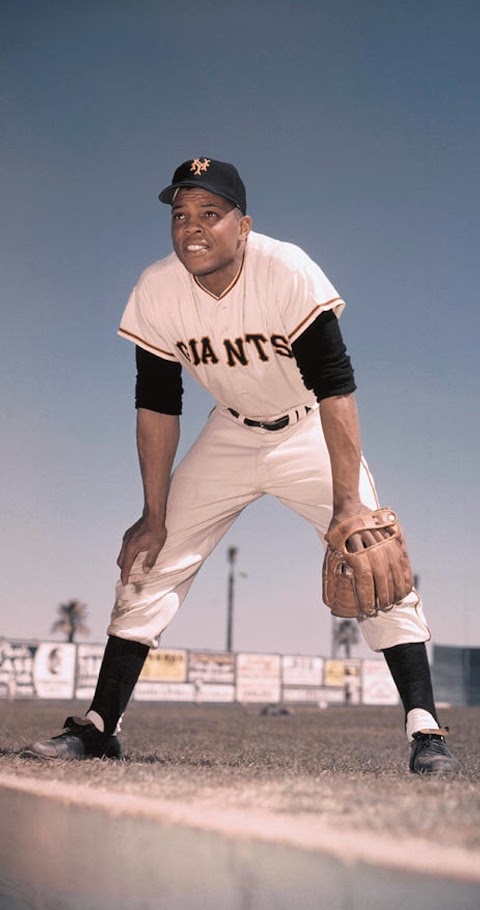
But once Mays got rolling for the Minneapolis Millers, there was no stopping him. He went on a tear. The Giants owner had a scout following around Mays to report back to the big league team in New York so the owner could keep track of how Mays was doing.
Here’s the scouting report back to the team owner in New York about what he was seeing as he was watching Mays.
“When he starts somewhere, he means to get there. Hell bent for election. Slides hard, plays hard. He is sensational and just about as popular with local fans as he can be. A real favorite. The Louisville pitchers knocked him down plenty, but it seemed to have no effect on him at all. This player is the best prospect in America. It was a banner day for the Giants when this boy was signed.”
That was a scout Hank DeBerry from the book. He’s writing back to the Giants owner on how this young prospect is coming along in the minor leagues. So Willie goes on a streak. Like he just described, he’s on a hitting tear. Call it whatever you want. He’s playing in Milwaukee. He hits a ball that blows a hole through the outfield fence. The ground crew, they don’t repair the hole in the wall. They draw a circle around it. Like it’s proof. It’s evidence. It’s like they knew history was in the making.
Just games into his minor league career with the Minneapolis Millers, Willie Mays is now hitting 477, almost 100 points higher than any other player in AAA. And that’s after not getting a hit in his first six games. So he’s crushing the ball, he’s stealing bases, he’s got a 16 game hit streak going. And it’s just too much. The big league team in New York, they’re like, okay, enough, bring him up.
Here’s a great quote from the book on just how fast Willie Mays burst onto the scene from after graduating high school to 35 games in the minors to the big leagues. It says,
“But his torrid hitting was noticed in New York. As Tom Sheehan, the Giants chief scout recalled, we pick up the papers one week and say, Hey, Willie’s hitting 300. Next week we look and it’s 350. Another week it’s 400. And finally, holy mackerel Willie’s up to 477, which has to mean he’s going at something like a 600 clip. So he’s gotta come to New York.”
That’s what Tom Sheehan remembers, the chief scout of the Giants after they’re looking and checking up on their young prospect in the minor leagues. So they call him up. They pull him out of the theater in the middle of the movie, like we talked about. Mays shows up at his coach’s hotel room. His coach tells him he’s heading to the big leagues and Mays can’t believe it. Then he says, I’m not going. Call him back and tell him I’m going to stay. His coach is like, what?
Mays is Hesitant
That’s not how this works. You have to go to the big leagues. The manager, Leo Durocher, just called me. Mays says, we’ll call him back and tell him I’m not going.
So the coach is like, I’m not telling him that. You can tell him that yourself. So the coach calls Durocher back and says, Hey boss, I have Willie here and he wants to tell you something. So Mays tells Leo Durocher, the manager of the Giants, that he doesn’t want to go to the big leagues. Mays isn’t sure he’s good enough to play in the big leagues.
He wants to stay in the minors and Durocher just loses his mind over the phone. This guy Durocher was a character. Anyway, Durocher says, you’re coming to the big leagues. End of story. And he adds a string of about six or seven F bombs, which I’m not going to repeat, but you get the picture.
Willie Mays Joins the New York Giants
Mays joins the big league club. He heads out to New York to meet the owner of the team. And then he quickly goes to Philadelphia where the Giants are playing later that day.
Mays gets to Philadelphia and he finds his new manager, Leo Durocher. Like I was just saying, this guy is a wild man. He had a few great nicknames. They call them “The Lip” because he would run his mouth nonstop. The most foul mouth you can imagine. And everything is in this book as you read it.
I’m not going to repeat most of the stories, but he also had another great nickname. “Fifth Avenue.” They call him Fifth Avenue because of his custom suits and his extravagant wardrobe. So this guy, Durocher was really happy to see Willie Mays show up.
Willie Mays First Batting Practice
He knew he was going to be a star and Durocher would be like a father figure to Willie Mays for many years, starting right here in Philadelphia. So this is amazing. One of the many big moments that jumped out at me in this book, before the game, the first game of his career in the big leagues, Willie Mays heads out to the field for batting practice and everyone turns to watch what this kid can do.
This is from the book it says right here.
“Bill Rigney recalled, he popped up, hit a weak grounder, followed one back, and then all of a sudden, he hit a rocket that landed in the middle of the upper deck in left field. Then he hit another rocket that went over the roof. Then he hit one that hit the right field scoreboard. Everything stopped. The Phillies stopped warming up and Ashburn and Hammer and Puddinhead Jones and all the others stopped to watch him hit. He got everyone’s attention. He was amazing. Phillie pitcher Robin Roberts remembered. I’m thinking, wow, I got to face this kid tomorrow night. How will I pitch to him? He was hitting them over the left field grandstands.”
That’s Willie Mays’s first round of batting practice in the big leagues in Philadelphia. Both teams just stop and stare. So this is an instant boost for the team. Willie brings an energy to his new team that’s noticed right away and DeRosier is pumped. There’s hype building with the fans and reporters. They have a new star.
Even though Mays struggles in this first few games in the big leagues, he starts off 1 for 26. Just one hit and he thinks they’re going to send him back to the minor leagues. But during this hitting slump to start his big league career, there’s another big moment. He had his first round of batting practice that we just talked about where he’s launching balls over the grandstand in Philly. Then after a few games, he hits his first big league home run. The book has a great description. Listen to this. The first home run for Willie Mays.
First Big League Home Run
“Mays then swung and missed badly on a fastball. Apparently overmatched, he guessed curve and guessed right. His bat flashed across the plate. Crack! For a moment there was silence. Then a gasp as fans tried to register what they saw. The ball didn’t tower or loft. It soared, flying over the left field roof, still rising on one long line as it disappeared into the night. Thunderous cheers rolled across the stands, and Mays jogged purposely around the bases, head down, unsmiling, seemingly embarrassed by the adulation. Spahn stood with his hands on his hips, looked down and kicked the dirt behind the rubber. When Mays reached the dugout, he slapped hands with Durocher, who smiled like a proud father. As Robert Creamer wrote in Sports Illustrated, the crowd roared and cheered as though Willie had just won the World Series. It was a strange, tingly thing to be a part of, because all that the crowd was saying really was, welcome Willie, we’ve been waiting for you all our lives. And the Giants announcer Russ Hodges said, if it’s the only home run he ever hits, they’ll still remember him. The savior had arrived.”
So Willie Mays is 19 and he’s starting to get comfortable playing in his new home, the historic stadium they called the Polo Grounds. He played center field and it just happened to be this gigantic outfield. And with the speed that Mays had, it was a perfect place for him to play. The book has a quote from Buck O’Neill about how fast Willie Mays was. He said, “There were men faster than Willie Mays, but I never saw one faster with a fly ball in the air.”
So this is a great place for Willie Mays to show off his speed rather than a smaller ballpark. In the book and another amazing quote, Donald Honing, a baseball historian, he wrote about this huge outfield at the Polar Grounds. And he said this, “Putting Mays in a small ballpark would have been like trimming a masterpiece to fit a frame.”
And so while Willy’s still fighting through a hitting slump and his manager Durocher plays a big part in giving Mays some much needed confidence, Durocher figures out how to handle Mays.
He’s never too hard on him like he might be with the rest of the team. And one of the other players, they said this in the book, they started to notice. He said,
“Mays was the only player I ever saw who could do no wrong in Durocherr’s eyes. Everyone else felt the lash at Leo’s tongue sooner or later. But Willy never did. Durocher even got a kick out of his errors. One day at the polo grounds, Willy dropped a fly ball. He looked toward the Giants’ dugout, and Leo was laughing.”
So, end of story. So it’s not hard to understand why Durocher treated Mayes differently than anyone else. He knew how special he was, and Durocherwas a fierce competitor who wanted to win. Well, here’s Willy Mays who was the most talented player he’d ever seen.
But then at the same time, he brought so much energy to the team and made everyone around him instantly better. So I said that Mays had this bad hitting slump when he joined the team, but it wasn’t that big of a deal because the Giants almost instantly started winning games. They’re still way behind the Brooklyn Dodgers in the pennant race. They’re like 13 games out of first place, but Mays made an instant impact and everybody noticed.
Willie Mays and “The Throw”
There’s another play they talk about in the book where Mays guns down a runner trying to score from third on a fly ball. This throw. The book describes this entire play, but basically Mays unleashes this perfect throw from the outfield. They said it would have been called a strike if it was a pitch.
The catcher tags out the Dodgers runner trying to score and this must have been an absolute rocket throw. I couldn’t find any video of it, but the book says after the ump calls the runner out it says this,
“Inside the Polo Grounds there was a momentary silence similar to the response when Mays hit his first homer, as if the fans couldn’t comprehend what they had just seen. Then the stadium erupted while Cox sat staring at the plate in disbelief.”
You’re going start to see a pattern here. People just can’t believe what they’re seeing. It’s another theme in the book. Stunned and silent fans scratching their heads trying to figure out what the hell just happened. There’s several such cases. The Giants are still 13 games out of first place at this point.
But Mays makes this unbelievable throw to nail the runner. He ends the eighth inning. The game is tied 1 to 1. Mays leads off the next inning with a base hit. The next guy hits a home run and the Giants win that game 3 to 1. So the Giants are starting to gain some ground on the Brooklyn Dodgers.
Jackie Robinson said after that game that it was the greatest throw he’d ever seen. That play became known as “The Throw.” But the book describes that it wasn’t even the throw that was the amazing part of the play.
The Electric Willie Mays
It was the improvisation, the footwork, running down the ball, spinning, throwing, all in one motion. Now the Giants end up catching the Dodgers in the standings and they force a best of three series for the pennant. If the Giants win two out of three games, they’ll go on to play the Yankees in the World Series. So all three of these teams are in New York at the time. It’s the Brooklyn Dodgers, the Giants and the Yankees. The book explains how basically the entire city shuts down for a few days.
And it’s one of the most iconic moments in baseball history during this best of three series when the Giants’ Bobby Thompson, he hits “the shot heard around the world,” and the Giants defeat the Dodgers and go to the World Series in 1951 to play the Yankees.
Announcer Ernie Harwell has a great description of this big moment. When Bobby Thompson hits this home run to beat the Dodgers, he says,
“It was the biggest crowd noise I ever heard. A complete eruption. Like the sky was being pulled apart.”
That is crazy. So the rookie Willie Mays was kneeling down at the on-deck circle when Bobby Thompson hit that home run. And the book says that he was actually praying at the time that he wouldn’t have to go up there and hit with the game on the line. This was such a huge moment. But they gave Mays a lot of credit for giving the Giants the spark and the momentum to catch the Dodgers in the standings and then go on to win the pennant.
Willie Mays Plays His Idol, Joe DiMaggio
So now Willie Mays is in his first World Series in his first year in the big leagues, he’s playing against his idol Joe DiMaggio. Growing up, Mays modeled his batting stance after DiMaggio and he’d run around the house as a little kid and he’d say, “call me DiMage.” That was his line when he was a kid.
So a few crazy stories from this World Series. This is DiMaggio’s last season and it’s Willie’s first season. In game one, DiMaggio hits a home run in the fifth inning to go up four to one. Here’s what happens next. This is in the book. It says
“In centerfield, Mays started to clap, his right hand slapping his glove. He didn’t even know he was clapping. It just seemed like the thing to do, to acknowledge the man whose grainy newsreel images were the model for his own batting stance, whose grace in centerfield and poise under pressure were always his own ideal. Mays stopped once he realized what he was doing, grateful that no one had taken a picture while he was cheering the enemy.”
That’s insane. Mays is out there clapping for DiMaggio as he’s rounding the bases during the World Series Game 1. Then he realizes what he’s doing and he stops. So this is Joe DiMaggio’s last season. It’s Willie Mays’s first season and there’s another rookie on the field for the Yankees. Mickey Mantle.
It’s the only time that all three of these players are on the field at the same time. In Game 2, with Mantle playing right field, DiMaggio in center, Willie Mays hits a fly ball. Mantle runs after it.
Willie Mays and Mickey Mantle in the World Series
DiMaggio calls for the ball and Mickey hits the brakes. He catches his spikes in the grass and he blows his knee out. They gotta cart him off the field and Mickey Mantle watches the rest of the World Series from the hospital with a serious knee injury. I did an episode on Mickey Mantle a while back and I covered all his early years leading right up to this 1951 season when he ended his rookie year in the hospital from this moment right here. That’s an amazing story. You have to check out the full episode.
That story was not just about Mickey, but it was also about his dad, who they called “Mutt.” Anyway, Mickey and his dad end up both in the hospital watching the rest of the World Series because of this fly ball off the bat of Willie Mays right here. I say this every episode now, but I love how all these episodes are starting to weave together. All these iconic events getting told from different books. Anyway, I have an old baseball photo that I’ve had framed since I was a kid.
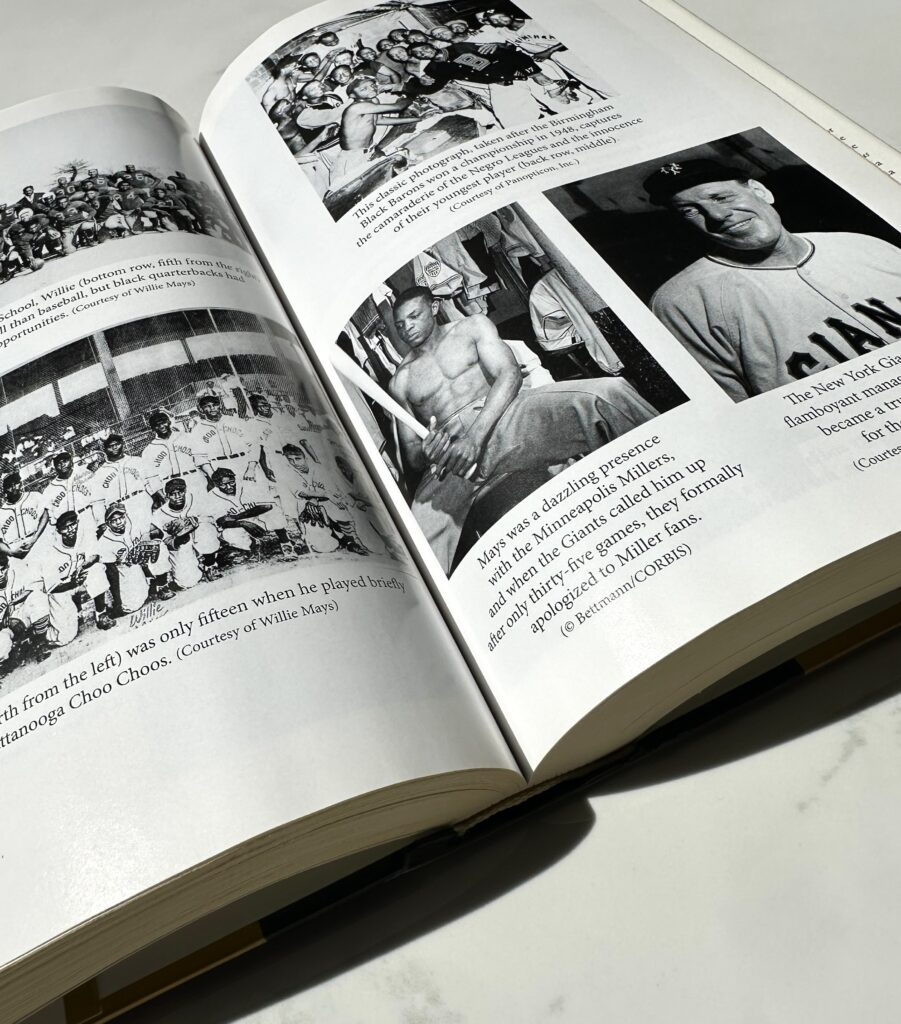
It’s this cool old black and white photo of Mickey Mantle and Willie Mays standing next to each other and they’re smiling. And I never really knew the background of that picture. But I finally realized this iconic photo of the two rookies were taken right before game one of the 1951 World Series at Yankee Stadium.
So it’s pretty wild how this photo now looks totally different after learning all about these two legends. And everything that happened to both of them leading up to this photo, this frame picture that I’ve been looking at for years, now it looks totally different all of a sudden.
Anyway, the Yankees would go on to win that World Series, but the Giants had their moment. “The shot heard around the world,” by Bobby Thompson. It’s still an iconic moment. The comeback that they made on the Dodgers to get to the World Series. And of course, now they have their superstar.
Willie Mays has voted Rookie of the Year in 1951, but he misses almost the entire next season and all of the 1953 season to serve in the Army. So almost two full seasons right after winning the Rookie of the Year award.
Willie Mays in the Army
The book goes into all of this with an entire chapter on his time in the military. Mays stays out of combat. They keep him in the US and it turns out that he plays a lot of baseball during his time in the service. So he’s able to keep his skills fresh. He also puts on 10 pounds of muscle.
So Mays gets ready to join the Giants again for the 1954 season. And I like this description about the aura of Willie Mays coming back to his team.
“A mythology about him had settled in. When Mays joined the Giants in 1951, the team was in 5th place. After he arrived, the team finished in 1st. When Maze played with the Giants in 1952, they were in 1st place. Then he left, and they fell to 2nd. Then last year, they were back in 5th place. Without Mays, they had no chance. With him, they were winners. And now, with his return, they would win again.”
Willie Mays and the 1954 World Series
So I don’t need to build up any more suspense. This story doesn’t need any build up.
The Giants win the World Series in 1954. Willie Mays comes back from his Army service and he leads his team to a World Series victory over the Cleveland Indians. One of the biggest upsets in World Series history.
But how’d they do it?
I thought I was a baseball fan, but I didn’t know the answer until I read this 600-page book.
Cleveland dominated the entire 1954 season, winning 111 games. One of the best regular seasons by any team ever. And then they got swept by the Giants in the World Series. Four straight games.
So what the hell happened?
The book has several chapters laying out all the events of this amazing New York Giants season in 1954. Willie Mays gets out of the Army. He has a monster year, wins the MVP award, and becomes a superstar. For a while, he was actually on pace to break Babe Ruth’s record of 60 home runs in a single season. Although he ends up hitting just 41.
But we’re talking about the World Series sweep. How the hell did they knock off Cleveland, the best team in the league, in four straight games?
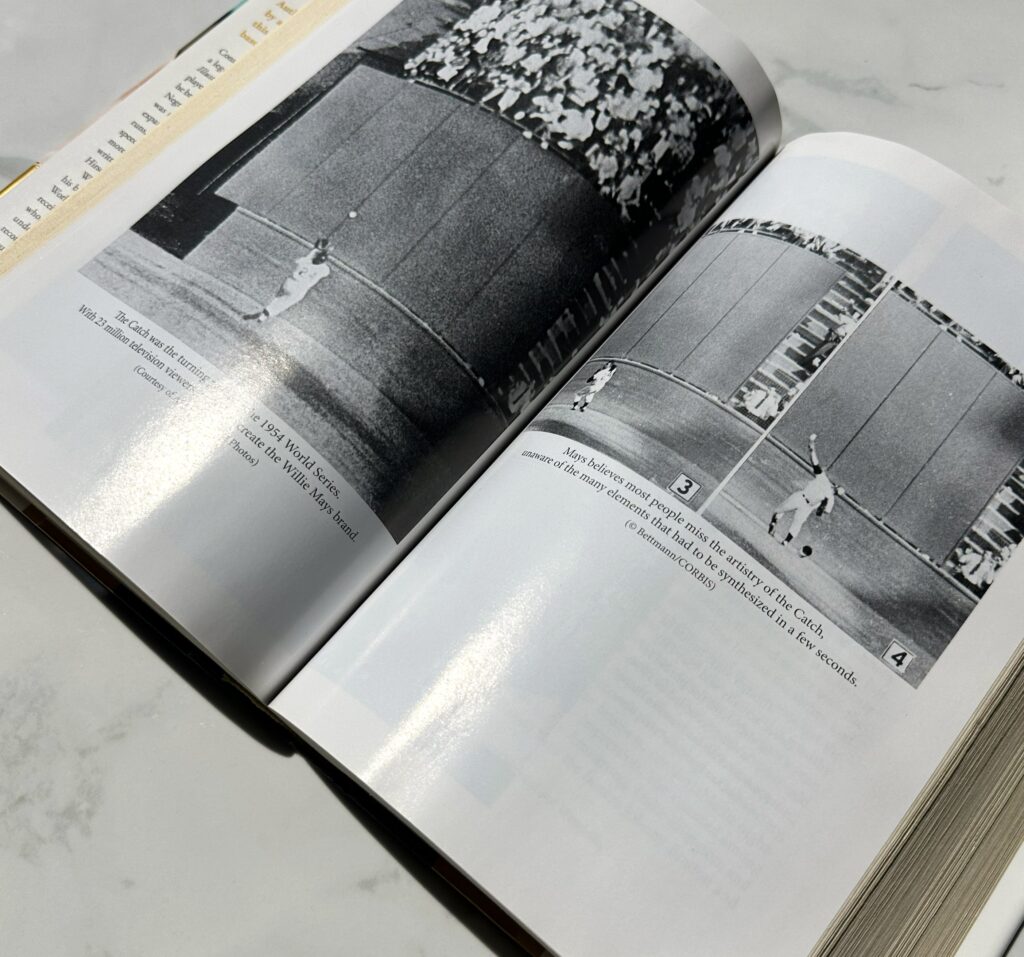
The book does a great job at answering this question. Over a few dozen pages of the first-hand accounts and interviews, there’s no doubt in my mind anymore, the World Series that year was basically over before it got started. When in the eighth inning of a two-to-two tie game, Willie Mays made “The Catch.”
Everybody knows “The Catch.”
You’ve seen it a thousand times by now. It almost looks routine for longtime baseball fans. You’ve seen this highlight so many times.
Willie Mays and ‘The Catch’
But now after reading this book and going page by page through the story of the 1954 World Series, I don’t think of it as the catch anymore. To me, I now think of it as “The Dagger.”
I’m not even sure if that term existed back in the 50s, but now we use “dagger” all the time. It’s to explain a crazy play that pretty much ices the game for good. Dagger means A comeback is now impossible. Look at any sport, it could be a long three-pointer. The final touchdown. Putting the game out of reach for good. That’s “The Dagger.”
I had no idea until I read this entire story that the catch by Willie Mays was actually “The Dagger,” that knocked out one of the greatest teams ever, the 1954 Cleveland Indians.
And nobody knew it at the time. It was still game one of a best of seven World Series.
Just like a lot of Willie May’s highlights, it takes time to think through what you actually saw. The first batting practice, everybody stops to watch. Silence. His first big league home run. Silence. People had to process what they were seeing.
Same thing with the catch. It took a while to comprehend what the hell happened. And if you don’t believe me on this, I’ll just read from this book. When he made the play, the book says,
“No one thought about the historical significance of the catch. All it meant was that the Indians were now on first and third with one out.”
Okay, so here’s what I’m talking about. “The Catch” was actually “The Dagger,” like I said, but that wouldn’t be apparent until a week later when all the dust settled.
This book goes through each second leading all the way up to the catch. It’s pretty amazing. Play by play. The scores tied two to two in the eighth inning. Cleveland has runners on first and second. Vic Wirtz, he’s a big lefty slugger for the Indians. He smashes a ball to dead center on a line. Remember, this game is at the polo grounds. One of the biggest yards of all time, I think. To dead center, it was like 480 feet. That’s almost 80 feet more than the average modern day ballpark.
Willie Mays, The Catch and Throw
So the Giants players get to the top step of the dugout. Leo Durocher says that he believed any ball could be caught by Mays, but he just wasn’t sure if the Polo grounds was big enough for this ball that was just hit by Wirtz.
Here’s a description of the hit by Wertz from a fan who was in the bleachers, Arnold Hanno. He wrote this as he watched the ball fly into the outfield.
“Then I looked at Willie, Hanno wrote, an alarm raced through me, peril flaring against my heart. To my utter astonishment, the young giant center fielder, the inimitable Mays, most skilled of outfielders, unique for his ability to scent the length and direction of any drive and then turn and move to the final destination of the ball. Mays was turned full head around, head down, running as hard as he could, straight toward the runway between the two bleacher sections. I knew then that I’d underestimated, badly underestimated, the length of Wirtz’s blow.”
So this fan looks to Mays in the outfield. He’s looking for some assurance that it’s all good, but his heart sinks.
Mays’s head down just running full speed toward the wall. Full head around, he says. This is not a good situation for the Giants. Basically everyone in the ballpark is thinking it’s two runs for Cleveland at the very least. Both baserunners could easily come around and score and it was just a question of if Wertz gets a triple or an in the park home run.
Shortstop Alvin Dark spun around and he looked at Maze and he thought this,
“Two runs. The ball’s distance wasn’t the only problem. Mays had no angle on it. The ball was winging directly over his head, which is one of the toughest catches in baseball.”
Can He Make The Catch?
And so the shortstop is like two runs right there automatically. He doesn’t even question that anybody’s going to get to this ball. The book also adds that what made this hit by Wirt such a problem for Maze was its tailing trajectory. That it seemed like no ball had ever traveled so far on such a low arc. It says,
“He ran past the farthest edge of the outfield grass, veering slightly to his right as his spikes touched the narrow cinder strip near the base of the wall. At the last moment, he looked up, extended his arms like a wide receiver, and opened his Rawlings Model HH glove. The ball fell gently inside. He had 10 feet to spare.”
Maze makes the unbelievable catch. The crowd is stunned, but just like the book says, the play wasn’t over.
There’s two base runners and Mays is running full speed in the opposite direction. So he slams on the brakes right at the outfield wall. He spins around and makes this incredible throw instantly to get the ball back into the infield. And here’s another great description from the book. Says,
“But Mays whirled through like some olden statue of a Greek javelin hurler. His head twisted away to the left and his right arm swept out and around. Hanno wrote his hat flew off in perfect sync with the corkscrew motion and it was Tthe throw of a giant. The throw of a howitzer made human. Arriving at second base, just as Doby was pulling in the third and Rosen was scampering back to first.”
This throwback to the infield completes this iconic catch by Mays. Nobody’s able to score on the play. The runner on second takes up and gets to third, but the runner on first had to go back because Mays throws a bullet right to second base.
The book says the second base umpire Jacko Conlon. He watched the throw come in from Mays, and he thought, this has to be the best throw anybody could ever make. And here’s why said it took a while to understand what happened with this catch until the dust settled. It took a week to really understand this catch. It’s still game one of the seven game series. The score is still tied in the eighth inning. The game goes into extra innings and you’ll never believe what happens.
The Amazing 10th Inning Play
Wertz comes up again, the same guy who was robbed in the 8th inning by Mays with that iconic catch and throw. Wertz in the 10th rips one into left center. It’s a sure triple or even an in-the-park home run if nobody can get to it in time, but Mays cuts the ball off and throws to third, holding Wertz to a double.
How they explain it in the book, this would have been almost impossible for anyone but Mays to cut this ball off. Any other player would have had to it go all the way to the wall for a triple.
but holding Wertz to a long double was huge because they leave him stranded at second. The Indians don’t score in the 10th. Later on, Mays said cutting that ball off in the 10th was as good, if not a better play than the catch because of the instant calculation, the instant gamble he had to make. Try to cut the ball off or let it go to the wall. And poor Vic Wertz, again, almost the hero, but Mays is there. Later, Wertz said,
“I think Willie may have made a better play on me in the 10th.”
So we’re not even done with this game yet. Bottom of the 10th, Mays is up. He walks. Instantly steals second base. He’s the winning run, one out. They walk the next guy to set up the double play. So first and second, one out. Pinch hitter Dusty Rhodes hits a home run down the right field line. 260 feet down the line. It drops into the first row of seats for a walk off home run.
Game over.
Game won, Giants win. After the game they said that home run traveled 200 feet less than Vic Wertz’s out to Willie Mays in the eighth inning. The 450 foot out, that famous catch. And that’s all anyone wanted to talk about, that incredible catch and throw by Willie Mays that saved the game in the eighth inning. And then that play he made again in the 10th inning to hold Wertz to a double. After the game, everyone was saying it was the greatest catch they’d ever seen.
Except of course they ask Leo Durocher, and he answers back with a string of F-bombs, which I cannot repeat. You got to read the book. I can summarize it by saying this. Somebody asked Durocher if it was the best catch he’d ever seen. And Durocher basically, and I’m paraphrasing here, but he just asked the reporter if he ever had his eyes open in the press box, because Willie makes plays like that all the time. So it’s just a typical Durocher response.
So the book quotes this guy, Arnold Hanno, a few times. He was in the bleachers and he wrote about this game. So the book includes some of his writing and this was his conclusion after the 10th inning play by Willie Mays.
“Hanno wrote, At this point, I think the Indians quit. It’s not fair to say that they quit in the eighth when Mays made his catch. They still had clawed away, stopping the Giants in the eighth and ninth, and they opened the 10th full of vinegar. But when Mays again indicated he was not Mays, but Superman, they must have known they were through.”
I’ll call it the dagger. Has any player ever won a best of seven World Series championship in the first game?
The Biggest Upset Ever?
One of the biggest upsets ever, don’t forget that the Indians set a record with 111 wins in the regular season that year. The 1927 Yankees, known as the greatest team of all time, they won 110 games in that year. This Indian’s team was a powerhouse.
Listen to this from the book, it’s all right here. Straight from the Indians players who played in the game.
“The Giants championship was one of the greatest upsets in World Series history. The 1906 Chicago Cubs, who won 116 games, also blew the championship, but at least they won two World Series games. The Giants sweep was stunning. Two of the Indians hitters, Doby and Rosen, played with injuries, but that alone could not really explain their futility. Lopez offered one possibility. “Losing the first game hurt us the most, he said. We had so many chances when a hit or a long fly would have scored someone. Willie Mays made that great catch on Wertz’s Drive, and after that we were never the same.”
They were never the same after that catch. When I see a photo of the catch now after reading this book about Willie Mays and fully understanding this moment, it wasn’t just a catch in game one of the World Series. It was “The Dagger.”
The series was over. One of the best seasons any team ever had. Up to that point, the Indian season was over with that play by Willie Mays. The absurdity of that play, the Indians realized they were up against Superman.
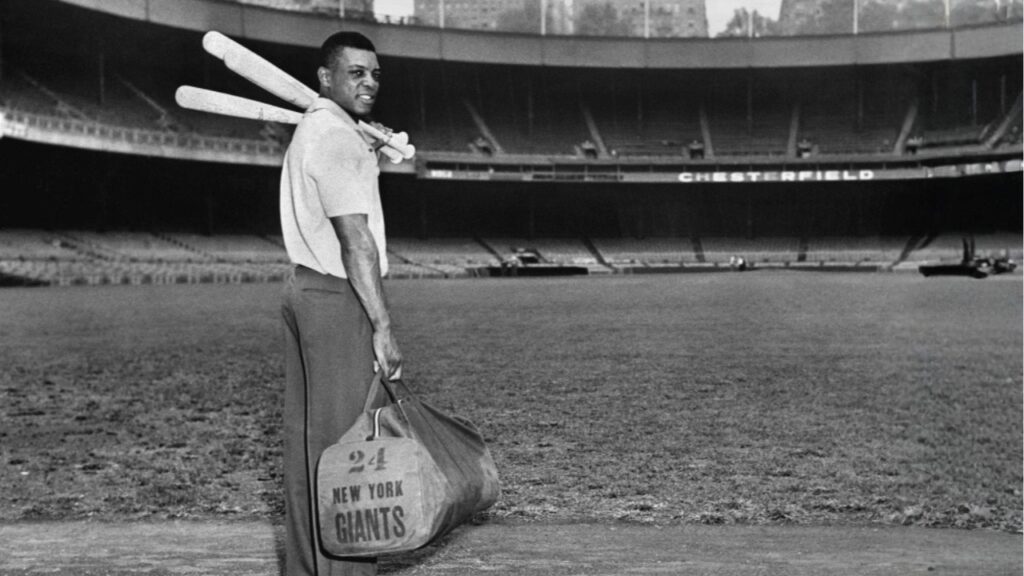
Bob Costas even pops up in the book and gives his explanation to the catch. He says it was just something that nobody’s seen before. He said once the ball left Vic Wertz’s bat, someone catching that ball was out of the question.
Costas says it like this,
“He turned and ran to a place where no one can go to get that ball. Starting where he started with the ball hit as it was hit. So it was more than just a great acrobatic play. It was a play that until that point was outside the realm of possibility.”
That’s Bob Costas. And then one more great description right here from the book. Says,
“This view became part of the Willie Mays mystique. That his catch had crushed the spirit of the mighty Indians, that his supernatural skills had crippled their resistance. The perception of invincibility loomed among the Cleveland faithful.”
People who grew up with Willie and played with him and watched him, it was obvious that he was different than anything they’d ever seen. The catch, the throw, these plays that he would make that blew everyone away.
Willie Mays, Totally Unique
It was very clear to everyone who watched Willie May’s play that he was totally unique, a completely new style, but when he did it during the World Series in such a big moment, this was at a time when television was taking off around the country. 23 million people were watching that World Series game one and saw the catch live as it happened. Here’s a great quote by author James Hirsch on the uniqueness of Mays.
“It’s appropriate that a film clip or an image, not a statistic, defines him. Unlike other great players who are associated with numbers, 56, 409, 61, 714. Mays holds no record with historical resonance. His brilliance was in how he played the game. And the catch evokes the awe and wonder of those skills.”
There’s a section in the book about how Willie Mays created his own category. Speed and base hits from the dead ball era evolved into the power hitting home run craze of the live ball era, then Willie Mays shows up and he can do it all.
What they would call a five tool player.
There was Ty Cobb who had the great speed and then Babe Ruth with the power and now Willie Mays who had it all. The book says,
“By combining the best of Cobb and Ruth, Willie Mays forged his own era by creating a new standard, the five tool player. Mays had never heard the phrase until it was applied to him, but it became part of the lexicon used to describe multi-talented contemporaries like Hank Aaron, Roberto Clemente, Frank Robinson. Just as Cobb and Ruth were the exemplars of their eras, Mays was the paragon of his.”
So that’s how he played his entire life. Since he was a kid, his dad taught him the more skills you had, the more likely you were to stay on the team.
There’s so many amazing plays in the book. Here’s a great one where the book says that his best catches seemed to be, “guided by some divine spirit.”
That’s insane.
The Amazing Plays Continue
There’s a story in here about a hit from Roberto Clemente. A line drive into left center. Mays is chasing it. And this old-timer whitey lockman, he was telling this story in the book, but Mays is running back for this line drive in the gap from Clemente. He reaches up with his bare hand and catches it with his right hand, his throwing hand, his bare hand.
He said it was sort of like that Kevin Mitchell barehanded catch that we all saw that we all see the replay of back in the 80s. That was a great catch. But he says this one was way better because Mitchell’s catch was in foul territory and this one was deep in left center field. And he said he remembered thinking, “My God, that’s not human.” That’s in the book.
So that’s a major theme in this book over and over. All five tools hitting for average, hitting for power, throwing, fielding, running. Every aspect of the game, Willie Mays would make plays and leave people scratching their head like what? What did I just see out there?
This combination of so many unique skills all rolled into one. He had the power of a Babe Ruth type slugger. We’ve already talked about a few of these times where the entire stadium just stopped to admire the distance the ball was traveling. Sometimes it’s still rising as it clears the grandstand, but then he hit the base pass with straight up aggression.
Willie Mays, A Terror on the Basepaths
As I read this book, I was reminded that Willie Mays was an absolute terror on the base pass, just like Ty Cobb. Listen to this. The book says Mays was a runner who wouldn’t take no for an answer. 1961 game against the Reds. Mays is on third, base is loaded, one out. Grounder to first. First baseman touches the bag and throws home for the double play, Mays bearing down on the catcher knowing it’s not a force out anymore. This poor catcher, Jerry Zimmerman. The book says quote,
“Zimmerman exploded upon contact. The ball, the glove, the mask and several pieces of Zimmerman appeared to disassemble in midair. Like the cat in a Looney Tunes cartoon. By the time things fell back to earth, Maze had scored. Another runner scored behind him.”
He completely ran over this poor catcher. He was a terror on the base paths. And here’s why they tried to compare his running to Ty Cobb. He would score from first on an infield out. He would score from first on a bunt without a fielding error. And he was one of only two players to ever score from first on a single to left field. These things are not normal. And these are what, this is what Willie Mays was doing on the bases. There’s so many other traits that set Willie Mays apart from anyone else, ever.
A Totally Unique Combination of Skills
A totally unique combination of not just skills but attitude, persona, aura, charm, whatever you want to call it. He ran the bases with aggression like Ty Cobb but then was the total opposite personality. Everyone loved and admired Mays. He knew how to put on a show and he just had this flair for the spectacular play. They called it “pure theater” in the book.
The way that he wore his cap just a little bit loose so it would fly off his head at just the right time as he’s running. But it wasn’t over the top. His positive and joyful personality was remembered by almost everyone.
He was humble. Even once he was a big star, they’d see him out in the street near his home in Harlem playing stickball with the neighbor kids. There’s some amazing photos of Willie out in the streets playing stickball with the kids before he heads to the ballpark for his game.
Then he’d get to the ballpark and bring drama and flair to the game with his play on the field. And the camera loved him as he was beamed into homes around the country, just as TVs were starting to sell by the millions for the very first time.
“The Say Hey Kid”
He was given the nickname “The Say Hey Kid,” back when he was a rookie, way back before he was even in the pros. If he wasn’t sure what somebody’s name was, he’d just say, “Hey,” and then he’d just follow it up with a question or start a conversation.
So he had this in enthusiasm. In the book they called it “contagious happiness that gets everybody on the club.” And they would say the love of life just flowed out of him. He was just this positive guy and it spread to everyone.
Another big takeaway. Willie Mays had such a positive and disciplined mindset starting from his father and that helped him in his early days playing with the Birmingham Black Barons when he was young.
He learned that defiance was self-defeating, and he kept his mouth shut when he’d hear the racial insults. And his play on the field was the best way to silence his critics. In the book he said that he tried to change the hatred to laughter by keeping things light and trying to smile when things were negative.
Willie Mays, the Positive Influence
He didn’t drink, he didn’t smoke, and talked about getting 8 hours of sleep. Much like my Ted Williams episode I did. I would strongly recommend you check out that Ted Williams episode. There’s some similarities in getting enough sleep before your games.
But I strongly recommend you read this entire book on Willie Mays. It’s the entire life from start to finish. How the legend of Willie Mays was created.
How the Legend of Willie Mays Was Created
I was thinking of a way to sum up this episode. Like I’m really going to bottom line the legend of Willie Mays. I don’t think I can. And like you’ve heard people try a million times before. Like, “He’ll never be forgotten…”
I’m not, I just don’t know what to say, nobody knows how to end an amazing story like this about Willie Mays.
They really can’t. And I’m not even gonna try. I’m not doing that. I’m not going out like that.
So what else can be said about Willie Mays? Well, maybe there’s a poet who can say it best.
So I’m sitting at my desk staring right at my bookshelf in front of me and then it hits me. I just did an episode on the great baseball legend, Walter Johnson, and the sports writer, Grantland Rice, keeps popping up in that book about Walter Johnson.
So I buy Grantland Rice’s book. And now it’s just staring at me from my shelf. I haven’t even opened it yet.
A Perfect Ending by Grandland Rice
And then I remember Grantland Rice, who they called the Dean of American Sports Writers. He was also a great poet. He wrote his book in 1954. That’s the only thing I know about it.
Well, I wonder what he wrote about Willie Mays.
I crack open the book. I flipped to the index and there it is. Willie Mays, page 354. The last page of the book.
I read a passage to start this episode. That was Grantland Rice, from the last page of his book. His line about Willie Mays was perfect. Here’s what made the hair stand up on my arm. In the middle of that sentence that I read to start this episode, Rice added this in parentheses. He said, “I write this in late June, 1954, with the Giants bidding fare to make shambles of the National League.”
Grantland Rice is writing the last passage of his book in late June 1954 as the Giants are starting to make their move, closing the gap on the first place Brooklyn Dodgers. Everything we’ve been talking about.
His perfect description of Willie Mays that I read to start this episode, he wrote that three months before Mays makes the iconic catch in Game 1 of the World Series. Grantland Rice wrote these words in the last paragraph of his book, “The Tumult and the Shouting.”
He was talking about the great athletes to come in the future and that he wouldn’t be around to witness it. He noted it was late June, 1954. He would pass away two weeks later on July 13th.
He never saw Willie Mays make the catch, but he knew it was coming.
“In the New York area alone, the 1954 season saw two, perhaps three present day stars who may take their place with the immortals. I mean Duke Snyder, Willie Mays and Mickey Mantle. With Brooklyn Snyder climbing the centerfield walls to haul in certain home runs and breaking those same fences with his bat. With Mays contributing glittering heroics each day. (I write this in late June 54 with the Giants bidding fare to make a shambles of the National League) with his basket catches, his rubber arm, booming bat, and most important, his contagious, irrepressible zest.
With Mantle commencing to play the ball George Weiss and Stengel hoped he’d play as DiMaggio’s replacement in the Yankee center field.
Well, how good can you get?
All three boys, incidentally, are the direct results of growing up with a bat, glove, and ball practically from the cradle.
All three stem from fathers who didn’t or couldn’t make the big step themselves, but who saw in their sons the potential realization of their own dreams.
I don’t know of a country in the world or another field where this type of thing could happen, except right here in a democratic, sports-loving America.
The best doesn’t belong to the past. It is with us now.
And even better athletes will be with us on ahead. When we arrive at the top athlete, the Jim Thorpe of the year 2000, we should really have something.
But by that year, I will have slight interest in what the field has to show.”
-Grandland Rice, ‘The Tumult and the Shouting’