
Colin Chapman
Colin Chapman
Episode #41
05.09.26
“I was not really an enthusiast. In fact, I never went to a race meeting until I actually raced myself. I was enthusiastic for building a thing which moved.”
– Colin Chapman
And so that right there is probably my favorite line out of this entire book that I just read. It’s Colin Chapman, ‘The Man in His Cars,’ by author Gerard Crombac, published in 1986.
Colin Chapman says he was not an enthusiast. He was enthusiastic for building a thing which moved. Out of all my racing and car creator stories that I’ve done so far, this is the first time I’ve heard anyone say it like this. It’s a great way to think about this guy. He was not an enthusiast. He was not sitting up in the stands watching. He was enthusiastic for building a thing that moved. I love that.
Here’s the entire quote in context from the book. It says,
“At this time competition had not yet entered his head. He told me himself later. “I was not really an enthusiast. In fact, I never went to a race meeting until I actually raced myself. I was enthusiastic for building a thing which moved. And so while at university, I decided to build my own special. This Mark 1 was going to be a touring car and I had been working on it for almost a year when I came across a car trial, which was taking place in Aldershot.”
So he comes across this race and he says, I was quite fascinated by this and rushed back to the partly finished special, scrapped the half enveloping body and turned it into a trials car. End of passage right there. There’s so many amazing stories in this book on Colin Chapman. Maybe the greatest Formula One car designer, engineer and team manager of all time.
So I picked out a few of my favorite stories from this book that I’ll get into in a minute. But first of all, how the hell did this guy win race after race? And how he start Lotus at the same time? One of the most iconic car brands of all time. How’d he do it? Well, it’s right here, this moment. I just read it from the book. Colin decided to build his own special. He’s just fixing up an old car and he sees an ad for a race posted.
Creating Lotus
And like he just said, he’s quite fascinated by this. The idea to enter his car in a race and drive it. He’s fascinated by it. That’s the start.
So back up a little bit. He buys his very first car, not to drive it, but to sell it, to make some money. As an engineering student at University College, him and a friend, they pool their money together and they buy a used car. And then they flip it for a profit. So they do it again.
And now they have a nice little side hustle going on. Pretty soon they’re buying and selling a car a week. Now Chapman has a bunch of cars, but the values suddenly plummet because there’s a fuel crisis and all his profit basically wiped out all at once. But he’s got one Austin Seven car that he couldn’t sell. It’s sitting there and he has an idea that he should modify it. And this is when he stumbled on that race.
Young Colin Chapman
Right about now, he graduates college with a degree in civil engineering. He’s already got his private pilot’s license. He loved aviation. You can see already, this is a young man with some motivation. So he loves aviation. So he decides to join the RAF, the Royal Air Force. You can fly for free if you join the Royal Air Force. So I’m thinking that has something to do with that decision.
At that same time, Colin’s learning all about cars. He joins a car racing club so he can meet people who know all about modifying cars for racing. Another little great piece of this story right here. Colin names his first car, that Austin Seven that he modified with the help of his girlfriend, Hazel, who would eventually become his wife. They wanted an original name for that Austin Seven car that they built. Colin decided to name the car, the Lotus Mark I.
There’s a few theories about why he chose that name Lotus. But the reason for why he chose that name is still a mystery to this day. He builds the Lotus Mark 1, then the Mark 2, not long after that, the Lotus Mark 3. Something that we see all the time with these racing stories, it’s always about the next car and what you’re going to do to improve it. How to get an edge on the competition with that next version. That’s all anybody thought about.
Whoever has the best ideas and the most creative solutions is going to win the race. And that’s what happens right here. Colin has a great design for the body of the Lotus, but he makes his first big breakthrough by modifying the engine. This is what I’m talking about. The book says,
“With three years competition experience already behind him, Colin Chapman realized that the race really started with the interpretation of the regulations.”
So what’d he do here?
He’s looking for improvements that nobody else is thinking about. He says, Whaltz, everybody else competing under the formula seem to accept this situation as a fact of life. Not so Colin Chapman. He devised a relatively simple way of what he called, De-simeasing the inlet ports. Okay, so now the book explains exactly what De-simeasing the inlet port actually means. Basically, Chapman’s re-engineering the engine.
Colin Chapman’s First Big Breakthrough
So he splits up the inlet manifold by welding steel sheets inside the engine. And what happens is they never tested exactly what the increased power was from this modification. The book just says the results were, “simply devastating.” The Mark III Lotus just walked away from the opposition. So the book goes on. It says,
“In most of the 750 Formula races, in that 1951 season, the Mark III Lotus ran away with everything, finishing the average 5 or 10 lap race at least half a lap ahead. Most of the other competitors found it very disheartening, and the end result was typical of what was to become one of Chapman’s eternal problems. After he had dominated the club’s 750 formula in such a way, the regulations were changed for the following year, and De-simeased ports were banned in order to restore the competitiveness to a class of racing which had very nearly been destroyed by his supremacy.”
His car just walked away from the opposition. This is a pattern you’re going to see throughout this book. Here’s the beginning of it. Chapman alters his engine. This old engine was from 1922. He comes up with the idea to desimese the ports. He blows everybody away and they banned that method for the next year so they can restore the competitiveness.
This is how Colin Chapman rolls.
So along with the race cars that he’s building, he starts Lotus Engineering. Now he can make some money with all the knowledge he’s gaining building his race cars. He’s still working his day job as an engineer for the British Aluminum Company. Colin’s doing all this on the nights and weekends.
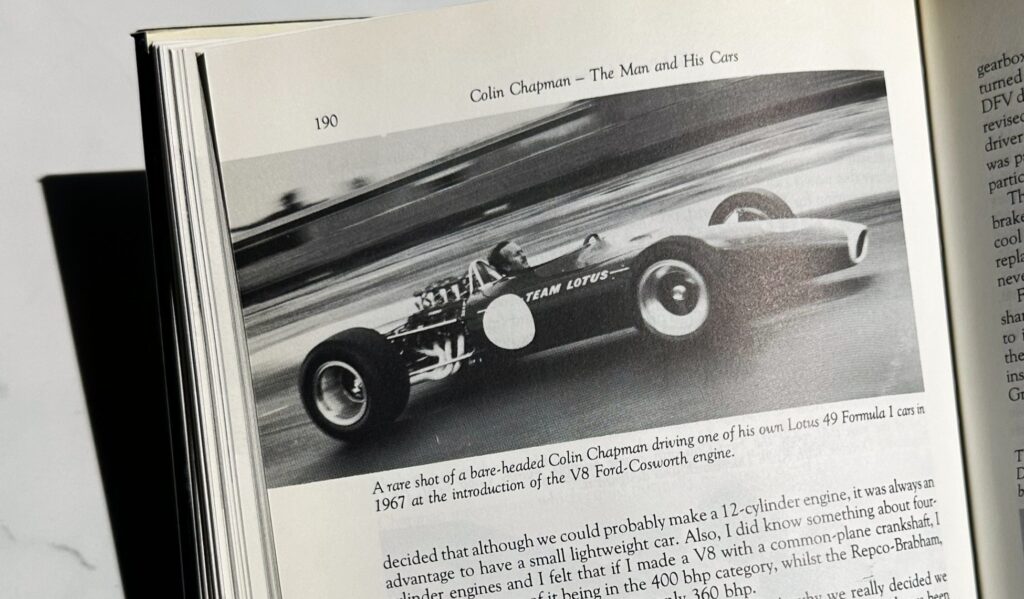
And his girlfriend Hazel is right there with him, helping him with the paperwork at the Lotus Engineering company that they started. So word’s starting to spread around a little bit about Colin and all of his engineering skills on these cars.
And because his cars are winning races, lapping the competition, he was an absolute learning machine. Just like he was devouring books and magazines about racing and building cars, anything he could get his hands on.
So now they’re in business with the goal being to make enough money with this engineering company to pay for his race cars. So Colin borrows 25 pounds from his girlfriend, Hazel, to pay for the legal documents so he could form Lotus, the new company. Then as he’s developing the Mark 6, his next race car, he’s also going to sell it to other enthusiasts too.
But he sets it up as a kit car. And there’s a really good reason to sell it as a kit. There’s a purchase tax of 25% on fully assembled cars that buyers had to pay, but there’s no tax on car parts. So selling the Lotus Mark 6 as a kit car qualifies it as just a bunch of parts. Then the customer assembles the car on their own and doesn’t have to pay that 25% purchase tax.
The Relentless Colin Chapman
Also, you could fit a few different types of engines into this car after you bought it. And so Colin, he sets up his car for the new Ford Console engine that just came out. As he’s trying to buy one of these new Ford engines, there’s none anywhere to be found. So he even writes a letter. He mails it to the chairman at Ford to try to get one of these engines. Still no luck. So what does he do? The book says,
“As usual though, Colin found a way over the problem by simply touring around all the Ford dealers in the London area, buying up bit by bit all the spare parts necessary to make up a complete engine.”
He’s relentless.
Nobody’s gonna sell me that engine. I’ll go around to every dealership in London and buy it piece by piece. One of his great quotes, he used to say,
“Rules are for the obedience of fools and the interpretation of smart men.”
You’re saying I can’t get that Ford engine? Okay, that’s fine. That’s easy. I’ll go around that and just buy up all the parts for it and put it together myself. Remember this, the Lotus engineering company was set up just to make money to pay for his own race car. So he’s selling these kit cars and the book says this, “he was only in this business to get free drives.”
This was the goal, to drive his race car. So the book goes on right here. says,
“So Colin was now on his own. For some time, it had been quite clear to him that he had found what he wanted to do in life and that the time had come when he must apply all his talent, skills and energy to make a success of it. He had tasted motor racing and what he wanted more than anything else was to drive faster and better cars. In order to be able to afford to do so, he was prepared to set himself an incredibly strenuous schedule for the next two years. Even so, it is doubtful if, at the time, he ever thought for a second that Lotus would ultimately become a fully-fledged automobile manufacturer. Indeed, even if that did enter his mind, it is questionable whether that was ever what he really wanted.”
Creating Lotus Motors
So the book talks about this a few times. That’s why I had to read that because this incredible stress of running a full blown auto manufacturer, it’s a big deal. He’s trying to race. That’s his passion is love. He wants to go faster. He was enthusiastic for building something that moved. And so at this point, remember he’s still working his full-time day job as an engineer as he’s starting Lotus. He says it right here. “We didn’t dare give up our day jobs.”
But also he’s not just working on cars in his spare time. He’s out there recruiting his Lotus team. He’s trying to find the best of the best to join up with them. There’s a story in the book about a friend of Colin’s and they bump into each other at a pub one night. Colin talks to this guy, Mike Costin.
He talks him into working part-time assembling cars for him. No pay. But you can be a driver in a race if you help out assembling cars, he tells him. And so they asked this guy, Mike Costins, they say, “what were you thinking?” Why would you do that? Why would you pledge all your spare time to this guy? Costin just says in the book, Colin had the most fantastic ability to motivate people. So Costin was just like, you know what, that’s a good question. I don’t know why I did that, but he asked me to do it. That’s why did it.
Building His Team
So this is like an Enzo Ferrari thing going on here. There’s a famous quote from Enzo. He said something like, his only talent or his greatest talent was just “stirring up men and machines.” That was his main talent. Colin’s doing the same thing right here. He’s putting his team together. They’re working in this rundown old busted up workshop in this shed.
They said in the winter as much snow piled up inside the shed as outside. So part of the roof must have been missing or maybe it only had three walls. But the orders for the Lotus 6 start coming in and they just make it work. Whatever they had to do, they had to make these cars and put them together.
They did not have a great setup is what the book is trying to say for building cars in this workshop. They had a couple old hacksaws, and a few hammers and drills. They had a wooden yardstick for measuring and an ancient vice. That was their setup. They were in there till one in the morning during the week. And then all through the entire weekend, they were building the Lotus six cars.
So you might be wondering where they got the parts for their cars. And that’s a great question.
They didn’t know either.
They just used whatever was laying around to build these cars. Incredible. The parts were cut from whatever they could find. It says old filing cabinets, bread tins, any kind of scrap they were using for car parts. The book says, “It was recycling at its best, long before the friends of the earth.” They go,
“You can reasonably say that the first few hundred lotuses were genuinely hand built to a much greater extent than any other car before or since.”
Now, eventually a few years go by, orders continue to come in for the Lotus cars. Colin decides to finally quit his day job as an engineer. He’s 27 years old. With only one full-time job now working at Lotus, things didn’t slow down for him. They said it was a crazy time trying to keep up with these orders. Colin starts another company to develop engines and gearboxes. Of course, it’s a separate company so they can avoid that 25% tax.
A few of the early Lotus employees are in this book talking about the early days. They said it was a nine to five job, 9 a.m. to 5 a.m. just to survive. They said they lived on pills, the blue one to get going and the yellow one to go to sleep.
One of the guys was talking about he was half dressed in front of his bed in the morning. His wife was like, are you coming? Are you going? So racing almost every weekend and building cars the rest of the week, all day and all night.
Now they enter the 24 hours of Le Mans for the first time. 1955. That’s the year of this terrible, horrific crash. 80 spectators are killed when a car goes into the crowd. After that crash, the race continued on, which is a crazy thing to think about. But Colin’s out there driving the Lotus Mark 9, the first time he’s ever raced at Le Mans. He ends up spinning out into the sandbank.
First Time at Le Mans
He quickly pulls out of that sand bank and he continues on. But the race officials disqualify him for pulling out of the sand without permission, which was an insane ruling to disqualify him for that. But that’s the first experience for Colin at Le Mans. So they go back the next year, they enter three cars at Le Mans. Colin’s car breaks down after 20 hours of racing and then another Lotus car at hour nine of the race, car hits a big dog going full speed down the Mulsanne Straight. And so that car is knocked out too.
But he’s driving his own race cars at Le Mans. That must have been a proud moment for Colin because it was always about racing. And the book says, “Did Colin aspire to become an established car manufacturer? No, says Fred Bouchelle. He just wanted to go racing. With anything I ever suggested, if it was a way in which a full-time business could afford to have a racing side, then that was all right. Colin never changed his views about this. The selling of racing cars or road cars had to provide the foundations upon which he could achieve his own racing ambitions.”
So I’m reading that because you need to see the balance. He was always going back and forth between the Lotus road cars and the racing. And it’s just back and forth trying to keep both things going.
One of the craziest things I didn’t realize until I read this entire book, was that Colin Chapman was innovating and inventing completely new ideas throughout his entire career from start to finish. It wasn’t just one invention.
Inventing Monocoque
We talked about him de-simesing that engine when he was just starting out. Here’s another big one right here. He says it in the book. “It came to me one day over lunch.” So Colin lays this all out. He’s thinking about how the space frame cars, like the actual structure of these cars.
Everything had to fit inside and around the frame of the car. These are the tubes of the structure. So he’s thinking the fuel tanks were a big problem when designing a race car because of the balance. They needed to sit in just the right place, but then all the other stuff had to fit around the fuel tanks and everything had to fit around the frame. So they had to make fuel tanks all different shapes and sizes, which meant they leaked. Then the welds would come apart and it was just a mess.
So finally, Collins sit in there thinking, if we could just get rid of the damn tube structure, this frame, if we could just get rid of that, then we could at least not have to make these crazy fuel tanks bend all around the tube frame. He says, “And I suddenly thought, why the devil don’t we just take two fuel tanks and bolt the front suspension to one end and the engine to the other? I remember drawing it out on a paper napkin. I rushed back home and started drawing it that night and within a week we had a working scheme out for it and we started building right away.”
So innovation over and over. This is a totally new idea to get rid of the frame and use the gas tanks almost as part of the frame of the car and take the frame out. And then you just have to wrap the car with panels to give it a shape. This is a groundbreaking idea at the time. Right here in the book it says,
“On that day, in that restaurant at Waltham Cross. Near Chestnut, the destiny of Formula One and motor racing in general was being reshaped. Because from then on, every racing car built was to be of monocoque construction.”
So this is the beginning of a big change for the entire industry. And this is another common occurrence in the book. From Colin’s Inventions you see the next year, or from that day forward, or from then on, everyone else did it like that too. It just shows you how brilliant of an idea it was when every other car would adopt the same exact design the next season. And over and over this happens with Chapman.
Back to the car. They replaced the tube frame by just connecting the gas tank to the suspension on one end and the engine on the other. Now they need to build over all that with panels and they call that monocoque.
The external skin is supporting the chassis and the body of the car, holding it all together. So a Monocoque Formula One car was totally new, and when they unveiled this car for the first time, it just blew everyone away. They said “photographers had difficulty in getting anywhere near because of the crowds around it, all reveling in the sleek lines and incredible simplicity.”
Colin Chapman Supremacy
This is hilarious right here. The Lotus 24 car is what was out at the time. So other race teams were buying these cars from Lotus and then they would use them in races. And then the Lotus team, would, of course, they would race the same cars that they were selling to other teams. Well, the Lotus 25 comes out with the new monocoque design. Totally blew everyone away.
And so some of these other racing teams that were running the Lotus 24s, they saw this new design and they’re like, that’s amazing. So when do we get our Lotus 25? They were asking Colin. Colin says, “yeah, you won’t be getting one of these.” There’s no way Chapman was going to just hand off his latest Monaco creation directly to his competition. He says, nah, you won’t be getting one of these. Everybody’s just like, damn!
So now Ford makes an appearance at Lotus. They send a few executives over to England to talk about possibly buying the company from Chapman. They want to buy Lotus. Ford wanted a company they could buy to build the GT40. And this is right after Ford tried to buy Ferrari when Enzo famously turned him down. And that of course, it sparked the Ford versus Ferrari battle of the 1960s.
Well, Chapman’s going to listen to the pitch from Ford, but then the talks just sort of fizzled out with no deal.
Wild Racing Stories
So as I’m going through this book, it’s packed full of wild racing stories. That’s what makes reading these entire books so much fun for me. You have to read the entire book for all these amazing details. You can’t skim through it because you’re going to miss all the good stuff. And I can only talk about a few of them now, but otherwise I’d have to go on for hours and hours. But here’s a good one.
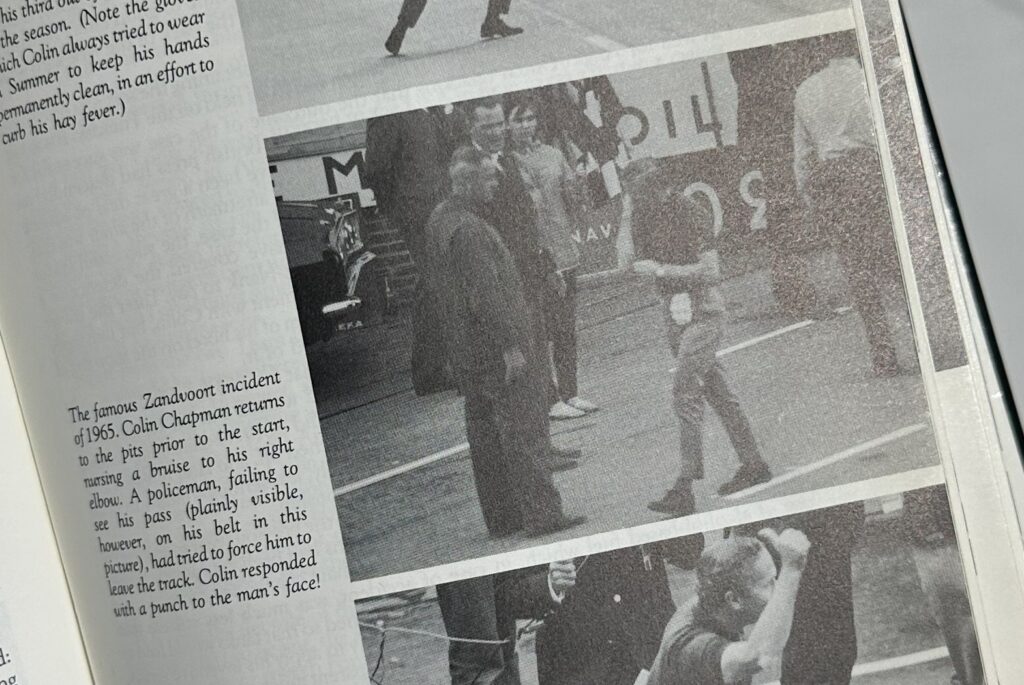
Check this out. It’s the Dutch Grand Prix right before the race starts. A police officer mistakenly put hands on Chapman. And you don’t want to do that. This is from the book right here.
“But it was the Dutch Grand Prix, which was probably the most memorable of the year because of a small but unpleasant incident, which later assumed quite large proportions. It was a very hot day for once and Colin was wearing a short sleeved open neck shirt, making it difficult for him to wear the official armband given him access to the track. Consequently, this was attached to his belt, a quite normal alternative. As Colin was walking back to the pits after bidding good luck to Jimmy on the start line, his arm was grabbed by an auxiliary policeman charged with the task of clearing the track. Seeing no armband, he was trying to force him over to the other side of the guardrail. Colin was not going to put up with treatment like that, and he promptly floored the man with a solid left hook. He thought no more about it and the race ended in another triumph for Jimmy Clark. But as soon as it was over a large contingent of Dutch police descended on the Lotus pit and tried to arrest Chapman on the spot.”
All right, so he’s trying to get back to pit row. The policeman didn’t see that he had his access armband around his belt instead of on his arm. So the guy grabs Chapman to get him off the track.
Chapman knocks him out with a left hook. Chapman goes back to pit row like nothing happened. There’s a great photo in this book of this exact moment. It’s amazing. Chapman’s walking across the track. He’s sort of rubbing his elbow in the photo. Well, he gets back to pit row like nothing happened. I mean, after all, there’s a race that’s about to start. He’s locked in. They end up winning the race. Jimmy Clark’s driving. Chapman is pumped.
There’s another photo of this in the book. They’re both jumping in the air with their arms up celebrating the victory. And then a group of Dutch police descend on the Lotus Pit to try to arrest Chapman for assaulting an officer. I mean, he shouldn’t have done that really, but he did. Chapman refuses to go with the police. They grab him. The book says the coppers had his head and arms. “We were all tugging away.” Colin’s wife, Hazel, to hold one of the policemen by the hair.
The police finally get him out of there and haul him off to the race control tower. They cut a deal right there to let Colin at least go take a shower and change his clothes before they drive him off to the police station where he’s going to spend the night in jail.
That’s a crazy story. that night a big group of Team Lotus friends and supporters hang to hang out outside the police station and they sing songs! It says, “rude English songs to cheer up the inmate,” who’s inside the jail.
So, and of course it says, Colin’s sitting in the jail and he’s sketching up a car design for his next Formula Three car on the back of the paperwork that he’d just been served. The story’s not over. keeps on going. Chapman had to go to court. Luckily he wins his court case, but it’s a media circus. And the craziest part of the story, check this out, the lawyer, who won the case for Chapman, he must’ve noticed all the press and attention for his client.
So after the winning verdict, the lawyer sends a giant bill to Chapman for his services, for defending him. And it says the amount was large enough to have covered the defense of a murderer. So it must’ve been this huge amount that the lawyer is trying to charge Chapman. And of course, Chapman says, that’s crazy, I’m not paying that.
The lawyer travels to London later to meet with Chapman so he can sort out this payment issue. The lawyer electrocuted himself while he was shaving in the bathroom of his hotel in London the morning of the meeting with Chapman, trying to collect his payment. The book doesn’t say, but I’m assuming it was this accidental and I guess fatal. It doesn’t say that either, but all it says is “that was the last that was heard of it.”
Another Wild Chapman Story
So that’s the end of that wild story. A year later, Chapman’s arrested again in Italy. Another incident. Him and Jack Brabham both are arrested. Chapman’s flying himself in his Piper Comanche to visit Dallara, the chief engineer at Lamborghini. They were buddies. Well, Chapman shows his pilot’s license to the air traffic control and doesn’t realize it, but his license is expired.
Then he bumps into Jack Brabham, who’s also a pilot. And Chapman asks Brabham, hey, can you fly me down to Bologna? I’m going to Lamborghini. Brabham says, yeah, of course, let’s go. And so Brabham goes to change his flight plans and somebody steals his travel bag. Well, that travel bag had all the starting money cash from the Monza race that they were both just in.
Now Brabham files a police report for the missing cash and the police decide to search the airplane. They find Chapman’s starting money in another bag. And it happens to be the exact same amount that was just stolen from Brabham that he claimed in this police report. Now the police think it’s some kind of insurance fraud going on, reporting stolen money that’s not even stolen.
So they throw Chapman and Jack Brabham in jail and it takes a while, but eventually the Italian Grand Prix race organizers, they have to tell the police that yes, both men were paid the same amount in cash as starting money for that race. And so they finally let him go.
Losing Jimmy Clark
Now Lotus goes public that year. They sold over 3,000 cars. Chapman owns 100% of the company. He’s now a millionaire. Lotus wins its third World Drivers Championship in Formula One.
And Jimmy Clark is killed in a crash during a race in Germany.
Colin is crushed.
One of his closest friends and a great driver, Jim Clark. So after the loss of Jimmy Clark, the friends around Chapman say they noticed a change. There was a phase one before Jimmy died and then a phase two Chapman after.
But the race goes on. All these racing stories that have done. This is devastating, but they have to pick themselves up and get ready for the next race. There’s another death for Team Lotus not long after Jimmy Clark. Here’s what it says in the book. It almost breaks Chapman.
It says, “Coming as it did so soon after Jimmy’s death. This was too much for Colin. And Andrew Ferguson remembers Colin saying to him at the hospital, this is it. I quit motor racing. I’m leaving right now. Sell the equipment, pay the bills and come home. But Andrew knew Colin well enough and decided to proceed as though he had said nothing. Nobody knows where he went to when he disappeared. But a few days later, he was back as though nothing had happened and never a word was said to Andrew about disobeying his instructions.”
So just over and over again, just like all the other racing stories that I’ve done, this is no different. We got to get ready for the next race. And they do.
Wings on Cars
It’s the first time they start to use wings on the Formula One cars right here. So the first wing on a Lotus car, it was from an old helicopter blade that was just lying around in the garage. They start fixing these wings on cars, realizing that the downforce helps with the traction.
So by 1968, every team is playing around with spoilers and wings on the cars. As they’re playing around with the downforce using wings and spoilers, Colin decided to buy a boat company called Moonraker Boats. Why not? He buys the company from a Lotus sales manager, one of his employees. Colin thought the boat industry was falling behind, so he designed a completely new manufacturing technique for making boat hulls, by using this vacuum molding technique, he’s using glass fibers to make boat hulls. And then he brings new ideas to the inside of the boat cabin using lightweight material. And this is all new to the boating industry.
And of course, all these methods were eventually adopted by the other boat manufacturers too. Colin’s looking for ways to improve things now outside of cars and racing.
He’s gonna do it with boats. This is important because Colin talks about his engineering principles right here. Check this out. I love this.
“We also introduced new technology into the interiors with many of the panels using a light cardboard honeycomb form of construction. All this new technology was introduced into a boating world which up to then had no idea whatsoever that such developments existed. Certainly Colin Chapman treated it all like racing car design, on the principle that you never engineer anything to be light in weight in the first instance without it breaking. And therefore you should engineer it on the borderline. Then once that particular item breaks, you beef it up until it’s strong enough.”
Right there, that’s one of his philosophies. He had the weight mania right there. That’s a line from Horatio Pagani that I was thinking about as I was reading this.
Horatio said that during an interview that everything had to be light weight. Well, Chapman had that same weight mania. He just obsessed over the weight. So instead of adding to it, he’s constantly trying to take-away to make it lighter.
Another great quote, would say,
“Simplify, then add lightness.”
That’s an amazing quote, but the engineering style, he wanted it to break to see how far he could go for failure. And then he would back it up, and then build it strong enough to hold together. It’s a different way of thinking about it.
So now he’s racing, he’s building and road cars. He’s running a boat company. He gets the idea that he might want to buy Aston Martin. And his thinking was that Aston had the more upscale customer at the time and the new Lotus road car, the Lotus Elite was going to be priced for the luxury market.
Colin Considers Aston Martin
He’s thinking this is a great way to sell to the higher end buyers. Just buy Aston Martin. And then as he looks into it, he goes and tours the workshop of Aston Martin. And what he sees is sort of a big mess. And there’s still hand building cars, maybe a little too much hand building going on. The shop is unorganized and just not what he had pictured. So they bail on that idea to buy Aston Martin.
So now you might be thinking he’s just living it up right now. With all these businesses and the racing team thinking about buying Aston Martin, he’s just rolling. Well, that’s not at all what’s going on right now. He’s trying to survive. He’s trying to stay afloat.
There’s a fuel crisis hitting the entire world economy right now. It’s the mid 1970s. The economy was not in good shape right here. We went through this in my Lamborghini Countach episode I did. This was not a good time to be selling high-end luxury cars.
So Chapman is trying to figure out how to keep the Lotus car company alive because that’s what’s feeding the race team. So they spend a lot of time on that Lotus Esprit road car. They have to sell cars one way or another. At one point right here, you can see how serious of a situation it is. He tells one of the Lotus engineers, he says,
“At the time of the 76’s introduction, I can remember Colin saying to me, the era of radical innovations has now passed. From now on we will proceed by detail improvements. Coming from such a man as Colin Chapman, this was indeed a surprise, but it just goes to show the frame of mind he was in at what was a critical time for all car manufacturers, but especially for Lotus due to the fuel crisis which had struck throughout the world a few months earlier. He knew this could have a serious effect on his company and he was reluctant to devote too much time to the racing cars when he had so much on his plate at Lotus cars.”
That’s a crazy quote right there if you think about it from a guy who is almost always thinking about ways to improve and do things better and innovate. He just said the era of radical innovations has now passed. It’s almost like he’s reminding himself time to focus or we could lose this whole thing.
Colin Won’t Stop Innovating
It’s also a crazy quote because even though he just said it, he just said the era of radical innovations has now passed. There’s no way Colin Chapman can obey that rule and not innovate. It’s impossible for him not to innovate because all he’s going to do next is innovate.
Listen to this. This jumped out at me. In answer to a question about the new clutch, he explained, “on entering a corner, particularly a fast one, the disruptive element of taking the foot off the throttle automatically produces engine overrun braking. Then applying the right foot to the brake produces quite a severe change of pitch, which in turn causes a change in the torque applied to the rear wheels, all of which tends to unsettle the car. This new system makes this transition between off-power and on-power both smoother and more gradual, and the increased stability enables the driver to negotiate the corner at a higher speed.”
Colin’s talking about the change of pitch as you take the corner. Going from throttle to brake, then back to throttle. The new clutch is smoothing this process out, and this was totally groundbreaking back in the 70s.
He’s just getting started.
There’s no end to how many different ways you can improve a car moving around a track at high speeds, especially if you’re Colin Chapman. The most creative minds will always be able to find that next idea.
Colin Chapman and the Ground Effects Car
As he’s laying in the sun on vacation in Ibiza, 1975, another idea hits him. He called it a “monumental decision.” Here’s how Chapman describes his next epiphany.
“I was in Ibiza in August, 1975, when I was there on holiday. I was sunbathing at the time and thinking about various ideas. And in my mind, I drew up some lines of investigation that I thought were necessary in order to decide what could be done to produce a negative pressure beneath the car which was greater than that above it. Then, if you could do that, it would produce the stabilizing forces necessary to hold the car down on the road without the need for wings.”
Alright, remember here, Chapman’s a pilot. He’d been flying since he was in high school. He’s thinking, how do I get downforce from the shape of the car itself? Then I can get rid of these damn wings. Because even though the wings make downforce, they also produce drag. So he gets to work right here. He says,
“When I got back from my holiday, we started an investigative program, not really with a car, but using various shapes such as flat plates and deflectors, aerofoil sections, oval sections, and so on. Just trying to study what happened between the body moving over the ground and the ground itself.”
Stop right here for a second. So you have to imagine what it was like back in 1975. Nobody was studying this stuff yet. They didn’t even have a wind tunnel set up to study the underside of a car yet. This was all totally new. Listen to this. Chapman says,
“What had always made this type of work so difficult in the past was that usually it had to be carried out in a wind tunnel. Almost all wind tunnels were principally designed for aircraft use and were really unsuitable for the experiments which we wanted to do. We needed to analyze the effect properly in a wind tunnel with a rolling road. Eventually we got permission to use such a wind tunnel and began some work with it, which had never been done before. We found that some shapes applied to the underside of the car would produce a small negative pressure, although not very much. And it’s still impossible to produce as much negative pressure beneath the car to equal the amount produced by the wing. Although the car itself is a relatively large object, it is not as efficient as a wing in terms of the total download it can produce. However, what it does produce, it does with less drag, and that’s important. So what we have been working on is to use a contoured underside to the car so as to run less conventional wing and by doing so produce the same downloading but with less drag.”
The Struggle and Breakthroughs of the Innovators
All right, I’m reading that because this idea right here that he’s talking about, this would change racing and the way that cars were designed from this day forward. And just like we talked about from this day on right here, I love these moments. It’s one of the main reasons I love doing these episodes. It’s like Carl Benz tried to explain in my last episode that I did, the father of the automobile, Carl Benz.
In his memoirs, he talked about how difficult it was because he had to solve every problem as it arises in order so that he could discover the next step and then solve that. And you can’t skip ahead. There’s no shortcuts for giant breakthroughs. All this struggle had to go in order and be addressed and solved before the next problem can unveil itself. That’s how Carl Benz described it.
Same thing going on here with Chapman. He’s so good at his craft. He’s the first one to encounter all these questions and problems because he’s thinking deeper and more creatively than anyone else. And he’s not just thinking about it. He has the right context to apply a solution because everything else that he’s encountered prior to it. He’s designed dozens of cars by now.
He was the very first Lotus race car driver. He knows what it’s like behind the wheel. He was the team manager. He knows everything about the competition and what they’re doing. He ran multiple businesses. He sold road cars to demanding customers. He engineered boats. He was a pilot. He knew all about wings and lift and drag and thrust. And of course, he knew all about downforce. You can look back and say, of course, he’s going to figure this out.
But just like Carl Benz, it took solving every single problem before this one to get to this idea right here. Here’s what he did straight from the book. Chapman says,
“We produced a depression underneath the car by taking the air in at the front, accelerating it through a throat rather like an in a carburetor choke and then expanding it again as it goes out through the back. The negative pressure created at the throat thus forces the car down onto the road surface.”
So they have to build a model car and they start really testing this idea. And while doing that, they discovered this negative lift from the car. It needs to be held together as the air is flowing under the car and through these airfoils. They call them tubs under the car. They discovered if you add skirts along each side of the car to hold the air in as it passes through and under the car.
Here’s how he explains the idea. It’s just another huge breakthrough by adding skirts along the sides of the car. I’ll just read it from him. says,
“Actually the amount of download these pods produce is quite small really, and can be rapidly dissipated by any inflow of air from the outside to the inside of the car. So you have to create a barrier, which in effect stops this cross flow of air. These are called skirts.”
And so this is it right here. The birth of the ground effect car. They go into all the details of all the testing that they did in the book, but basically they find a wind tunnel that has a moving road under the car. And there were not many around at the time that were set up like this, but it was at Imperial College in London.
Just the Beginning of the Discoveries
Now, one of the big things that they discovered that the closer they moved the car to the ground, like down to four or five inches off the ground, the downforce increased dramatically. So this fake ground that was moving under the car in this wind tunnel, it started sucking right up to the underside of the car as they’re doing their testing.
They had to reconfigure the wind tunnel to hold this thing in place in the simulated road. That’s when they knew they were really onto something big. Here’s a crazy line in the book. They set up a coded message to send if this testing worked or not.
So they were using some ideas from an aircraft. was the de Havilland Mosquito airplane. So of course the coded message was “the mosquito flies.” And when they finally got this to work in the wind tunnel, that’s what they sent. Here’s how they said it.
“When we first tested this, we agreed we would send back a coded message, “the mosquito flies.” When we had proven it to be successful. That came on the day of Graham Hill’s funeral in early December 1975. We also then discovered that heating the air created thrust.”
So this is on the same day of funeral of the funeral for Graham Hill. He’s a legendary race car driver who was killed in a plane crash. And then they’re discovering things all along the way too, that the heating of the air created thrust.
So racing development and engineering just takes off from here. It says, this turned out to be a very interesting period in racing car development. Because as Peter War put it, “By that time we were beginning to get involved in all sorts of things, which we didn’t even know existed until then, like friction-free suspension.”
So now it’s like everything’s back on the table here. The whole world is opened up to some of these guys that were looking at this stuff. Suspensions, tires, downforce. Peter War keeps going on in the book. Says,
“It was an exciting time too. And the time when, in my view, motor racing ceased to be a black art. What was happening was that people were now devoting themselves exclusively to the engineering side.”
So this is the time right here. Adrian Newey talked about this time in his book. I did an episode on Adrian Newey and his awesome book that he wrote. He’s just getting out of college right at this point. And Newey’s armed with an aeronautical engineering degree.
He talked about how lucky he was to be coming out of college right at this point in time when everything was just going crazy when they were discovering when they were making all these discoveries with the racing. And so Newey also talks about Colin Chapman was a hero of his because of this time right here. Gordon Murray, same thing. He talks about this time just a huge leap going on right now in racing.
The JPS Lotus 78
Now they have to test their new ground effects car on the track. And the hardest part is trying to keep it a secret. Nobody else knows about this. So they decide not to enter the car immediately in a race. They wait for the next race season to start before they use this car in a real race. Because if they used it at the end of the season, all the other racing teams, they would see how great it was. And then they’d have the entire off season to copy it and build their own version.
So Colin decides to wait. So the first race of the 1977 season, the JPS Lotus 78 makes its debut, the ground effects car, and it looks so different. It turns out nobody’s interested in copying the car when they see it because it looks too big and bulky, way too heavy. It’s too big on top because the underside is hollowed out to create the downforce.
So people saw the car for the first time and they thought it looked too big and heavy. Well, they had no idea what was actually happening under the car.
“The real significance of the closeness of the car to the road surface was not fully appreciated. People thought that Chapman had put two extra wings on the sides of his cars at the expense of extra weight and volume. There was no doubt that the car looked very nice indeed. In some eyes it was the best looking Lotus F1 car of all. With the extra large side pods, its appearance was certainly somewhat different from any of the others. Little did any of those present at that first test session realize that within two years every competitive Formula One racing car would virtually be a copy of the 78.”
There it is again, like I said, every time. “From this day forward,” this is what it’s gonna be. So they race this car. They just happen to have Mario Andretti as their driver. They didn’t win a championship that year, but Mario won four Grand Prix races. He used to say about this car, he said Mario Andretti would say, “the car feels like it’s painted on the road.” It was just glued down to the track.
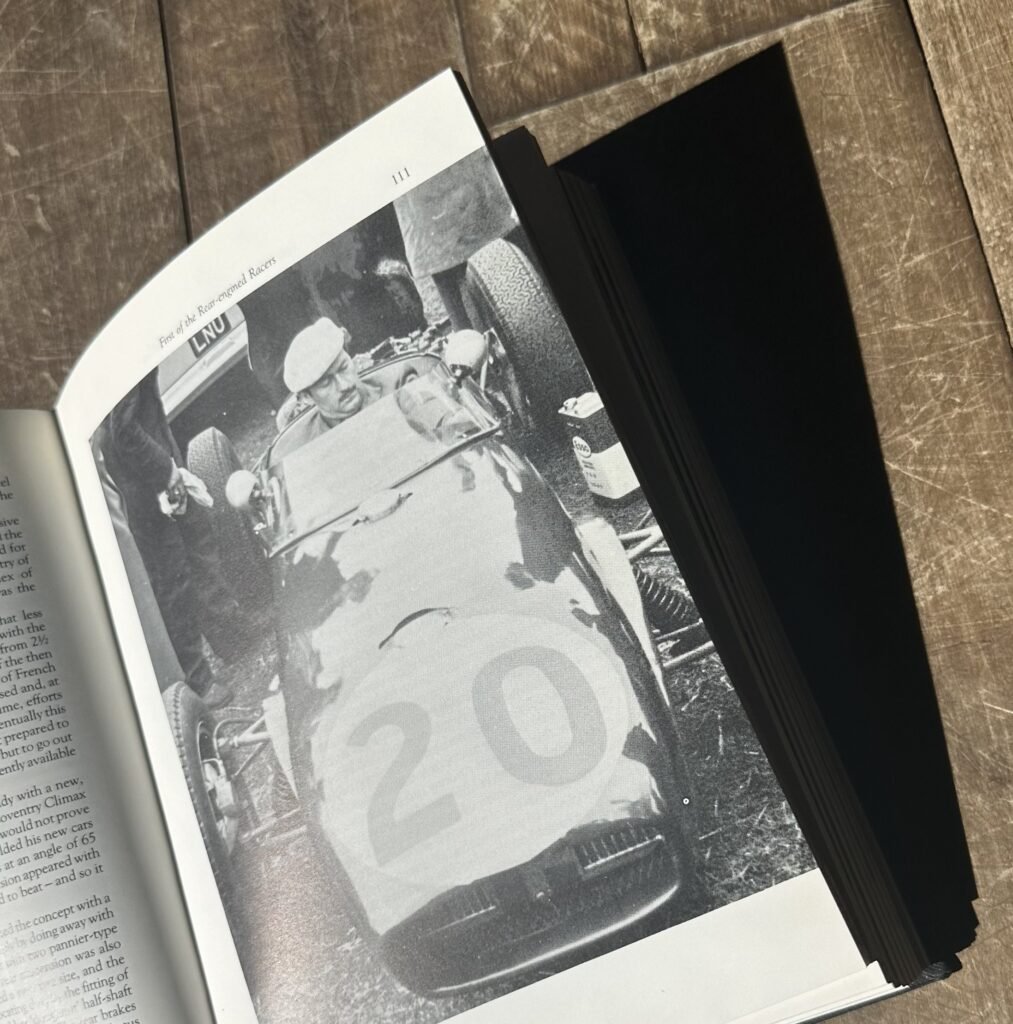
Over the next four years, it was pretty lean now for Team Lotus. Even though Chapman invented the ground effect car, he moved on to the next idea that he was having when all the competition, they stuck with it and they’ve perfected this one concept. He sort of took his eye off the ball here and it’s probably because he had the Lotus car manufacturing headache to deal with. Many other race teams did not have that headache. The constant financial pressure of running that Lotus car brand.
So he smartly sold the boat business. But getting through the 1970s in manufacturing was grueling. Like I said, in all my episodes, the world economy was not doing well because oil prices were high. Interest rates were high. Inflation was high. It’s tough. It’s nasty out there. And it was years and years of this. Even in the early 1980s, still a challenge. It was not all clear yet.
I did an episode on Alan Paulson, the legendary aviator who ended up buying Gulfstream Aerospace. He bought it in the 1970s. He was able to buy Gulfstream for pennies on the dollar because of this rough economy. He was one of the only ones who had some cash to buy it.
So Chapman’s grinding through heading into the 1980s right here. There’s talk of Colin taking over as president of Formula One, because there’s an effort by this group. They want to get rid of Bernie Ecclestone right here. They approach Colin and it’s all set for him to take over as president. He even flies down to Ferrari to get the blessing from Enzo and everything’s all set. He gets home from Italy and Colin changes his mind. He doesn’t want to do it. He’s got enough going on and he’s probably right. So Bernie Ecclestone remained at the head of Formula One.
De Lorean Motor Company
I was saying that in the early 1980s, they were still rough for car sales. Lotus had an all time low. They only sold 345 cars in 1981. Luckily, they had an engineering business that was keeping everything afloat. And right here, this is what I was curious to see in the book as I got to this period of time. The author that wrote the book, he was a close friend, a lifelong friend of Chapman’s. So I wasn’t surprised when I read this, but at this point, the Lotus Engineering Company, they enter into a contract to consult the DeLorean Motor Company out of Ireland.
There’s some business dealings that go on here that probably took a while to sort out, and that was probably past the time when this book was actually published, back in 1986. Here’s what it says in the book though.
“One such consultancy contract at around this time, and which no doubt helped the company to maintain its solvency, was that placed by the now somewhat notorious DeLorean Motor Company based in Northern Ireland and heavily subsidized by the British Labour government. Even at the time of writing, a number of questions relating to this contract are still unanswered, and may remain so for a long time to come.”
So, and that’s all he says in the book about DeLorean, right here, that’s it. And he’s right, there’s questions that would remain unanswered for a long time to come.
I can’t skip past this issue right here.
The book was published just three years after Chapman died in December, 1982. He had a sudden heart attack and he dies age 54. Chapman’s going through it in 1982. He’s got his hands full leading up to this heart attack like we were just talking about earlier.
He’s trying to keep several businesses afloat. He’s not selling many cars. He wasn’t winning the races that he once did. On top of that, he had this crazy new design for the Lotus 88 race car. It was a twin chassis structure. Now, very long story short, this car was banned from racing and Chapman was absolutely beside himself from this ruling. And of course, he fought it hard. He appealed several times in multiple countries. He wrote letters in response to the rulings. He really wanted this car to race. He felt like it was a great design and they wouldn’t allow it.
This is leading right up to his heart attack. At the same time, it turns out they would find out later on that DeLorean Design Consulting Contract. None of that money was ever sent to Lotus, the company, but instead it was like $17 million that went to a secret shell company in Geneva. That shell company in Geneva was set up by John DeLorean, Colin Chapman and Fred Boucher, the Lotus CFO.
And this was not good. This is a big scandal.
Fred Boucher went to prison for three years. Once they discovered this fraud, John DeLorean was caught, but he was acquitted. But if Colin Chapman went to pass away from that heart attack, they say Chapman would have faced charges and he could have gone to prison for this very, very shady deal right here.
So of course there’s theories out there that Chapman fled, and faked his own death knowing that he was busted for this fraud.
It’s wild stuff man to think about the pressure as you’re reading through this chapter of the book. The stress I can’t imagine right up to the end of his life. Chapman had some balls in the air at this point you could say.
Colin Chapman, First Principles
25 years of Grand Prix racing. 72 victories in Chapman’s Formula One cars. From suspension systems, monocoat chassis, wings on the car, ground effects, active suspension, and so many other inventions you can’t even list them all. All these innovations were adopted by the rest of the competition once Chapman unveiled it.
And it wasn’t just racing, but the Lotus car brand sold 34,000 cars in that same time. And all through this book, over and over they repeat, the only reason Colin Chapman sold cars was so he could pay for his racing.
So here’s how the book describes how skilled Chapman was back in the day.
“Basically, he was endowed with a tremendously clear and analytical mind, which enabled him to solve almost any problem simply by going back to first principles. In solving a problem, says Hazel Chapman, he always came up with a way of doing so that no one else ever had thought of. He always tackled it from a completely fresh angle.”
And that was an awesome book to read.
Lasting Legacy
Right at the end of his life with all the other things that he had going on, he wanted to reinvent private air travel with microlight aircraft. He was working on a design for a new aircraft when he died. He hated all the regulations of the auto industry. He was constantly trying to get around the rule book in Formula One car design.
And he figured the best way to fly was to use a microlight, or a ultralight aircraft because they were outside of the standard rules for a typical single engine airplane. So they didn’t require all the training and the licensing. You could just get in and take off. That just made sense to Colin. In everything he did, his famous motto, “rules are for the interpretation of wise men and the obedience of fools.”
On his gravestone, there’s another great motto. It’s part of the Chapman family crest from his ancestors. This is the last sentence of the book. The motto is, “Crescent sub ponder vertus.”
“In adversity, we thrive.”
So there’s a few other great Colin Chapman quotes that I found, and I can’t leave him out of this story right here. He would say,
“A racing car that survives the finish line, it’s a car that is too heavy.”
That is exactly what we were talking about earlier. You have to build it to fail first and then back it up just a little bit so it holds together. It’s great.
He famously remarked that, “Adding power makes you faster on the straights, but subtracting weight makes you faster everywhere.”
So then at the end of the book, Chapman’s kids, they talk about their dad. They love their dad. And every one of the kids wrote a couple pages about their amazing dad. And they remember him giving this advice to them as they were kids.
It’s a perfect quote.
Coming from a guy like Colin Chapman, like we said in the beginning of this episode, he was enthusiastic for building a thing which moved. So this is the advice he would always tell his kids. Chapman would tell them,
“Once you look back, you’re finished.”